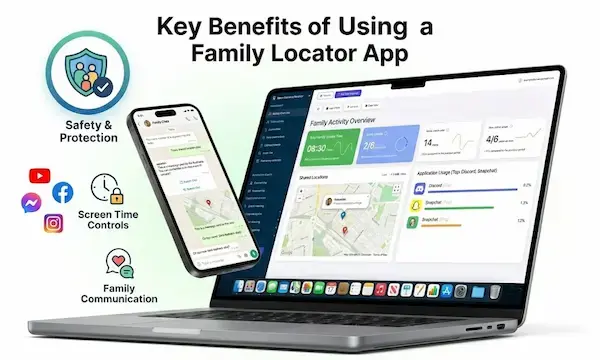
What Is a Family Locator App and Who Should Use It? In a world where everyone is constantly on the move, staying connected with the people you care about isn’t just convenient—it’s essential. Whether you’re a parent worried about your child getting home safely, a caregiver supporting elderly family members, or simply trying to coordinate daily life more efficiently, a family locator app offers a practical solution.
But what exactly is a family locator app, how does it work, and—more importantly—is it something you should be using? This guide breaks it all down with clarity, depth, and real-world relevance so you can make an informed decision.
Contents
- 1 What Is a Family Locator App? (Quick Definition)
- 2 Why Family Locator Apps Matter More Than Ever
- 3 Key Features of the Best Family Locator Apps
- 4 How Accurate Are Family Locator Apps?
- 5 Are Family Locator Apps Safe? (Privacy & Ethics)
- 6 Best Family Locator Apps in 2026
- 7 Family Locator Apps vs GPS Trackers
- 8 How to Choose the Right Family Locator App
- 9 Pros and Cons of Using a Family Locator App
- 10 What’s Next: The Future of Family Locator Apps
- 11 Final Verdict: Is a Family Locator App Worth It?
- 12 FAQs – What Is a Family Locator App?
What Is a Family Locator App? (Quick Definition)
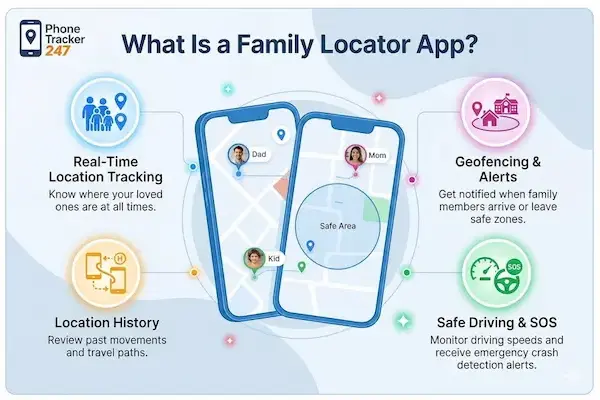
A family locator app is a mobile application that uses GPS and network-based technologies to share real-time location data among trusted members within a private group, often called a “circle.” It allows users to see where their loved ones are, receive alerts when they arrive or leave specific places, and communicate quickly in case of emergencies.
How It Works
Family locator apps rely on a combination of:
- GPS (Global Positioning System) for precise outdoor tracking
- Wi-Fi positioning enables more accurate location tracking indoors where GPS is limited.
- Cell tower triangulation when GPS signals are weak
These technologies work together to provide continuous, real-time updates on a shared map interface.
Who Typically Uses It
- Parents monitoring children’s safety
- Households looking after aging parents or older relatives
- Couples coordinating daily routines
- Groups traveling together
Why Family Locator Apps Matter More Than Ever
The Reality: Safety Is a Daily Concern
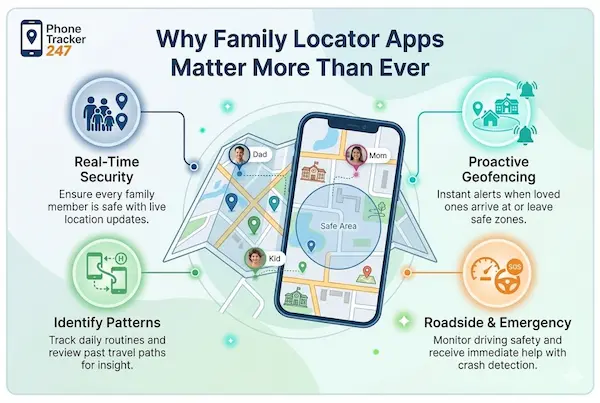
Urban environments, busy schedules, and unpredictable situations have made it harder to stay informed about loved ones’ whereabouts. A simple missed call or delayed response can trigger unnecessary stress.
From Anxiety to Clarity
Family locator apps address a deep psychological need: certainty. Instead of worrying, you can instantly verify someone’s location and status.
Real-Life Use Cases
- A child arrives at school → automatic notification
- An elderly parent leaves home unexpectedly → alert triggered
- A partner is commuting late → real-time tracking reduces concern
- Emergency situations → instant SOS signal with exact location
Key Features of the Best Family Locator Apps
Some apps simply do a much better job than others
1. Real-Time Location Tracking
Live updates on a shared map with high accuracy.
2. Geofencing & Smart Alerts
Set virtual boundaries (home, school, office) and receive notifications when someone enters or leaves.
3. SOS & Emergency Alerts
One-tap emergency button that shares location instantly with all members.
4. Battery Monitoring
Know when someone’s phone is about to die—critical in emergencies.
5. Location History
Track movement patterns over time for added context.
6. In-App Messaging
You can chat right inside the app instead of jumping between different ones
7. Privacy Controls
Granular permissions to decide who sees what and when.
How Accurate Are Family Locator Apps?
Accuracy is one of the most misunderstood aspects.
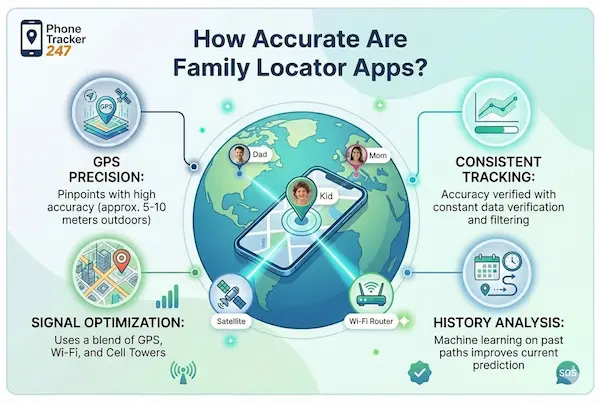
Technology Comparison
- GPS: Highly accurate (within 5–10 meters outdoors)
- Wi-Fi: Moderate accuracy indoors
- Cellular: Less precise but widely available
What Affects Accuracy
- Things like tall buildings or tunnels can interfere with the signal
- Device quality
- App permissions and settings
- Battery optimization modes
Advanced Improvements
Top apps now use hybrid tracking systems and AI algorithms to improve consistency and reduce lag.
Are Family Locator Apps Safe? (Privacy & Ethics)
This is where many users hesitate—and rightly so.
Data Security
Reputable apps use:
- End-to-end encryption
- Secure cloud storage
- Multi-factor authentication
Who Can See Your Location?
Only members you explicitly approve within your private circle.
Potential Risks
- Keeping tabs too often can start to feel intrusive and may slowly affect trust between people
- In some cases, it can be used in a way that feels more controlling than caring
- Data breaches (in low-quality apps)
Best Practices
- Always get consent from all members
- Avoid tracking adults without clear agreement
- Regularly review permissions
Legal Considerations
Laws vary by country, but tracking someone without consent is often illegal, especially for adults.
Best Family Locator Apps in 2026
While the market continues to evolve, here’s how to evaluate top options:
What to Compare
| Feature | Free Apps | Paid Apps |
| Accuracy | Medium | High |
| Alerts | Basic | Advanced |
| Privacy | Limited | Strong |
| Support | Minimal | Priority |
Top Use-Based Recommendations
- For families with kids: Focus on geofencing + alerts
- For elderly care: Prioritize SOS + simplicity
- For privacy-conscious users: Look for strong encryption policies
Family Locator Apps vs GPS Trackers
Key Differences
| Criteria | Family Locator Apps | GPS Devices |
| Hardware | Smartphone-based | Dedicated device |
| Cost | Low / subscription | Higher upfront + subscription |
| Flexibility | High | Limited |
| Accuracy | High | Very high |
When to Use Each
- Use apps for daily coordination
- Use GPS devices for high-risk tracking (e.g., dementia patients)
How to Choose the Right Family Locator App
Checklist
- Real-time tracking accuracy
- Reliable notifications
- Strong privacy controls
- Cross-platform compatibility
- Reasonable pricing
Questions You Should Ask Before Choosing a Family Locator App
Before installing any app, it’s worth slowing down and evaluating whether it actually fits your needs—not just in features, but in real-world usage.
- Will it drain your battery too quickly?
Some apps run constantly in the background, which can significantly impact battery life if not optimized properly. - Do you have full control over your privacy?
A reliable app should let you decide exactly who can see your location and when. - Is the support team responsive when issues happen?
When dealing with safety-related tools, slow or non-existent support is a serious drawback.
Warning Signs to Watch Out For
Not every app on the market is trustworthy. Be cautious if you notice:
- A lack of clear or transparent privacy policies
- Overloaded ads, especially in free versions
- Consistently negative feedback from users
Pros and Cons of Using a Family Locator App
What Makes Them Valuable
- Helps improve safety and awareness
- Makes daily coordination between family members easier
- Reduces unnecessary worry
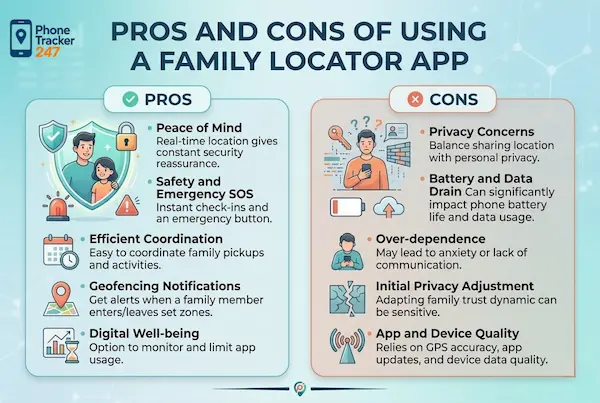
Potential Downsides
- Raises privacy concerns if misused
- Can lead to over-reliance in some situations
- Often comes with subscription fees for full features
What’s Next: The Future of Family Locator Apps
This category is evolving quickly, with new technologies reshaping how these apps work.
Smarter Alerts with AI
Apps are starting to detect unusual behavior patterns and send proactive notifications before issues arise.
Integration with Everyday Devices
Expect tighter connections with wearables, vehicles, and smart home systems.
Stronger Focus on Privacy
Future apps are moving toward giving users more transparency and control over their data.
Final Verdict: Is a Family Locator App Worth It?
A family locator app makes sense if:
- You’re the one making sure kids or older family members are safe and accounted for
- You want real-time visibility without constant check-ins
- You need a simpler way to coordinate daily routines
Used correctly, it’s less about tracking—and more about staying connected without friction.
For daily updates, subscribe to PhoneTracker’s blog!
We may also be found on Facebook!
FAQs – What Is a Family Locator App?
1. What is a family locator app?
It shares real-time location within a trusted family circle.
2. How does a family locator app work?
It uses GPS, Wi-Fi, and cell tower data.
3. Who should use a family locator app?
Parents, caregivers, couples, and traveling groups.
4. Can it send location alerts?
Yes, geofencing alerts show arrivals and departures.
5. Can it help in emergencies?
Yes, many apps include SOS or emergency alerts.
6. Does it show location history?
Yes, some apps show past routes and movement patterns.
7. Are family locator apps accurate?
Accuracy depends on GPS, signal, settings, and battery.
8. Are family locator apps safe?
Yes, if they use privacy controls and consent.
9. Is consent important?
Yes, tracking should be open, legal, and agreed.
10. What features matter most?
Live location, alerts, history, SOS, and privacy controls.