Table of Contents
- The Digital Anchor: Location Sharing as a Tool for Connection
- The Golden Rule: Consent and the Death of “Stealth” Tracking
- Practical Benefits: Safety, Logistics, and Peace of Mind
- Setting Healthy Boundaries: Avoiding the Surveillance Trap
- Technical Specs: Location Tracking Accuracy and Reliability
- Choosing the Right Tool: From Native Apps to Specialized Services
- The Security Perspective: Protecting Shared Data from Intruders
- Frequently Asked Questions
The Digital Anchor: Location Sharing as a Tool for Connection
A phone tracker app for couples serves as a modern digital anchor, providing real-time visibility into a partner’s safety and logistical progress. When used correctly, these tools eliminate the “where are you?” text cycle, allowing couples to coordinate arrivals and ensure mutual security without invasive questioning or constant manual updates.
In the fast-paced environment of 2026, the smartphone has evolved from a simple communication tool into a sophisticated beacon of our physical presence. For couples, the decision to share location data is often less about suspicion and more about the “frictionless” life. We live in an era where commuting is unpredictable and late-night solo travel is a reality. Having a partner’s “dot” on a map acts as a silent reassurance—a way to know they’ve cleared the highway traffic or reached their destination safely.
As a cybersecurity expert, I often view these apps through the lens of data utility. At PhoneTracker247.com, we see that the most successful implementations of this technology aren’t built on control, but on convenience. It’s about knowing when to start dinner or when to leave for the airport. However, the shift from “useful tool” to “emotional burden” is a subtle one, requiring a framework of trust and clearly defined rules.
The Golden Rule: Consent and the Death of “Stealth” Tracking
The only healthy way to use a phone tracker app for couples is through explicit, enthusiastic, and ongoing consent. Stealth tracking or “stalkerware” is not only a violation of trust that can destroy a relationship, but it is also legally classified as harassment or stalking in most jurisdictions in 2026.
Transparency is the bedrock of any digital interaction between partners. The tech industry has moved aggressively to kill the “hidden” tracking market. Modern operating systems now provide periodic reminders, such as: “Your location is being shared with [Partner’s Name]. Do you want to continue?” These prompts are vital online safety tools that prevent accidental or coercive surveillance.
If a relationship requires secret device monitoring to function, the problem isn’t the technology—it’s the trust. In the world of cybersecurity, we advocate for “informed participation.” Both parties should be able to see who has access to their data and be able to revoke that access at any moment without fear of retaliation. This balance ensures that the app remains a safety feature rather than a weapon of digital domestic abuse.
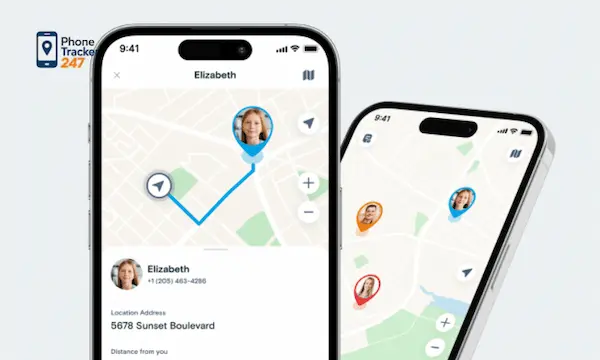
Phone tracker app for couples showing shared real-time GPS location between two partners on smartphone
Practical Benefits: Safety, Logistics, and Peace of Mind
Beyond simple location, the primary benefits of sharing data include emergency response capabilities, improved logistical coordination, and reduced “communication fatigue.” Modern apps allow for geofencing, which notifies a partner when the other has left work or arrived at a specific high-risk location like a late-night parking garage.
Let’s look at the “Safety Check” scenario. Imagine a partner who frequently works late or travels through areas with poor lighting. By utilizing a phone tracker app for couples, the other partner can receive an automated alert the moment they depart their office. This is a classic example of location tracking accuracy serving a protective purpose. It replaces the need for a “text me when you leave” message that a busy person might forget to send.
Furthermore, these tools are invaluable for parents. Much like digital parenting software helps guard children, couple-centric tracking allows parents to coordinate who is picking up the kids from school based on who is geographically closer to the campus. It turns the phone into a tactical planning tool for the family unit, making life significantly more efficient.
Phone tracker app for couples displaying both partners location pins on a tablet map at home
Setting Healthy Boundaries: Avoiding the Surveillance Trap
Healthy boundaries in location sharing involve deciding when and why tracking is active. Experts recommend “Purpose-Driven Sharing,” where couples might share location during commutes or solo trips but maintain a “Right to Disconnect” during social outings with friends or personal errands to preserve a sense of individual autonomy.
One of the biggest mistakes couples make is adopting an “always-on” policy without discussing the psychological ramifications. Even in the closest relationships, a sense of being constantly watched can lead to “surveillance anxiety.” You might find yourself wondering, “Why is he still at the grocery store?” or “Why did she take a different route home?” This level of micro-scrutiny is the antithesis of a healthy bond.
To avoid this trap, we suggest:
- The Sunset Rule: Only share location for a specific window of time (e.g., while one partner is traveling out of town).
- The Emergency-Only Access: Using apps that only reveal location when a “SOS” or “Request Location” button is pressed and approved.
- Open Audits: Periodically checking the PhoneTracker247 blog for updates on privacy settings to ensure your data isn’t being leaked to third-party brokers.
Couple using phone tracker app for couples to view shared location history together on tablet
Technical Specs: Location Tracking Accuracy and Reliability
Modern location tracking accuracy is achieved through a “fused” provider model, combining GPS, Wi-Fi triangulation, and Bluetooth beacons. In urban environments, dual-frequency GPS (L1 and L5) allows for precision within three meters, though indoor tracking often relies on nearby Wi-Fi MAC addresses to pinpoint coordinates.
When a couple uses a tracker, they expect precision. However, as a tech journalist, I have to warn about “location drift.” This occurs when a phone is inside a large building (like a mall) where the GPS signal is blocked by concrete. The phone might “drift” to a nearby street on the map, leading to unnecessary confusion or false accusations.
Understanding the tech prevents these “digital misunderstandings.” If your partner’s dot is jumping across the screen, it’s likely a signal issue, not a secret detour. High-quality online safety tools now include “Signal Strength” indicators to tell the viewer if the location is “Current” or “Cached,” which adds a layer of much-needed context to the data.
Phone tracker app for couples helping two partners coordinate locations using smartphones and a physical map
Choosing the Right Tool: From Native Apps to Specialized Services
Choosing a phone tracker app for couples depends on your hardware ecosystem and the level of detail required. Native solutions like Apple’s “Find My” or Google’s “Location Sharing” are highly secure and battery-efficient, while third-party apps offer advanced features like crash detection and historical travel logs.
If you are an all-Apple household, the native Find My app is often the best choice. It is integrated into the OS, uses end-to-end encryption, and has minimal impact on battery life. For Android users, Google Maps Location Sharing provides a similar, cross-platform experience that works well even if one partner has an iPhone.
For those who want more than just a dot on a map, apps like Life360 have become the standard for device monitoring in a family or couple context. These apps provide “Safety Reports,” which can tell you if your partner was speeding or if they’ve been involved in a collision. While these features are excellent for safety, they do require a higher level of data trust, as the app company itself often collects and stores this movement history.
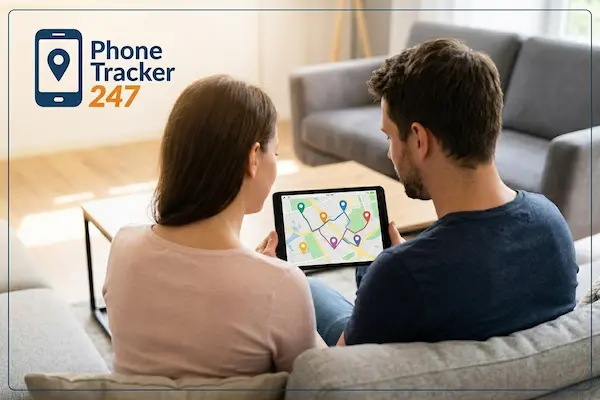
Phone tracker app for couples showing multiple GPS location pins on a shared map viewed on tablet
The Security Perspective: Protecting Shared Data from Intruders
Security for a phone tracker app for couples must be a top priority to prevent “Location Leaks” to malicious actors. Both partners should use strong, unique passwords and hardware-based two-factor authentication (2FA) to ensure that their shared location data doesn’t fall into the hands of hackers or data brokers.
Shared data is a shared risk. If your partner’s account is compromised, the hacker doesn’t just get their emails—they get a real-time map of your location as well. This is why we advocate for “Digital Hygiene.” Regularly check your “Device List” in your account settings and remove any old phones or tablets you no longer use.
Furthermore, be wary of “free” tracking apps that aren’t from major developers. In the world of online safety tools, if the product is free, your location data is usually being sold to advertisers. Stick to reputable services that prioritize encryption. You can find more security hardening tips at PhoneTracker247.com.
Frequently Asked Questions
1. Is it a red flag if my partner wants to track my phone? It depends on the motivation. If it’s for safety (e.g., late-night commutes) and is a mutual, transparent agreement, it can be a healthy part of a 2026 lifestyle. If it’s demanded as a way to “prove” where you are or comes with a lack of trust, it is a significant behavioral red flag.
2. Can I track my partner’s phone without them knowing? Technically, “stealth” apps exist, but they are increasingly illegal and highly detectable. Modern iPhones and Androids will send constant notifications if a tracking app is running. At PhoneTracker247.com, we strictly advise against any form of non-consensual tracking.
3. Does a phone tracker app for couples drain the battery? Native apps (Apple/Google) are very efficient. Third-party apps that provide “Live” updates can drain the battery faster, especially on older devices. To save power, set the app to update only when the location changes significantly.
4. How accurate is location tracking in 2026? With dual-frequency GPS and Wi-Fi assisted location, location tracking accuracy is typically within 3-5 meters (about 10-15 feet) in open areas. Indoors, it relies on Wi-Fi and may be less precise.
5. Can a VPN hide my location from my partner? No. A VPN hides your IP address from websites, but it does not affect your phone’s GPS hardware. If you have granted location permissions to a tracking app, it will still see your true coordinates regardless of your VPN status.
6. What is “Geofencing” for couples? Geofencing allows you to set a virtual boundary (like a 500-foot circle around your home). When your partner enters that circle, you get an automated notification. It’s perfect for knowing when to put the pasta in the water!
7. How do I stop sharing my location if I feel unsafe? On iPhone, use “Safety Check” in Settings to instantly revoke all sharing. On Android, go to the “Privacy Dashboard” to kill location permissions. If you feel you are being monitored without consent, please seek professional help or contact a local domestic safety resource.