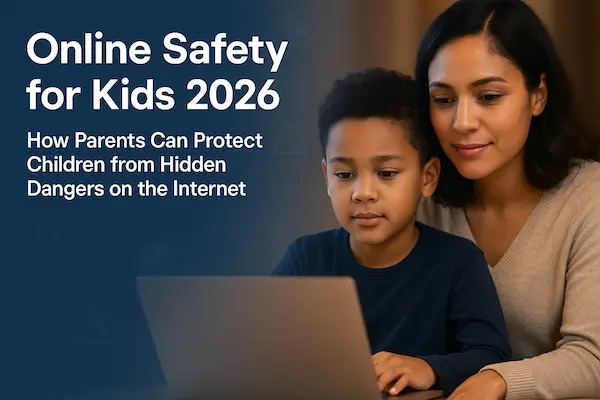
In this guide, we break online safety for kids 2026 into clear, practical sections that parents, carers, and schools can actually use. You will see how children use the internet today, what the biggest risks look like, which tools and rules really help, and how to build a living safety plan that keeps pace with new apps, laws, and technologies.
Contents
- 1 1. Online Safety for Kids 2026: Complete, Evidence-Based Guide for Parents and Schools
- 2 2. Key Takeaways: Online Safety for Kids 2026 at a Glance
- 3 3. What Is Online Safety for Kids in 2026 and Why It Matters
- 4 4. How Kids Use the Internet in 2026 (Devices, Platforms, Digital Habits)
- 5 5. Biggest Online Risks for Kids in 2026 (Content, Contact, Conduct, Contract, Data)
- 6 6. Age-Based Online Safety for Kids 2026: What to Do at Each Stage
- 7 7. Step-by-Step Online Safety Plan for Families in 2026
- 8 8. Tools and Parental Controls for Online Safety for Kids 2026
- 9 9. Teaching Digital Literacy to Support Online Safety for Kids 2026
- 10 10. Laws, Regulations, and Children’s Digital Rights in 2026
- 11 11. Working with Schools and Communities on Online Safety for Kids 2026
- 12 12. Red Flags and Incident Response: What to Do When Kids Are in Online Trouble
- 13 13. Future Trends Beyond 2026: Metaverse, Smart Toys, and AI Companions
- 14 14. 2026 Online Safety for Kids Checklist (Printable Summary)
- 15 FAQs: Online Safety for Kids 2026 (Quick Answers for Parents and Schools)
- 16 Conclusion
1. Online Safety for Kids 2026: Complete, Evidence-Based Guide for Parents and Schools
The internet is no longer a separate “online world” for children – it is simply where they learn, play, talk to friends, and explore. By 2026, most kids will use multiple connected devices every day: a phone or tablet at home, a school laptop, a gaming console, maybe even a smart watch or VR headset. That connected life brings huge benefits, but it also means online safety for kids can’t be an afterthought or a one-time conversation.
When people search for online safety for kids 2026, what they really want is not theory. They want clear, realistic guidance: What are the real risks now? What do I actually do about them this week with my family or my students? This guide focuses on practical steps grounded in current best practices from educators, child psychologists, cyber-security specialists, and frontline experience from parents and schools.
You will not find “perfect parent” rules here. Instead, the aim is to help you build a flexible safety plan that fits your child’s age, personality, and culture. We will look at how children really use the internet in 2026, where the biggest threats come from (content, strangers, money traps, data misuse), and how to respond when something goes wrong. You will also see how schools, clubs, and communities can back up parents so kids are not left to navigate everything alone.
Because laws and platforms change fast, this guide treats online safety for kids in 2026 as a moving target. You will see where regulations are tightening, why platforms are under more pressure to protect minors, and what that actually means for your family at home. Nothing here is legal advice, but it will give you the right questions to ask and the main areas to review regularly.
Most of all, this is about balance. Children need freedom to learn, create, and connect – and they also need clear boundaries, honest conversations, and adults who know how to use the tools available. If you are a parent, carer, teacher, or school leader, the goal is simple: after reading, you should feel ready to update your own online safety for kids 2026 plan and take a few concrete actions right away.
2. Key Takeaways: Online Safety for Kids 2026 at a Glance
This section gives you a fast, high-level overview of what really matters in online safety for kids 2026 before you dive into the details. Use these key takeaways as a checklist to see where your family, classroom, or organisation is already strong and where you may need to tighten your approach.
-
Online life is everyday life. In 2026, kids move seamlessly between school platforms, social media, games, and AI tools, so online safety has to cover learning, play, and socialising – not just “stranger danger.”
-
Risks are broader than just bad content. Online safety for kids 2026 includes exposure to harmful material, contact with strangers, cyberbullying, scams, in-app spending, and silent data collection that shapes a child’s digital footprint for years.
-
Age and stage matter. A six-year-old with a shared tablet and a sixteen-year-old on social media need very different rules, tools, and conversations; age-based plans work better than one strict rule for every child.
-
Technology can help, but it is not enough. Device controls, kid profiles, filters, and activity reports are powerful, yet they only work when combined with clear family rules, regular check-ins, and trusted relationships.
-
Digital literacy is the new life skill. Children need to learn how to spot fake news, deepfakes, manipulative design, and unhealthy online behaviour, and also how to be kind and responsible in their own posts and messages.
-
Parents and schools need to work together. Consistent expectations between home and school, shared language about risks, and clear response plans make it easier for kids to ask for help when something goes wrong.
-
Online safety is an ongoing process, not a one-time fix. Laws, apps, and platforms will keep changing after 2026, so families and schools should review their online safety plans regularly and update rules, tools, and conversations at least once or twice a year.
3. What Is Online Safety for Kids in 2026 and Why It Matters
Before you can build an effective plan, it helps to be clear about what online safety for kids 2026 actually means in practice. This section defines the concept, explains why it has become so critical for children’s wellbeing, and shows how the current digital landscape is different from previous years.
1. What “Online Safety for Kids 2026” Really Means
When we talk about online safety for kids 2026, we are not only talking about blocking a few websites or turning on a filter. Online safety now means protecting children’s minds, emotions, data, money, and relationships in a digital world that follows them everywhere. It covers what they see, who can contact them, what they share, which apps track them, and how they behave when nobody is watching.
In 2026, online safety also includes how children interact with AI tools, recommendation algorithms, and immersive environments. A child can be sitting in the living room and still be exposed to strangers in a game chat, targeted ads in a video feed, or manipulative “limited-time offers” in a mobile app. Because of that, any serious approach to online safety for kids has to be holistic: combining technical settings, clear family rules, emotional support, and practical skills that children can carry into adulthood.
2. Why Online Safety for Kids in 2026 Is More Urgent Than Ever
Children are going online younger, staying online longer, and doing more important things there than ever before. Schoolwork, friendships, hobbies, identity, and even early romantic relationships are partly built through screens. That makes online safety for kids 2026 a core part of child wellbeing, not a side topic for “IT people” or only for high-risk cases. When something goes wrong online, it can affect grades, sleep, self-esteem, and family relationships in the offline world.
At the same time, the digital environment has become more complex. Harmful content no longer appears only on shady websites; it can slip into mainstream platforms via recommendations, comments, or trending sounds. Strangers do not always look suspicious; they can use real photos, shared interests, and AI-generated messages to build trust. Even when nothing dramatic happens, constant comparison, pressure to respond instantly, and fear of missing out can drain a child’s mental health. All of this is why families and schools need a structured, 2026-ready plan instead of relying on old advice from ten years ago.
3. How Online Safety for Kids 2026 Differs from Earlier Years
A decade ago, most guidance focused on desktop computers, basic web filters, and a few big social networks. In online safety for kids 2026, the landscape is very different. Children move between phones, tablets, laptops, smart TVs, gaming consoles, and sometimes VR or AR headsets. They use short-form video apps, chat servers, encrypted messaging, learning platforms, and AI assistants, often in the same afternoon. This constant switching makes it harder for adults to keep track of where risks might appear.
The threats themselves have evolved. Deepfakes, AI-generated images, clone voices, and highly personalized scams blur the line between real and fake. Data tracking is more invisible, and business models often depend on keeping children engaged for as long as possible. Meanwhile, new laws and platform rules are pushing companies to protect minors, but enforcement is uneven and still developing. The practical result is that parents, carers, and schools cannot rely on technology alone. To make online safety for kids in 2026 truly effective, they need up-to-date knowledge, age-appropriate conversations, and a living safety plan that is reviewed and adjusted regularly.
4. How Kids Use the Internet in 2026 (Devices, Platforms, Digital Habits)
To protect children online, adults first need to understand how kids really use the internet in 2026 across different devices and platforms. This section looks at the screens, apps, and daily routines that shape children’s online lives so you can align your safety choices with their actual habits.
1. Devices Kids Rely on in 2026
For most children, the internet in 2026 is not tied to a single screen. A typical child might watch videos on a smart TV, chat with friends on a phone, play games on a console, and do homework on a laptop or school-issued tablet, all in the same day. Some older kids and teens also experiment with VR headsets, AR glasses, or smartwatches that keep them connected even when other devices are put away.
This constant access reshapes online safety for kids 2026. Instead of protecting just one family computer in the living room, parents have to think in terms of an ecosystem of devices. Each device may have different settings, parental control options, and privacy risks. That is why a family safety plan should list every screen and account a child uses, including shared devices like smart TVs and consoles, not only personal smartphones.
2. Popular Platforms, Games, and Apps for Children and Teens
Children and teenagers rarely stick to a single platform. They jump from short-form video apps to messaging, from multiplayer games to group chats, and from school platforms to streaming services. Some apps are clearly labelled for entertainment, others mix learning and social features, and some tools, especially AI assistants and creative apps, blur the line between work and play. Many of these platforms encourage constant interaction through notifications, streaks, and rewards.
For online safety for kids 2026, it is more useful to understand what a child does on each platform than to focus only on the brand name. A chat feature inside a game can be as risky as a standalone messaging app. A video platform that autoplayes content can expose kids to more extreme material if nobody reviews the recommendations. Parents and schools need to know which apps have public profiles, open chat, direct messaging, or location sharing, and adjust rules and controls around those features.
3. Daily Screen Time and Hybrid Online–Offline Life
In 2026, many kids flow between online and offline activities without thinking about the difference. They might do homework in an online classroom, then stay at the same device to chat with friends or play, then check social media while travelling to a sports practice. Even when they are physically with friends, part of the interaction may still happen through screens, sharing memes, streaming music, or posting photos together.
This hybrid life means that healthy online safety for kids in 2026 is not about banning screens altogether. Instead, it is about creating rhythms and boundaries that protect sleep, concentration, and mental health. Clear rules around device-free times (such as meals and late evenings), tech-free spaces (like bedrooms for younger children), and regular breaks help kids step back from constant stimulation. When adults model balanced habits themselves, children are more likely to treat screens as a tool that fits into life, not something that controls their day.
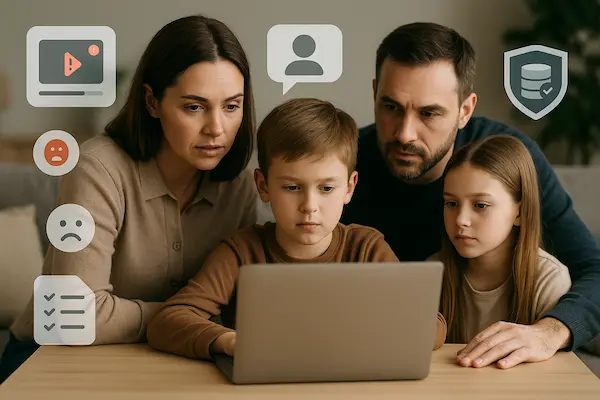
5. Biggest Online Risks for Kids in 2026 (Content, Contact, Conduct, Contract, Data)
Not all online risks look the same, and many are easy to miss if you only focus on obvious dangers. Here we break down the main risk categories that define online safety for kids 2026—what children see, who can reach them, how they behave, what they sign up to, and how their data is used—so you can recognise problems earlier.
1. Content Risks: Harmful and Inappropriate Material
Harmful content is still one of the most visible threats to children online, but in 2026 it appears in more subtle ways. Violent scenes, sexualised images, self-harm content, hateful memes, and extremist propaganda can surface in recommended videos, comment sections, or trending challenges, even when a child did not actively search for them. Algorithms that focus on engagement can accidentally promote shocking or extreme material because it grabs attention.
Effective online safety for kids 2026 accepts that children may occasionally see something disturbing, even with filters in place, and prepares them for that reality. Parents and teachers can explain in advance what to do if a child encounters upsetting content: stop watching, close the app, tell a trusted adult, and avoid sharing it further. Regularly reviewing subscriptions, recommended feeds, and “watch history” together also helps adults spot patterns before they escalate.
2. Contact Risks: Strangers, Grooming, and Exploitation
Not every online stranger is dangerous, but children cannot reliably tell who is safe. Groomers and abusers may use friendly language, shared interests, and even AI-generated messages to build trust. They may appear in game chats, comment threads, or DMs, slowly pushing boundaries, asking for private information, moving conversations to more private apps, or requesting images and videos. Some scams targeting kids and teens also start with “kind” offers of help or compliments.
To strengthen online safety for kids 2026, families and schools should move beyond “never talk to strangers” and teach more nuanced rules. Children need to recognise red flags: someone asking them to keep secrets from adults, move to a new app, send photos, or share things that feel uncomfortable. Role-play conversations, simple scripts for saying “no”, and clear promises from adults (“You won’t be in trouble for telling me”) all make it easier for kids to speak up early.
3. Conduct Risks: Cyberbullying, Trolling, and Digital Reputation
Many of the most painful online experiences for children do not come from strangers, but from classmates, teammates, or friends. Cyberbullying can happen through group chats, private messages, comment threads, or shared photos, and it can follow a child home long after school ends. Jokes, memes, or “roasts” can quickly cross the line into harassment, exclusion, and humiliation. At the same time, what a child posts in anger or as a joke can stay online long enough to affect future opportunities.
An online safety for kids 2026 plan has to address behaviour, not only technology. Families and schools can set clear expectations about language, sharing images, and joining group chats where others are being mocked. Children should understand that screenshots and forwarded messages can spread far beyond the original audience, and that they are responsible for their words even if a post is deleted later. Teaching empathy and conflict resolution skills online is as important as teaching them in the classroom or playground.
4. Contract and Money Risks: In-App Purchases, Gambling-Like Features, and Scams
Games and apps aimed at children increasingly rely on microtransactions, loot boxes, and time-limited offers to drive revenue. Some of these mechanics blur the line between play and gambling, rewarding kids with randomised items, flashy animations, or social status. Without clear boundaries, children can spend large sums of money or feel pressured to pay to keep up with friends. On top of that, scams aimed at teens, fake giveaways, impersonation, and investment schemes, are becoming more polished and harder to detect.
From a online safety for kids 2026 perspective, parents and carers should treat payment settings as part of child protection, not just family budgeting. Turning off one-click purchases, requiring adult approval for spending, and using prepaid methods where appropriate all help. Teaching children how to spot common scam patterns, urgency, secrecy, unrealistic rewards, equips them to pause before they tap. Families can also agree on rules for spending in games and apps so children know what is acceptable and when they must ask first.
5. Privacy and Data Risks for Children in 2026
Every app, platform, and device collects some data, and many collect far more than a child or parent realises. Location, contacts, browsing habits, viewing time, and interaction patterns can be combined to build detailed profiles. These profiles shape the ads children see, the content recommended to them, and sometimes even the prices or offers they receive. If accounts are not properly secured, data can also leak in breaches or be misused by others.
Modern online safety for kids in 2026 therefore includes digital privacy as a core pillar. Parents and older children should learn to review app permissions, turn off unnecessary tracking, and use privacy settings that limit who can see posts, stories, and profiles. Strong passwords and multi-factor authentication reduce the risk of accounts being taken over. Regularly cleaning up old apps, accounts, and shared posts helps reduce long-term exposure, and gives children a sense of control over their digital footprint as they grow.
6. Age-Based Online Safety for Kids 2026: What to Do at Each Stage
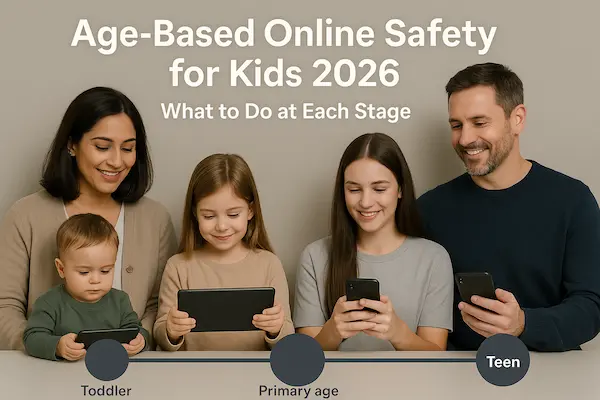
Children at different ages need very different kinds of guidance, rules, and tools. This section shows how to adapt your online safety for kids 2026 strategy for early childhood, pre-teens, and teenagers, so protection grows with your child instead of holding them back.
1. Online Safety for Kids 3–7: First Screens and Simple Boundaries
For very young children, online safety for kids 2026 starts with adults controlling the environment. At this age, kids do not need open access to the whole internet; they need carefully chosen apps, videos, and games that match their development. Using child profiles, whitelisted apps, and trusted video libraries is far more effective than trying to explain complex risks. Devices should stay in shared spaces so adults can casually glance at the screen and step in if something looks wrong.
The focus for ages 3–7 is to build good habits and simple language around safety. Children can learn that full names, addresses, school names, and passwords are “family-only information.” They can also learn to stop and ask an adult if something feels scary, confusing, or “not right.” Even if they do not fully understand online safety for kids in 2026, they can understand that their grown-ups want to help keep both their bodies and their feelings safe, including when they are using screens.
2. Online Safety for Kids 8–12: Games, Group Chats, and First Social Accounts
Between 8 and 12, many children move from passive watching to active participation. They join multiplayer games, start group chats for homework and hobbies, and may ask for their first social media or messaging accounts. At this stage, effective online safety for kids 2026 means combining firm boundaries with guided independence. Rules should cover what information can be shared, which apps are allowed, and what happens if rules are broken—not as punishment, but as a safety measure.
This is also the best time to practise specific skills: how to set a strong password, how to block and report someone, how to mute or leave a toxic group chat, and how to handle friend requests from people they do not know in real life. Parents and carers can sit next to children while setting up accounts, walking through privacy settings together instead of doing it secretly in the background. Pre-teens are old enough to understand that some people lie about who they are online, and that even “nice” strangers should not receive photos, personal details, or information about where the child will be at a specific time.
3. Online Safety for Teens 13–17: Social Media, Identity, and Independence
By the teenage years, young people often see the internet as a key part of their identity and social life. They may manage multiple accounts, experiment with different personas, and use platforms that adults know little about. Heavy-handed control can backfire, pushing teens to hide their online life or create secret accounts. For online safety for kids 2026 in this age group, the goal is guided autonomy: giving teens more say while keeping non-negotiable safety lines in place.
It helps to be transparent about what parents will and will not do. For example, a family might agree that parents can see who teens follow and who follows them, but will not read every private message unless there is a clear concern. Conversations should address body image, social comparison, online dating, explicit content, and the pressure to respond instantly. Teens also need to understand how universities, employers, and scholarship committees may review applicants’ online presence. When they participate in setting their own online boundaries—and understand why those rules exist—they are more likely to see online safety for kids in 2026 as a shared responsibility rather than a set of arbitrary restrictions.
7. Step-by-Step Online Safety Plan for Families in 2026
Good intentions are not enough; families need a simple, written plan they can actually follow. In this part of the guide, you will learn how to turn online safety for kids 2026 into concrete steps, agreements, and routines that everyone in the household understands.
1. How to Create a Family Online Safety Agreement in 2026
A written family agreement turns vague ideas about online safety into specific, shared expectations. It does not have to be long or legalistic; one or two pages with clear bullet points are enough. Start by listing all the devices and accounts your children use. Then, agree on when, where, and how those devices can be used—for example, no phones at the dinner table, no headphones after a certain time, and no new apps without permission. Involving children in the discussion makes them more likely to respect the outcome.
To keep the agreement aligned with online safety for kids 2026, review it at least once a year or whenever there is a major change, such as a new school, a new device, or a new platform that becomes popular. Younger children might sign the agreement with drawings or stickers, while teens can help update clauses as they take on more responsibility. The document itself is less important than the process of talking through expectations and consequences together.
2. Setting Clear Rules for Screen Time, Devices, and Apps
There is no single perfect number of hours that suits every child, but families should still set boundaries so screens do not crowd out sleep, exercise, and face-to-face time. A practical approach to online safety for kids 2026 is to tie screen rules to routines rather than just minutes: no gaming before homework, no social media during meals, no devices in bedrooms overnight. These patterns help protect health and focus without requiring constant minute-by-minute monitoring.
It is also useful to categorise apps into groups: “always allowed with supervision” (school platforms, educational tools), “allowed with time limits” (games, social media, streaming), and “not allowed” (adult-only, anonymous chat, or services that conflict with family values). Children should know that adults can remove or pause access to an app if new risks appear, such as a surge in harmful challenges or a change in privacy policy. When rules change, explain the reasons in plain language so kids see it as part of keeping online safety for kids in 2026 up to date, not as random control.
3. Scheduling Regular Digital Check-Ins with Your Kids
Even the best rules and tools will miss some problems, which is why regular, low-pressure conversations are one of the most powerful parts of online safety for kids 2026. A digital check-in can be as simple as fifteen minutes once a week where you ask open questions: What apps are you enjoying right now? Have you seen anything online that surprised or upset you? Is anyone making you feel uncomfortable in chats or games? The goal is curiosity, not interrogation.
These conversations work best when children believe they can tell the truth without immediately losing all access to their favourite platforms. You can still set firm boundaries and take action when needed, but start by listening and thanking them for being honest. Over time, these check-ins teach children that asking for help is normal and expected, not a sign of failure. They also give parents and carers a real-time view of how online safety for kids in 2026 is playing out inside their own home—insights no filter or dashboard can fully replace.
8. Tools and Parental Controls for Online Safety for Kids 2026
Technology can be a strong ally if you know which settings to use and where to find them. This section walks through the most useful device-level and platform-level tools that support online safety for kids 2026, and how to choose apps and games with safety in mind from the beginning.
1. Device-Level Controls on Phones, Tablets, and Computers
Modern devices come with surprisingly powerful safety features, but many families never turn them on. On phones, tablets, and laptops, you can usually create separate child profiles, limit which apps can be installed, filter web content, and set daily time limits. Some systems even allow you to approve or deny app downloads from your own device, without taking your child’s phone away. Used well, these controls form a strong technical foundation for online safety for kids 2026.
A good starting point is to sit down with your child and set up their device together. Walk through the settings menus, explain what each control does in simple terms, and agree on limits that feel fair. Turn off unnecessary location sharing, restrict access to app stores, and make sure automatic updates are enabled so security patches arrive on time. Device-level controls are not about spying; they are about making sure the basic doors and windows of your child’s digital “house” are locked before they start exploring.
2. Platform-Level Controls on Social Media, Games, and Streaming
Even with safe devices, individual apps and platforms can introduce new risks. Social networks, online games, and streaming services often have their own privacy dashboards, family centres, and reporting tools. These may allow you to hide a child’s profile from public search, disable direct messages from strangers, moderate comments, and filter mature content. Some gaming platforms let you control who can join voice chat or send friend requests.
For online safety for kids 2026, it helps to treat each new platform like a new neighbourhood. Before your child spends time there, explore the “safety,” “privacy,” or “family” sections yourself. Check how easy it is to block or report someone, and whether there are age-specific settings. Show your child where these tools live, so they know what to do if something feels wrong while you are not there. Revisit settings every few months—platforms update features frequently, and new options may appear that can make your child’s experience safer.
3. Choosing Safer Apps and Games for Kids in 2026
With thousands of apps competing for attention, picking the right ones can feel overwhelming. A simple rule for online safety for kids in 2026 is to slow down before tapping “install.” Look at age ratings, read several recent reviews (including negative ones), and check whether the app is made by a known developer or an unknown company with little information. Be wary of apps that request permissions far beyond what they need, such as a puzzle game asking for contact list access or a flashlight app asking for your location.
Families can create a “trusted list” of apps that children are allowed to use and a short process for adding new ones. For example, a child might need to show a parent the app store page, explain what the app is for, and wait a day before it gets approved. This delay alone filters out many impulsive downloads. Over time, children learn to evaluate apps through a safety lens, not just based on what friends recommend. That habit is one of the strongest defences for online safety for kids 2026, because it changes how children think about technology, not only which tools they use.
9. Teaching Digital Literacy to Support Online Safety for Kids 2026
Filters and controls can block some threats, but real protection comes from children’s ability to think clearly about what they see and do online. Here we focus on digital literacy skills that make online safety for kids 2026 more sustainable: spotting fakes, understanding algorithms, and practising kindness in digital spaces.
1. Helping Kids Recognise Fake News, Deepfakes, and AI-Generated Content
Technical controls can block some threats, but they cannot teach judgement. In 2026, children are surrounded by images, videos, and messages that may be edited, staged, or generated entirely by AI. Teaching them to question what they see is essential for online safety for kids 2026. Start with simple questions: Who made this? Why did they make it? How do we know if it is true? Encourage children to check information against trusted sources rather than accepting every dramatic headline or viral clip.
You can practise together by looking at examples of misleading thumbnails, clickbait titles, and obviously edited images, then gradually move to more subtle content. Show them that even adults double-check facts and change their minds when new information appears. The goal is not to turn kids into cynics, but to help them develop a healthy, curious scepticism so they are less likely to be misled, manipulated, or frightened by false information online.
2. Explaining Algorithms and Echo Chambers in Kid-Friendly Language
Recommendation systems decide what many children see online long before they decide for themselves. Feeds suggest videos, songs, posts, and people to follow, often based on what kept their attention in the past. For online safety for kids 2026, it is important that children understand this basic idea: if they watch a lot of one type of content, the system will show them more of it, whether it is helpful or harmful. This can create “echo chambers” where one narrow view of the world feels like the only reality.
You can explain algorithms with everyday metaphors. For example, you might say a video app is like a friend who only remembers what you enjoyed last week and keeps offering you more of the same, even if it is not good for you. Encourage kids to notice when their feed seems repetitive or extreme and to intentionally search for different topics or follow a variety of creators. This not only broadens their perspective but also reduces the chance that they will be pulled deeper into harmful or obsessive content patterns.
3. Building Empathy, Kindness, and Respect Online
Many online problems that hurt children—bullying, shaming, exclusion—are really problems of behaviour and values. Teaching empathy and respect is therefore a central part of online safety for kids in 2026, not an optional extra. Children need to understand that there is a real person on the other side of every message, avatar, or username, and that words can cause pain even when typed quickly or meant as a joke.
Practical tools help. Families and schools can use simple frameworks like “pause before you post” or ask children to imagine how a message would feel if it were read aloud in front of the whole class. Discuss real scenarios (with details changed to protect privacy) instead of only giving abstract rules. Praise children when they stand up for others, refuse to share humiliating content, or apologise for a hurtful comment. When kindness is treated as a daily digital habit, not just a slogan, it becomes a powerful shield that supports online safety for kids 2026 and makes the online world safer for everyone.
10. Laws, Regulations, and Children’s Digital Rights in 2026
Behind every app and platform are legal rules and rights that shape how children should be treated online. This section explains how evolving regulations and children’s digital rights connect to online safety for kids 2026, and what that means for the decisions families make every day.
1. Key 2026 Rules That Affect Online Safety for Kids
Around the world, governments and regulators are tightening expectations on how tech companies treat children online. In many regions, platforms are expected to offer stronger privacy by default for minors, limit profiling for advertising, and act more quickly when harmful content is reported. Some countries are experimenting with age-appropriate design rules, which require services to put children’s best interests first when they design features, recommendations, and data collection.
For families, the practical lesson is simple: online safety for kids 2026 is no longer just a private family issue. Platforms have legal responsibilities too, even if enforcement is uneven. When you report harmful content or behaviour, you are not “making a fuss”; you are using tools that laws increasingly expect companies to provide. Knowing that you have this backing can make it easier to push for changes, whether that means asking a platform to remove content or pressing a school to update old policies.
2. Understanding Children’s Right to Privacy and Protection Online
Children have the same basic rights to privacy and safety online that they have offline, but those rights can be hard to see behind the smooth design of apps and games. They include the right to have their data collected fairly and only when necessary, the right to clear explanations they can understand, and the right to be protected from exploitation and serious harm. In many places, children also have the right to ask for certain data to be corrected or deleted.
When you think about online safety for kids in 2026, it helps to adopt a rights-based mindset rather than only a rule-based one. Instead of asking “Is my child allowed to do this?”, ask “Does this service respect my child’s rights?” If an app nudges kids to share more information than they need, makes it hard to say no, or hides critical choices in complex menus, that is a warning sign. Teaching older children about their digital rights empowers them to speak up and question designs that feel unfair or intrusive.
3. What Parents Should Do (and Not Do) with Kids’ Data
Parents and carers often hold more information about a child than anyone else—photos, school reports, medical details, private messages. Posting family moments online can seem harmless, but large collections of images and personal stories can create a detailed digital shadow that a child never chose. Good online safety for kids 2026 includes thinking carefully about what you share and where you store it.
A simple rule is to avoid posting anything that reveals a child’s exact location, daily routine, or sensitive struggles without their clear, age-appropriate consent. Use private sharing tools when possible, and consider what your child might think about a post when they are older. At the same time, parents should model good security: strong passwords for family photo libraries, locked devices, and cautious use of cloud services. Protecting children’s data is not just about what companies do; it is also about the choices adults make every day.
11. Working with Schools and Communities on Online Safety for Kids 2026
No child’s online world is limited to home; it extends into classrooms, clubs, and wider communities. In this part, we explore how parents, teachers, and local organisations can cooperate to make online safety for kids 2026 more consistent and effective across all of a child’s environments.
1. How to Align Family Rules with School Online Safety Policies
Children move between home, school, and extracurricular activities with the same phone in their pocket, so fragmented rules can confuse them. One teacher may ban phones completely, another may allow them for research, while home rules might be different again. To make online safety for kids 2026 coherent, families and schools should share information and look for alignment where it matters most: how devices are used, how incidents are handled, and what language is used to describe risks.
You can start by asking your child’s school for copies of their acceptable use policy and any online safety curriculum they follow. Compare these with your own family agreement. Where there are gaps or contradictions, talk to teachers or school leaders about finding common ground. Even small things—like using the same terms for cyberbullying or sharing the same reporting channels—can help children know what to do and who to tell when something goes wrong.
2. Partnering with Teachers, Counselors, and School IT Staff
Teachers, school counsellors, and IT staff often see patterns that families cannot: sudden changes in group chat dynamics, repeated reports about the same app, or shifts in how students talk about a particular game. Building a respectful partnership with these professionals strengthens online safety for kids in 2026 far beyond what any one parent can do alone.
If you have concerns about your child’s online behaviour or wellbeing, share them with the school early rather than waiting for a crisis. Likewise, invite staff to tell you if they notice worrying signs in class or on school platforms. Approach these conversations as joint problem-solving, not blame. Remember that teachers may also need support and training to keep up with new apps and risks; parents who stay informed can be valuable allies rather than critics.
3. Community Resources, NGOs, and Helplines for Online Safety
No family or school needs to solve everything themselves. Many regions have helplines, NGOs, and community groups focused on digital safety, mental health, and child protection. Some offer free workshops for parents, student ambassador programs, or confidential support when a serious online incident occurs. These organisations often track trends faster than official policies and can provide practical, up-to-date advice tailored to local culture and law.
For a robust online safety for kids 2026 strategy, collect key contacts in one place: helpline numbers, trusted websites, and local support services. Share this list with older children and teens so they know there are multiple safe adults and organisations they can turn to, not just their immediate family. Knowing help exists before they need it makes it easier for kids to reach out when it really matters.
12. Red Flags and Incident Response: What to Do When Kids Are in Online Trouble
Even with strong prevention, problems can still arise, and how adults respond can either reduce or amplify the harm. This section gives you practical guidance for recognising warning signs and handling incidents in a way that supports online safety for kids 2026 without panicking or overreacting.
1. Warning Signs Your Child Might Be Struggling Online
Children do not always tell adults when something online is hurting them. Instead, they may show indirect signs: suddenly hiding their screen, becoming unusually secretive, avoiding school, losing interest in activities they used to enjoy, or having trouble sleeping. They might seem anxious when notifications arrive, or they may be glued to their device in a way that feels desperate rather than relaxed.
These signals do not prove that an online problem exists, but they are reasons to pay closer attention. Within a broader online safety for kids 2026 plan, parents can treat red flags as invitations to open a gentle conversation: “I’ve noticed you seem more stressed after using your phone. Is there anything happening online that you’d like to talk about?” A calm tone and genuine curiosity are more effective than sudden bans or accusations.
2. Step-by-Step Response Plan for Parents in 2026
When you do discover a serious issue—cyberbullying, blackmail, exposure to disturbing content, or risky behaviour—it can be tempting to react instantly. A structured response helps you protect your child without making the situation worse. First, focus on safety and emotional support: reassure your child that you are glad they told you and that you will work through it together. Listen to their account fully before jumping into solutions.
Next, gather evidence: screenshots, usernames, links, and timestamps. This documentation is critical if you need to report the behaviour to a platform, school, or authority. Then, use the built-in tools that support online safety for kids 2026: block the offender, report abusive content, and adjust privacy settings. Depending on the severity, inform the school or club if peers are involved so they can protect other children too. In cases involving threats, explicit images, or ongoing harassment, consider reaching out to specialised helplines or law enforcement.
3. When to Involve School, Helplines, or Law Enforcement
Not every unkind comment requires a formal report, but some situations clearly cross the line. Involving a school may be appropriate when bullying involves classmates or affects learning. Helplines can offer confidential advice when you are unsure what to do next or when your child is reluctant to speak to someone they know. Law enforcement is more relevant when there are credible threats of harm, exploitation, extortion, or circulation of explicit images involving minors.
A mature online safety for kids 2026 approach recognises that escalating a case is not a failure of parenting; it is a sign that the situation is serious and deserves professional support. When you do seek outside help, continue to support your child emotionally. They may feel ashamed, guilty, or afraid, even if they did nothing wrong. Regular check-ins, reassurance, and, if needed, professional counselling can help them rebuild confidence and trust after the crisis passes.
4. Supporting Kids’ Emotional Recovery After Online Harm
The impact of an online incident often lasts longer than the incident itself. A child who has been bullied, tricked, or exposed may replay events in their mind, worry about what others think, or fear that the problem will return. Recovery is part of online safety for kids in 2026, not a separate topic. It involves validating feelings, avoiding blame, and giving the child space to talk about what happened at their own pace.
It can also help to gradually rebuild a sense of control. That might mean cleaning up friend lists, unfollowing stressful accounts, changing usernames, or taking a short break from particular apps while keeping social contact through safer channels. In some cases, families may temporarily simplify a child’s online life so they can reconnect with hobbies and relationships offline. The goal is not to ban the internet forever, but to remind children that they are more than what happened to them online.
13. Future Trends Beyond 2026: Metaverse, Smart Toys, and AI Companions
Online life will not stop evolving when your current plan feels complete. Here we look ahead at emerging technologies—immersive worlds, connected toys, and AI companions—and what they mean for online safety for kids beyond 2026, so you can prepare instead of being surprised.
1. Online Safety for Kids in Immersive Worlds (VR, AR, Metaverse)
Immersive environments bring new layers of opportunity and risk for children. In virtual worlds, experiences feel more “real” because they engage sight, sound, and movement at the same time. That intensity can make positive experiences—like learning or creative play—very powerful, but it can also make harassment, fear, or peer pressure feel overwhelming. Voice chat, avatars, and shared virtual spaces introduce social complexity that basic filters may not catch.
Looking ahead from online safety for kids 2026, families should treat VR and AR like any other connected technology: set time limits, check age ratings, and explore environments together before giving unsupervised access. Children need to know how to handle unwanted contact in these spaces, how to report abuse, and how to step away if an experience feels uncomfortable. Keeping play in shared physical spaces, where adults can see and hear what is happening, reduces the chance that harmful behaviour goes unnoticed.
2. Smart Toys, Voice Assistants, and Always-On Devices
Smart speakers, connected toys, and voice-activated assistants can seem harmless, even charming, but many of them constantly listen for “wake words” and send data back to servers. Some devices collect information about a child’s voice, interests, and routines. In a world shaped by online safety for kids 2026, parents should think carefully before adding microphones and cameras to bedrooms or playrooms, especially if they do not fully understand how data is stored and used.
If you do use connected toys or voice assistants with children, review privacy settings, disable unnecessary data storage, and turn devices off when they are not needed. Explain to kids that these gadgets are not magical friends, but tools made by companies. They should not share secrets, passwords, or private information with them. Teaching this distinction early will make it easier for children to evaluate new devices critically as technology keeps evolving.
3. Preparing Kids for the Next Wave of Digital Change
The only constant in children’s digital lives is change. New apps, trends, and devices will appear after 2026 that we cannot fully predict today. That is why the most important part of online safety for kids 2026 is building adaptable skills and values, not just locking down specific platforms. Children who know how to ask good questions, think critically, set boundaries, and ask for help will be better prepared for whatever comes next.
Parents and schools can nurture this resilience by involving kids in safety decisions instead of imposing every rule from above. Ask for their ideas about fair limits, listen to their experiences, and encourage them to look out for friends who might be struggling online. When children see themselves as active partners in their own digital wellbeing, they become more capable of navigating future changes confidently and safely, both online and offline.
14. 2026 Online Safety for Kids Checklist (Printable Summary)
Sometimes you just need a clear list to work through rather than a long explanation. This checklist section turns the main ideas from your online safety for kids 2026 strategy into quick, printable action points you can review, tick off, and revisit with your family or team.
1. Device and Account Security Checklist
Use this quick checklist to review the technical side of online safety for kids 2026 in your home.
-
Every child has their own user profile on shared devices (no full admin access).
-
Screen lock (PIN, password, or biometric) is enabled on all phones and tablets.
-
Operating systems and apps are set to update automatically.
-
Strong, unique passwords are used for important accounts (email, school platforms, cloud storage).
-
Multi-factor authentication is turned on for key accounts used by teens and adults.
-
App store purchases require adult approval or use a controlled payment method.
-
Default privacy settings have been tightened on major social, game, and streaming accounts.
-
Location sharing is turned off by default and only enabled when truly needed.
-
Old or unused apps and accounts have been deleted or deactivated.
2. Family Rules and Conversation Checklist
These points help keep online safety for kids 2026 anchored in everyday routines rather than one-off lectures.
-
Your family has a written or clearly agreed online safety plan for 2026.
-
There are device-free times (e.g., during meals, before bed) that everyone respects.
-
There are device-free spaces for younger kids (e.g., bedrooms, bathrooms).
-
Rules for new apps and games are clear: children know they must ask before installing.
-
Children know which types of personal information they may never share online.
-
You hold regular digital check-ins (weekly or monthly) with each child.
-
Kids understand what cyberbullying looks like and what to do if they see it.
-
Family members talk openly about mistakes or uncomfortable experiences online without immediate blame.
3. Emergency and Support Checklist
This part of online safety for kids in 2026 prepares your family to act quickly during a crisis.
-
Children know they can come to you or another trusted adult if something online feels wrong.
-
You and your child know how to block and report users on their main platforms.
-
You know how to take screenshots and save links as evidence if needed.
-
Contact information for school staff (teacher, counsellor, safeguarding lead) is easy to find.
-
You have a list of local or national helplines and reputable online safety websites.
-
You have discussed, at least once, when and why you might involve the school, a helpline, or law enforcement.
-
You have thought about who else—family, friends, professionals—could support your child emotionally after a serious incident.
FAQs: Online Safety for Kids 2026 (Quick Answers for Parents and Schools)
Parents, carers, and educators often ask the same core questions when they try to improve online safety for kids 2026. This FAQ section provides short, practical answers that are easy to scan and share, while also feeding rich, structured information to search engines and AI tools.
1. What does online safety for kids 2026 include?
It includes protecting children’s mental health, privacy, money, and social relationships across all the devices, apps, and platforms they use every day.
2. How can I quickly improve online safety for my kids in 2026?
Update devices, tighten privacy settings, enable basic parental controls, and set a simple family rule: no new apps or games without an adult’s approval.
3. When is the right time for a child’s first phone in 2026?
Choose a time that matches your child’s maturity and your capacity to guide them, starting with clear rules, limited apps, and regular check-ins rather than full freedom.
4. How much screen time is healthy for kids in 2026?
Healthy screen time is balanced: it should not regularly disrupt sleep, schoolwork, physical activity, or real-life friendships.
5. Which parental controls are most effective for online safety for kids 2026?
Child profiles, app-install approval, content filters, and easy block/report tools offer the strongest protection when combined with honest conversations.
6. How do I talk about online risks without scaring my child?
Use calm, practical language, focus on what they can do if something feels wrong, and make it clear they will not lose everything just for telling the truth.
7. What should I do first if my child is cyberbullied in 2026?
Reassure them, save evidence, block the offenders, report the behaviour to the platform, and involve the school or a helpline if the situation continues.
8. How often should we update our family online safety plan in 2026?
Review it at least once a year and after big changes like new devices, new schools, or new social platforms your child starts to use.
Conclusion
Online life is now woven into almost everything children do, from homework to hanging out with friends. That reality will not reverse, and there is no simple switch that makes the internet completely safe. The good news is that families, schools, and communities have more tools, knowledge, and support than ever before. A thoughtful online safety for kids 2026 plan does not aim for perfection; it aims for steady, practical protection that grows with each child.
If this guide has shown anything, it is that safety is a shared effort. Devices, apps, and filters play a role, but so do bedtime routines, conversations at the dinner table, classroom rules, and the way adults behave with their own screens. When children see the same messages reinforced at home and at school—that their wellbeing matters more than likes, streaks, or scores—they are far better equipped to handle the inevitable bumps of digital life.
To turn ideas into action, it helps to start small and specific. You do not need to rebuild everything overnight. Pick a few clear steps and put them in your calendar, just as you would a medical check-up or a school meeting. Over time, those small changes add up to a more resilient online safety for kids in 2026 framework that feels natural instead of forced.
Here are five simple moves you can make in the coming days:
-
Review devices and accounts – List every screen your child uses and check basic security and privacy settings.
-
Create or update your family agreement – Write down key rules for 2026, even if it is just a single page on the fridge.
-
Schedule a digital check-in – Set aside time this week to ask your child about the apps, games, and online spaces they care about most.
-
Tighten one high-risk area – For example, in-app purchases, social media privacy, or game chat settings.
-
Save key contacts – Add school staff, helplines, and trusted websites to a shared list that older children can access too.
The digital world will continue to change after 2026, but the core principles of online safety for kids 2026 will stay useful: know what children are doing online, keep communication open, use technology wisely, and be ready to act when something is not right. With those foundations in place, you are already giving the children in your care a much safer, calmer path through their connected world.
For daily updates, subscribe to PhoneTracker’s blog!
We may also be found on Facebook!