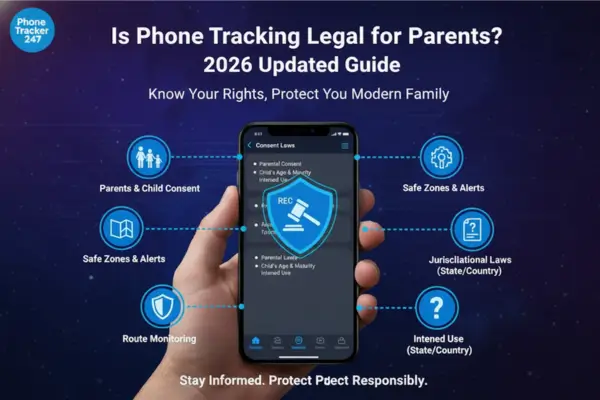
Navigating the complex question: Is phone tracking legal for parents? This 2026 guide provides essential clarity on consent, jurisdiction, and maintaining digital well-being while using parental monitoring apps.
Is Phone Tracking Legal for Parents? Understanding the Core Legal Principle
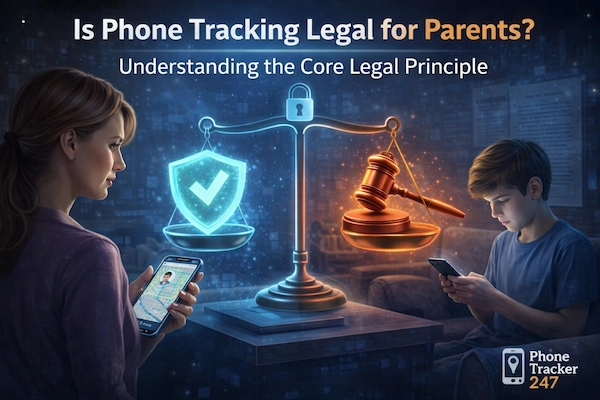
Is Phone Tracking Legal for Parents? Understanding the Core Legal Principle
The immediate answer to Is Phone Tracking Legal for Parents? is generally yes, provided the child is a minor and the device is owned or paid for by the parent. However, this seemingly simple answer is heavily nuanced by age, jurisdiction, and the critical issue of consent, particularly as of the 2026 regulatory updates. Parental authority typically includes the right to oversee and protect minor children, a principle that extends into the digital realm for purposes of cyber risk prevention and physical safety.1 This widely recognized legal latitude underpins the use of parental monitoring apps, yet parents must operate within the specific statutory boundaries of their location to ensure full compliance with regulations.
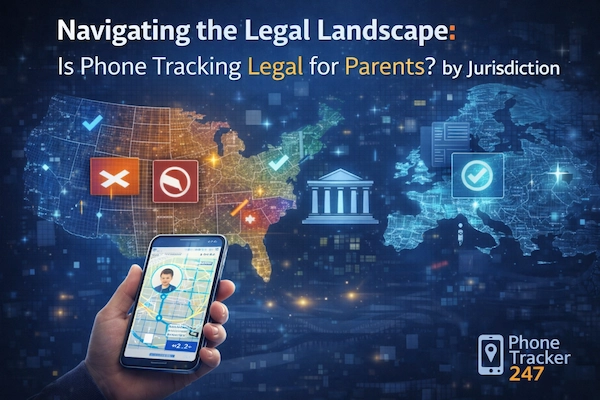
Navigating the Legal Landscape: Is Phone Tracking Legal for Parents?
Determining Is Phone Tracking Legal for Parents? requires a localized approach, as laws vary significantly between countries and even between states within the US.2 In most parts of the United States, parents are generally permitted to use location tracking accuracy tools on their minor children’s devices. This stems from the parental right to control, care for, and secure their child’s welfare. Conversely, in regions operating under stricter data protection regimes, such as the European Union’s GDPR, the situation demands closer scrutiny. The evolving concept of children’s online behavior and the move toward privacy-by-design standards across the globe are continuously tightening the legal framework surrounding all online safety tools.
US State Variations and the Age of Majority
While federal law (like COPPA) focuses primarily on how companies handle children’s data, state-level statutes dictate how tracking devices are used by individuals. Several US states have specific anti-stalking or electronic tracking laws.3 Crucially, many of these laws include explicit exceptions that allow a parent or guardian to track their minor child, which clarifies the position on Is Phone Tracking Legal for Parents?4 However, as children approach the age of majority (typically 18), their legal rights, including privacy rights, increase substantially, creating a complex gray area for parents monitoring older teens.5
Global Perspective: GDPR and Parental Authority
In the European Union, the legal answer to Is Phone Tracking Legal for Parents? is guided by the GDPR and national laws which often grant children increasing autonomy as they mature. While a parent’s right to protect a child remains paramount, the collection of precise geolocation data is considered highly sensitive.6 For parental monitoring apps to be compliant, the use must be proportionate to the risk, and the child’s right to privacy policy and consent must be considered, which makes open dialogue a legal necessity, not just an ethical recommendation.
The Critical Role of Consent and Transparency in Answering: Is Phone Tracking Legal for Parents?
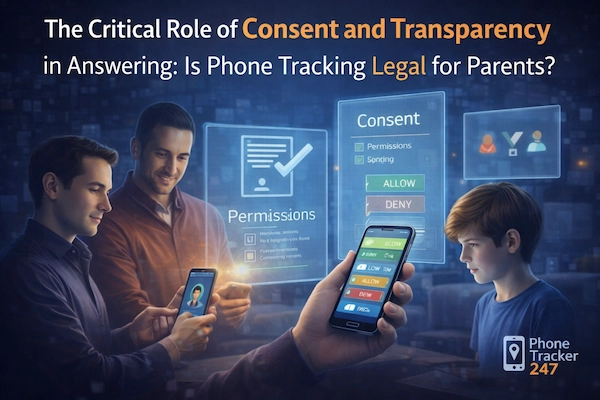
The Critical Role of Consent and Transparency in Answering: Is Phone Tracking Legal for Parents?
The crucial distinction between legal phone tracking and unlawful surveillance lies in transparency and consent. While parents technically hold the legal authority to monitor their minor children, the practice of secretly installing device monitoring software—often termed “stalkerware”—is ethically questionable and may even violate local wiretapping or computer misuse laws, especially if the software intercepts communications. An honest discussion is key to understanding the full scope of Is Phone Tracking Legal for Parents?
The Best Practice: Transparency over Secrecy
The most secure legal and ethical approach is for parents to be completely transparent about the use of online safety tools.7 The California Age-Appropriate Design Code (effective 2024/2025) and similar global legislation now require platforms to provide an “obvious signal” to the child when their activity or location is being tracked.8 This regulatory trend underscores the importance of discussing why the tracking is in place (for safety and cyber risk prevention) rather than if it is in place. When transparency is maintained, the answer to Is Phone Tracking Legal for Parents? becomes unequivocally positive, reinforcing trust as a core value in parenting in the digital age.
Table 1. Parental Phone Tracking Legal Risk Matrix (2026)
A practical, compliance-first matrix that helps parents compare common monitoring features by legal risk level, transparency requirements, and safer usage boundaries.
| Monitoring Use Case | Typical Legal Risk (General) | Lower-Risk When… | Risk Increases When… | EEAT / Compliance Note |
|---|---|---|---|---|
| GPS location tracking (school commute, late-night rides) | Low–Medium | The child is a minor, the parent owns/manages the device/plan, and tracking is clearly disclosed for safety use | Tracking is continuous, hidden, or not tied to a clear safety purpose | Frame tracking as a safety agreement, not punishment; define time windows (school commute, events, travel) |
| Geofencing alerts (home/school/activities) | Low–Medium | Geofencing is used for safety boundaries and parents explain what alerts mean | Too many zones or constant alerts create “surveillance by default” | Keep zones limited and relevant; review them regularly |
| SMS / DM monitoring | Medium–High | Used for clear safeguarding reasons (bullying, sextortion, threats) with transparency and limited scope | Parents monitor all conversations secretly or use it for non-safety control | Document the risk-based reason (e.g., self-harm warning signs, online predator concerns) |
| Call recording | High | Explicit consent is obtained where required and the use is narrowly justified | Recording is hidden or local wiretapping/eavesdropping rules are ignored | State/country laws vary significantly on recording consent—check local law before enabling |
| Ambient audio / microphone monitoring | High | Used only in exceptional, safety-critical situations and with strict legal review | It captures third-party conversations or is used as background surveillance | Treat as the highest-risk feature; disable by default unless legally cleared |
| Keystroke / keyboard capture | High | Limited to urgent safeguarding and clearly disclosed to the child (and co-parent if relevant) | It captures private credentials, unrelated personal content, or is installed secretly | Use only if proportionate to a documented risk; avoid blanket, long-term use |
| Hidden app install / “stalkerware-style” monitoring | Very High | (Best avoided) | The app is concealed, no notice is given, or communications are intercepted | Secret installs can cross into unlawful surveillance territory; choose visible, transparent tools |
| Tracking during co-parenting / custody time | High (conflict risk) | Both parents agree in writing (custody terms / parenting plan) | One parent tracks during the other parent’s custody time without agreement | Add a written custody clause covering location-sharing, logs, and access rules |
| Monitoring older teens (16–17) | Medium–High | The parent uses a consent-first approach and narrows monitoring to safety scenarios | Monitoring ignores the teen’s growing privacy/autonomy | Reassess settings as the teen matures; reduce scope over time |
| Monitoring after age 18 | High | The young adult gives informed consent | Parent assumes prior control still applies | Treat 18+ as an adult privacy case: get explicit consent or stop tracking |
Distinguishing Parental Rights from Surveillance: The Ethics of Device Monitoring
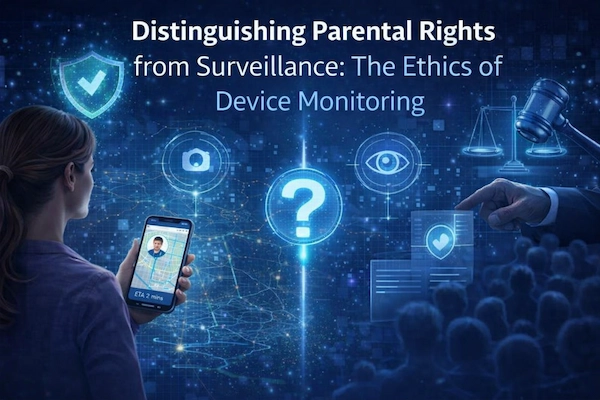
Distinguishing Parental Rights from Surveillance: The Ethics of Device Monitoring
The legal principle allowing device monitoring is rooted in the parent’s duty of care, but this power is not absolute. Legal experts and family courts increasingly emphasize that monitoring must be used to ensure the child’s safety and digital well-being, not to pry into non-risk-related social life or control the child excessively. A court might scrutinize the use of a monitoring app if it is deemed excessive or detrimental to the child’s development or privacy rights.9
Screen Time Management and Location Tracking Accuracy
Effective parental control often utilizes screen time management alongside location tracking accuracy. For example, a parent using a monitoring app to restrict screen time while a child is at school, or ensuring they are at the agreed-upon location, is a justifiable use of mobile security practices. This demonstrates that the technology is employed to mitigate known risks related to children’s online behavior or physical safety, fulfilling the parent’s legal and ethical duty to protect the child. This purposeful usage is essential in the context of Is Phone Tracking Legal for Parents?
Is Phone Tracking Legal for Parents? When Co-Parenting and Custody are Involved
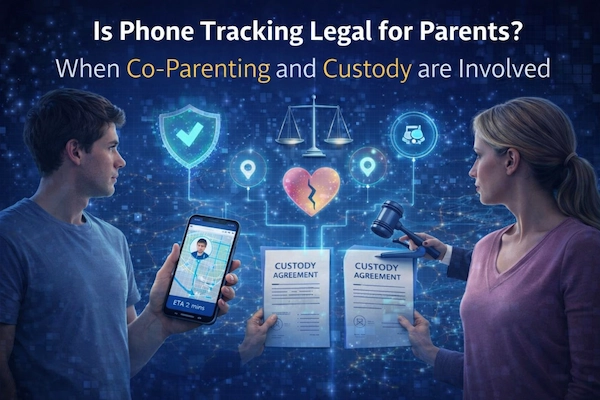
Is Phone Tracking Legal for Parents? When Co-Parenting and Custody are Involved
The legal landscape becomes exceptionally complex when divorced or separated parents are involved.10 While Is Phone Tracking Legal for Parents? is clear for the primary guardian, tracking the child while they are in the custody of the other parent without explicit agreement can lead to significant legal conflict.11 Courts view unauthorized tracking by one parent during the other’s visitation time as a serious breach of privacy and trust, sometimes even considering it harassment or an invasion of the other parent’s time.12
The Need for Joint Compliance with Regulations
Custody agreements should explicitly address the use of parental monitoring apps. If a parent wishes to use a service like PhoneTracker247.com, the details regarding the sharing of location tracking accuracy data and access to device monitoring logs should be negotiated and documented. Failure to do so can result in the exclusion of such data in court proceedings or even modifications to the custody arrangement itself. For robust, legally sound guidance on Is Phone Tracking Legal for Parents? in this context, all decisions must prioritize the child’s best interests and the joint compliance with regulations.
Compliance with Regulations and the Future of Parental Monitoring Apps
As new state and federal laws (like the Kids Online Safety Act and various state age-assurance laws) take effect in 2026 and beyond, the framework defining Is Phone Tracking Legal for Parents? continues to evolve. These new regulations are forcing app developers to implement stricter privacy-by-design standards, which ironically benefits parents by making high-quality, legally sound online safety tools more readily available.
Selecting Compliant Tools for Cyber Risk Prevention
Parents must choose parental monitoring apps from providers that demonstrate a strong commitment to their privacy policy and consent and full compliance with regulations. Apps that are transparent about the data they collect and how they secure it offer the most legally defensible position. By selecting certified, transparent services, parents ensure their efforts at cyber risk prevention remain within the bounds of the law, affirming a responsible approach to the question, Is Phone Tracking Legal for Parents?
Table 2. Consent-First Parent Monitoring Compliance Checklist (2026)
A step-by-step checklist parents can follow to use phone monitoring tools responsibly, transparently, and in a way that is easier to defend legally and ethically.
| Step | What Parents Should Do | Why It Matters (Legal + Ethical) | What to Keep as Evidence |
|---|---|---|---|
| 1. Confirm device ownership and account control | Use monitoring on a phone/plan the parent owns or manages (when possible) | Parent-managed devices are generally a stronger legal position than child-owned devices | Phone purchase receipt, carrier account ownership screenshot |
| 2. Explain the monitoring purpose clearly | Tell the child what is monitored and why (safety, travel, emergency response) | Transparency reduces legal/ethical risk and builds trust | Family digital safety agreement (1-page summary) |
| 3. Use a “safety-first” scope | Enable only the features needed (e.g., GPS + geofence first) | Data minimization is a core privacy principle and supports proportional use | Feature checklist with enabled/disabled settings |
| 4. Avoid hidden surveillance features by default | Do not use concealed installs, secret recording, or stealth settings | Hidden monitoring is the highest-risk behavior and can resemble stalkerware | Screenshot showing visible app/icon/child notice |
| 5. Check local recording laws before call/ambient features | Verify one-party vs all-party consent rules in your jurisdiction | Recording laws vary by state/country and can create major exposure | Short legal note, attorney email, or compliance memo |
| 6. Set time-based rules | Limit tracking to school commute, late-night outings, travel, or emergencies | Narrow time windows show proportionality and reduce over-monitoring | Schedule screenshot / written house rules |
| 7. Review and reduce monitoring as the child matures | Reassess at 13, 16, and 18; reduce intrusive features over time | Older teens have increasing autonomy and privacy expectations | Quarterly review notes / changed settings log |
| 8. Add co-parenting rules in writing (if applicable) | Agree on when tracking is allowed and who can see logs | Prevents custody disputes and misuse claims | Parenting plan / custody addendum |
| 9. Use a transparent, privacy-focused app | Choose tools that clearly explain data collection, retention, and access controls | Strong provider transparency improves legal defensibility | Privacy policy link + settings screenshots |
| 10. Create an escalation rule for serious risks | Define when parents may temporarily increase monitoring (e.g., missing child, self-harm risk, grooming) | Shows monitoring changes are risk-based, not arbitrary | Written escalation checklist and incident notes |
| 11. Keep retention short | Delete or stop storing logs that are no longer needed | Supports privacy-by-design and data-minimization expectations | Monthly deletion reminder / retention rule |
| 12. When unsure, get local legal advice | Ask a lawyer for state/country-specific rules | Laws differ widely; legal advice is the safest path for edge cases | Attorney consultation note (even brief) |
Real-World Scenarios and Best Practices for Mobile Security Practices
Responsible implementation is the cornerstone of legal and ethical mobile security practices.
Scenario: A parent wishes to use GPS tracking on their 16-year-old’s smartphone.
Best Practice: The parent should purchase the device, maintain the account, and initiate an open dialogue. The conversation should frame the use of parental monitoring apps not as punishment, but as a mutual safety agreement, acknowledging the teen’s increasing independence while managing the risks associated with parenting in the digital age. The tracking should be limited in scope and time, focusing on safety during travel or late-night outings. This mindful application of the technology firmly supports the legal interpretation of Is Phone Tracking Legal for Parents?
Frequently Asked Questions (FAQs)
1) Is it legal for parents to track a child’s phone in 2026?
Usually yes for minors, but it depends on local laws + device ownership + consent.
2) Does owning the phone/plan make tracking more legal?
Yes—parent-owned/managed devices are typically safer legally than child-owned ones.
3) Can I track a 16–17 year old?
Often yes, but get clear consent and keep it transparent.
4) Is GPS tracking different from reading texts/DMs?
Yes—location is often lower-risk than message/social monitoring.
5) Are hidden tracking apps legal for parents?
Risky. Secret install can violate privacy or surveillance laws—avoid “stalkerware.”
6) Is recording calls/ambient audio allowed?
High-risk area. Recording may break wiretapping/eavesdropping rules.
7) What about divorced/co-parenting situations?
Be careful—tracking can cause legal issues without a written agreement/custody terms.
8) Do laws differ by country/state?
Yes—rules vary widely. Don’t assume one place’s law applies everywhere.
9) What’s the safest compliance approach?
Use consent-first, limit features to safety needs, and minimize data.
10) What should I do if I’m unsure?
Check local rules or ask a lawyer; choose transparent, privacy-focused tools only.
Conclusion: Is Phone Tracking Legal for Parents?
The definitive answer to Is Phone Tracking Legal for Parents? in the 2026 digital landscape is: Yes, absolutely, when used transparently and responsibly on a minor’s device. The legal right is anchored in the parent’s duty to protect their child and perform due diligence in parenting in the digital age.
As compliance with regulations tightens around the globe, especially concerning children’s online behavior and privacy policy and consent, the emphasis shifts from if parents can track to how they track. The best mobile security practices require that parental monitoring apps be used openly, with the focus remaining squarely on safety, digital well-being, and cyber risk prevention. The future of parental oversight is not about secret surveillance, but about transparent, powerful online safety tools that empower both parent and child.
Quick Summary — Is Phone Tracking Legal for Parents in 2026?
This quick summary table gives parents a clear, compliance-first framework for using phone tracking legally and responsibly—focused on safety, transparency, and proportionate monitoring.
| Priority Area | What Parents Should Do | Why It Matters | PhoneTracker247 Role |
|---|---|---|---|
| 1. Start with the Core Rule | Track only for child safety on a minor’s device (ideally parent-owned/managed) | This is the strongest legal/ethical foundation for parental monitoring | Supports parent-managed monitoring workflows for family safety |
| 2. Use Transparency First | Tell your child what is monitored and why | The article makes clear that transparency is the line between safety use and risky surveillance | Helps families use monitoring as a safety agreement, not a secret tool |
| 3. Keep Monitoring Proportionate | Begin with lower-risk tools (GPS, geofencing) before more intrusive features | Legal and ethical risk increases when monitoring expands into messages/audio without clear need | Lets parents build a layered setup based on actual risk |
| 4. Avoid Hidden / Stalkerware-Style Use | Do not secretly install tracking or intercept communications | Hidden monitoring creates the highest legal and trust risk | Encourages a visible, consent-aware monitoring approach |
| 5. Handle Co-Parenting Carefully | Use written custody/parenting agreements for tracking rules | Co-parenting disputes are a major legal risk area in the article | Keeps location/log access aligned with agreed family rules |
| 6. Review and Reduce Over Time | Reassess settings as the child gets older (especially older teens) | Good monitoring should adapt to maturity and privacy needs | Makes it easier to scale monitoring up/down responsibly |
Use Phone Tracking the Right Way: Legal, Transparent, and Safety-First
The real question in 2026 is no longer just whether parents can track a child’s phone—it’s how to do it responsibly. PhoneTracker247 helps families monitor location and device activity with a safety-first approach built around visibility, transparency, and practical parental control.
Start using PhoneTracker247 today to protect your child with a monitoring system designed for modern parenting—clear, compliant, and focused on digital well-being.
For daily updates, subscribe to PhoneTracker’s blog!
We may also be found on Facebook!