
In a world where digital privacy is constantly under threat, learning how to detect a keystroke logger on your device is more critical than ever. From parents safeguarding their children to professionals protecting confidential data, understanding the signs and tools for detection helps you stay secure.
Contents
- 1 What Is a Keystroke Logger?
- 2 Common Signs of a Keystroke Logger on Your Device
- 3 How to Detect a Keystroke Logger on Windows or Mac
- 4 How to Detect a Keystroke Logger on Android or iPhone
- 5 How to Detect Hardware Keystroke Loggers
- 6 Tools That Help Detect Keystroke Loggers
- 7 What to Do If You Find a Keystroke Logger
- 8 How to Prevent Keystroke Loggers in the Future
- 9 Is Detecting a Keystroke Logger Legal?
- 10 FAQs About Detecting Keystroke Loggers
- 11 Conclusion
What Is a Keystroke Logger?
A keystroke logger, often called a keylogger, is a type of surveillance software or hardware that records every key you press on your keyboard. These tools can be used for legitimate monitoring, like corporate security or parental control, but they’re also employed by cybercriminals to steal passwords, financial data, and personal messages.
Types of Keystroke Loggers
- Software keyloggers run in the background of a device and log keystrokes into a file or send them remotely. They are often installed via malware or unauthorized access.
- Hardware keyloggers are physical devices attached between a keyboard and a computer or embedded in USB connectors; they are harder to detect with software tools.
- Mobile keyloggers can exist on Android or iOS devices, usually requiring either root/jailbreak or misuse of accessibility features.
Software keyloggers or keystroke recorder are more common on desktops, while hardware variants can bypass many digital protections. Mobile keyloggers exploit operating system permissions to capture typing activity.
Why Keystroke Loggers Are Dangerous
- They capture passwords, PINs, and credit card numbers, which can lead to identity theft.
- They often operate silently and secretly, making them a stealthy threat.
- Many come bundled with other malware like remote access trojans (RATs), increasing compromise risk.
Keyloggers may be used “legitimately,” but without clear consent, they pose serious privacy and legal issues.

Common Signs of a Keystroke Logger on Your Device
If you’re asking how to detect a keystroke logger, start by observing your device’s behavior for unusual signs. Not all keyloggers trigger obvious symptoms, but most will leave detectable clues.
Performance and System Warning Signs
- Slow system performance, frequent freezes, or crashes can signal unwanted software running in the background.
- Unexpected pop-ups, error messages, or programs launching themselves can be red flags.
- High CPU usage for no clear reason may suggest hidden monitoring activity.
Such symptoms don’t guarantee a keylogger but warrant further investigation—especially if they coincide with other anomalies.
Unusual Network or Battery Activity
- Unexpected spikes in data usage may indicate logged keystrokes being sent to a remote server.
- Rapid battery drain on mobile devices can signal background monitoring apps.
- Unknown processes accessing the network can appear in system monitors or firewall logs.
These behaviors help answer how to detect a keystroke logger by highlighting patterns inconsistent with normal use.
If you want the full context, here’s what an Android keylogger is and why some “hidden logger” apps are risky.
Table 1: Keystroke Logger Detection Checklist
| What to Check | What You Might Notice | How to Verify (Quick Action) | What It Often Means |
|---|---|---|---|
| Sudden battery drain | Battery drops faster than usual even on standby | Compare “Battery usage” by app (Android/iOS) for unknown apps | Background monitoring or data sending |
| Unusual device heat | Phone feels warm when not in use | Check for heavy background activity + restart & see if heat returns | Stealth process running |
| Data usage spikes | Mobile/Wi-Fi data increases unexpectedly | View data usage per app and look for unknown services | Logs being uploaded |
| Random pop-ups / overlays | Ads or permission screens appear | Check “Display over other apps” / Accessibility permissions | Aggressive apps or abuse of permissions |
| Keyboard behavior changes | Laggy typing, autocorrect weirdness | Test in Safe Mode (Android) or with a clean keyboard app | Keyboard-level interception risk |
| Unknown apps with odd names | Apps you don’t remember installing | Review installed apps + sort by install date | Potential spyware/keylogger |
| Accessibility settings altered | Accessibility enabled for unknown app | Audit Accessibility and turn off anything suspicious | High-risk permission often used for logging |
| Device admin / profiles | Can’t uninstall an app / restrictions appear | Check Device Admin Apps (Android) / Profiles & Device Management (iOS) | Elevated control, possible persistence |
| Microphone/camera indicators | Indicator appears unexpectedly | Review app permissions and recent access | Broader surveillance, not just logging |
| Accounts sign-in alerts | Emails/social logins from new locations | Check “Security” page of key accounts + revoke sessions | Credentials may be captured |
| Antivirus/Play Protect warnings | Security tool flags a threat | Run a reputable scan + check scan history | Known signature detected |
| Strange system permissions | SMS, Accessibility, Notification access granted | Review permissions & “Special app access” | Common path for spyware behavior |
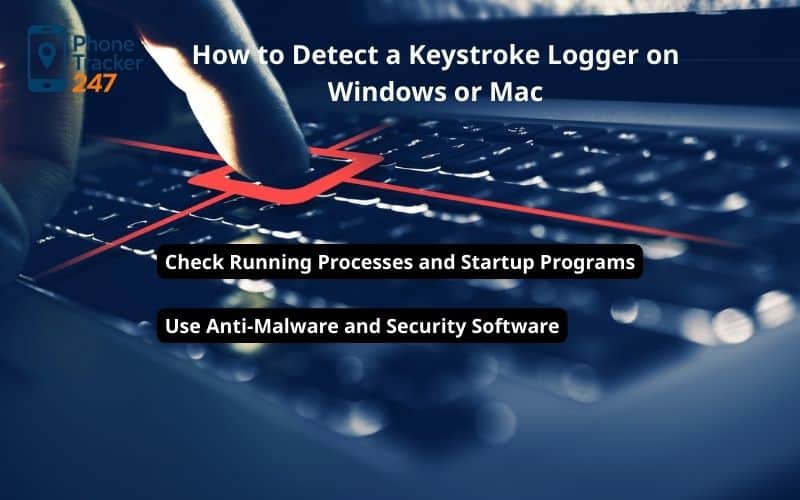
How to Detect a Keystroke Logger on Windows or Mac
Detecting keylogging software differs by operating system. Both Windows and macOS offer tools and methods that help you inspect running processes and system settings.
Check Running Processes and Startup Programs
- Open Task Manager (Windows) or Activity Monitor (Mac) to view running apps and processes.
- Look for unfamiliar or suspicious entries that do not correspond to installed software.
- Investigate processes with random names or those consuming significant resources.
Software keyloggers often disguise themselves, but careful inspection can reveal tell-tale signs you should investigate.
Reviewing startup programs helps you catch persistent keyloggers that launch each time your system powers up. Use tools like msconfig on Windows or Login Items on Mac to manage these entries.
Use Anti-Malware and Security Software
- Run a full system scan with reputable security software that detects keyloggers and spyware.
- Consider specialized anti-keylogger tools that focus on monitoring and stopping input recording software.
- Enable real-time protection if your antivirus supports heuristic detection.
Security suites help automate many aspects of how to detect a keystroke logger, catching threats that manual checks might miss.
How to Detect a Keystroke Logger on Android or iPhone
Mobile operating systems have different security models, but keyloggers can still exist—especially if a device is rooted, jailbroken, or permissions are misused.
Signs of a Keylogger on Mobile Devices
- Unexplained battery drain or overheating can indicate background data capture.
- Random app crashes or slow responsiveness are often symptoms of hidden processes.
- Increased data usage without obvious reasons may signal logging activities.
These symptoms, especially when occurring together, help you start the process of how to detect a keystroke logger on mobile.
Be aware that modern mobile security makes unnoticed installation difficult, but unauthorized apps and permission abuse can still enable keylogging.
App Permission and Accessibility Checks
- Review installed apps and their granted permissions.
- Pay special attention to apps with keyboard access or Accessibility privileges.
- Remove anything unfamiliar or unnecessary, especially if it can record input.
Keyloggers on iPhone often request more permissions than they need, so auditing these can reveal suspicious behavior.
How to Detect Hardware Keystroke Loggers
Software scans don’t help with hardware keyloggers, so you must physically inspect connections and devices.
Inspect USB and Keyboard Connections
- Examine the connection between your keyboard and computer for any intermediary devices.
- Look for unusual USB adapters, dongles, or devices plugged in without your knowledge.
Hardware keyloggers can be tiny, but careful visual inspection usually detects them.
Use On-Screen Keyboards for Testing
- Use the on-screen keyboard to enter sensitive information like passwords.
- If login attempts succeed when using the on-screen keyboard but fail with the physical keyboard, it could indicate monitoring.
This simple test helps determine whether keystrokes from physical hardware are being intercepted.

Tools That Help Detect Keystroke Loggers
Using purpose-built tools increases your chances of identifying covert monitoring software.
Anti-Keylogger and Endpoint Security Tools
- Dedicated anti-keylogger applications detect suspicious modules designed to capture input.
- Comprehensive endpoint security suites combine behavior analysis with traditional scanning.
- Some tools offer alerts when input interception APIs are accessed.
These professional tools support how to detect a keystroke logger by automating detection tasks.
Endpoint security systems are especially valuable in corporate or business environments where threats are persistent.
Network Monitoring and Firewall Alerts
- Set up firewall alerts for unknown outbound connections.
- Monitor network traffic for suspicious IP connections which could be receiving logged data.
- Tools like network intrusion detection systems (NIDS) can help identify covert communications.
Network-based monitoring highlights back-end communications from keylogging software.

What to Do If You Find a Keystroke Logger
Finding a keylogger is only the first step. Acting quickly minimizes damage and restores security.
Remove the Keylogger Safely
- Boot your device into safe mode to prevent the keylogger from running.
- Use up-to-date security software to remove or quarantine detected threats.
- On mobile devices, uninstall suspicious apps and revoke dangerous permissions.
Proper removal ensures the keylogger doesn’t persist or reinstall itself.
Secure Your Accounts After Detection
- Change all passwords from a secure device.
- Enable two-factor authentication (2FA) where available.
- Review financial accounts for unauthorized activity.
Securing accounts is essential after answering how to detect a keystroke logger, especially if sensitive information was compromised.
How to Prevent Keystroke Loggers in the Future
Prevention is far easier than detection. Strong digital hygiene and cautious behavior reduce the risk of keylogger infections.
Security Best Practices
- Keep your operating system and apps updated to close vulnerabilities.
- Install apps only from trusted sources like official app stores.
- Avoid public USB charging stations or unknown drives.
These habits strengthen your defenses and make it harder for keyloggers to install.
Use Legitimate Monitoring and Security Solutions
- For parental monitoring or work device oversight, choose reputable tracking apps with clear privacy policies.
- Ensure users are informed and give consent where required.
Choosing legitimate tools avoids legal issues and reduces the need for reactive detection strategies.
Table 2: Where Keyloggers Hide
| Platform / Scenario | Common “Hiding Places” | High-Signal Clues | Recommended Next Steps (Safest Order) |
|---|---|---|---|
| Android (non-root) | Malicious keyboard apps, Accessibility abuse, Notification access | Unknown keyboard, Accessibility enabled for unfamiliar app, “Display over other apps” | 1) Turn off suspicious Accessibility/overlay 2) Boot Safe Mode 3) Uninstall suspicious apps 4) Run security scan |
| Android (rooted / custom ROM) | Root-level spyware, system app injection | Apps reappear after uninstall, system partitions modified | 1) Backup essentials 2) Check root manager logs 3) Reflash trusted ROM/firmware 4) Change passwords from clean device |
| iPhone/iPad (no jailbreak) | Configuration profiles, MDM, malicious apps with permissions | “Profiles & Device Management” entries you don’t recognize | 1) Remove unknown profiles/MDM 2) Update iOS 3) Review permissions 4) Reset settings if needed |
| iPhone/iPad (jailbroken) | Tweaks capturing keystrokes, injected libraries | Cydia/Sileo packages you didn’t install, instability | 1) Remove suspicious tweaks 2) Update/restore iOS via Finder/iTunes 3) Change credentials afterward |
| Windows PC / Laptop | Browser extensions, startup tasks, suspicious services | New extensions, unknown startup items, unusual outbound traffic | 1) Disconnect from internet 2) Full AV scan + second opinion scanner 3) Review startup/services 4) Reinstall OS if persistent |
| macOS | Login items, launch agents/daemons, shady profiles | New login items, LaunchAgents entries, unexpected profiles | 1) Remove unknown profiles 2) Review Login Items 3) Scan 4) Reinstall if you can’t fully remove |
| Browser-based “keylogger” | Rogue extensions, injected scripts on fake sites | Extension asks for broad permissions, popups on legit sites | 1) Remove unknown extensions 2) Reset browser 3) Clear sessions 4) Enable MFA |
| Workplace/School managed device | Legitimate monitoring tools (policy-based) | MDM installed by organization, policy banners | 1) Read policy 2) Ask IT 3) Don’t attempt bypass 4) Use personal device for private accounts |
| Shared/borrowed device | Installed tracking apps, saved keyboard/input tools | New admin users, unknown apps, settings changed | 1) Remove unknown users/apps 2) Factory reset if uncertain 3) Re-secure accounts |
| “Physical access” risk | Hardware keyloggers (PC), installed spyware (phones) | Tampered cables/ports (PC), unknown apps after someone had device | 1) Inspect hardware (PC) 2) Change passwords 3) Reset/reinstall if needed |
| Cloud account compromise | Not a keylogger—account is hacked | MFA prompts, session logins, recovery email changed | 1) Secure accounts first 2) Revoke sessions 3) Rotate passwords 4) Check for forwarding rules |

Is Detecting a Keystroke Logger Legal?
Understanding the legal landscape around detection and monitoring is crucial for ethical compliance.
Legal and Ethical Considerations
- Laws vary by country and region, especially concerning consent.
- Employers might have the right to monitor company devices but typically must disclose this to employees.
- Using keyloggers on devices you don’t own or without clear permission is illegal in many jurisdictions.
Before deploying monitoring or detection tools, understand relevant local regulations.

FAQs About Detecting Keystroke Loggers
Q: Can Antivirus Always Detect Keyloggers?
A: No. Traditional antivirus tools may miss sophisticated or newly developed keyloggers, which is why combining manual checks and specialized tools is essential.
However, modern security suites increasingly include behavior-based detection to catch stealthy threats.
Q: Can Keyloggers Hide From Detection?
A: Yes. Advanced keyloggers use obfuscation and rootkit-like techniques to evade detection. This makes regular system checks and network monitoring critical.
Learning how to detect a keystroke logger involves both software tools and observational vigilance.
Q: Can a Factory Reset Remove a Keylogger?
A: A full factory reset generally removes software keyloggers but won’t affect hardware keyloggers. Always back up important data securely before resetting your device.
Conclusion
Understanding how to detect a keystroke logger empowers you to take control of your digital security. By recognizing warning signs, using the right tools, and applying preventive measures, you can protect your personal and professional data from unauthorized monitoring. Whether you’re a parent, business owner, or individual user, proactive vigilance is your best defense in 2026 and beyond.
Quick Summary Table: What to Do If You Suspect a Keylogger
| Priority | Action | Why It Matters | Time Needed |
|---|---|---|---|
| 1 | Disconnect from Wi-Fi/mobile data | Stops data exfiltration while you investigate | 30 seconds |
| 2 | Check special access (Accessibility / Device Admin / Profiles) | These permissions are commonly abused for logging | 2–5 minutes |
| 3 | Remove unknown apps/extensions (especially new ones) | Eliminates the most common infection source | 5–15 minutes |
| 4 | Run a reputable security scan | Catches known threats and risky behavior patterns | 10–20 minutes |
| 5 | Update OS + apps | Patches vulnerabilities used by spyware families | 10–30 minutes |
| 6 | Change passwords from a clean device + enable MFA | Blocks account takeover even if typing was captured | 10–25 minutes |
| 7 | If symptoms persist: backup essentials and reset/restore | Most reliable way to remove persistent threats | 30–90 minutes |
If you manage family devices, a shared phone, or a work device you’re responsible for, the safest advantage you can have is visibility, knowing what’s happening before it becomes a crisis.
Use PhoneTracker247 to help you monitor device health and activity only on devices you own or have explicit permission to manage. When you have clear oversight, it’s easier to spot suspicious behavior early, reduce risky installs, and keep the people you care about protected.
Instead of invasive logging, use privacy-first monitoring features like location sharing, alerts, and activity signals with transparency.