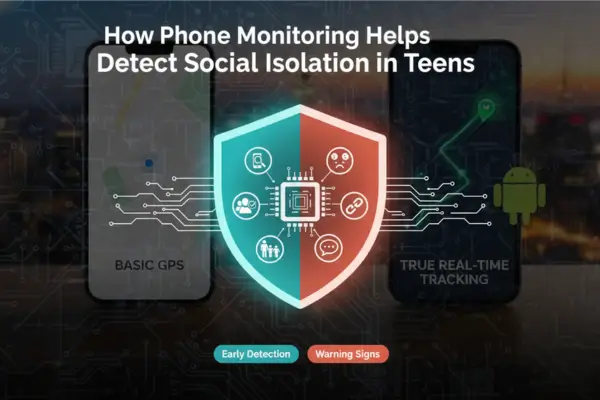
Discover How Phone Monitoring Helps Detect Social Isolation in Teens by analyzing digital footprints. Use Device monitoring to protect your child’s Digital well-being.
Contents
- 1 The Silent Crisis: Identifying Withdrawal in a Digital World
- 2 How Phone Monitoring Helps Detect Social Isolation in Teens via Screen Time
- 3 How Phone Monitoring Helps Detect Social Isolation in Teens Through Silence
- 4 How Phone Monitoring Helps Detect Social Isolation in Teens Using Location Data
- 5 How Phone Monitoring Helps Detect Social Isolation in Teens via Search Trends
- 6 Balancing Privacy, Consent, and Safety
- 7 Frequently Asked Questions (FAQs)
- 8 Conclusion: From Detection to Connection
The Silent Crisis: Identifying Withdrawal in a Digital World
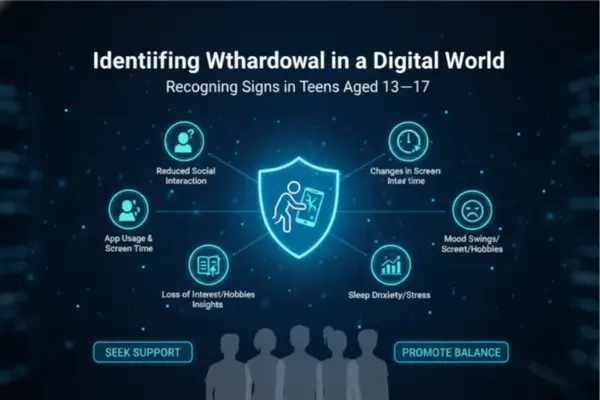
The Silent Crisis: Identifying Withdrawal in a Digital World
In the landscape of parenting in the digital age, social isolation is rarely as visible as a child sitting alone in a cafeteria. Today, isolation hides behind a glowing screen. A teenager can be physically present in the living room, device in hand, yet completely cut off from meaningful human connection. This phenomenon creates a unique challenge for guardians: distinguishing between a tech-savvy introvert and a child in crisis. Understanding How Phone Monitoring Helps Detect Social Isolation in Teens is the key to bridging this gap. It involves looking past the mere presence of the phone to analyze the nature of the interaction—or the lack thereof.
Social isolation is a precursor to severe mental health issues, including depression and anxiety.1 However, teens often mask their pain with excessive digital consumption. Without visibility into their digital life, parents are often blind to the reality until it is too late. By utilizing advanced device monitoring and online safety tools, parents can identify the subtle digital markers—such as shifts from active chatting to passive watching—that signal a child is retreating from the world. This data-driven approach transforms parental intuition into actionable insight.
Table 1: Social Isolation Early-Warning Signals
| Signal type | What the monitoring data may show | Why it matters | Low-intrusion “support” action (parent next step) | When to escalate |
|---|---|---|---|---|
| Screen time shift | Sudden move from messaging/interactive apps → long sessions on passive feeds/streaming (“doom scrolling”) | Can indicate withdrawal and coping via numbing content | Ask about stress first; suggest a small offline plan (walk, snack, short hangout) + set gentle nighttime boundaries | If late-night binge patterns persist + mood drops over 1–2 weeks |
| Communication drop-offs | Outgoing texts/calls drop sharply; “silence” compared to their usual baseline | A reliable indicator of social pullback | Start a feelings-based talk: “You’ve seemed quieter lately—how are you really doing?” | If they stop replying to close friends or isolate from all peers |
| “Digital ghosting” pattern | Many unread/repeated notifications from close friends; messages read but ignored | Can signal low emotional energy, conflict, anxiety, or depression | Offer help rebuilding connection (invite a friend over; plan 1 easy social touchpoint) | If paired with bullying signs or sudden friendship rupture |
| Location contraction | Routine becomes “School → Home” only; stops going to clubs, practices, friends’ houses | Physical withdrawal mirrors social withdrawal | Ask about what changed (coach? friend group? confidence?); offer a “tiny restart” (one practice, one meetup) | If they avoid all “third places” for multiple weeks |
| Geofence anomalies | Doesn’t go where they said they’d go; stays home or goes to secluded spots when “meeting friends” | Objective check-in for safety (not spying) | Calm check-in: “I’m worried—are you safe? Want me to pick you up?” | If they repeatedly disappear/lie or show signs of risk behavior |
| Search & help-seeking keywords | Searches like “why does everyone hate me,” “loneliness,” “symptoms of depression,” etc. | Can reveal internal distress earlier than conversations | Offer support options: school counselor, therapy, trusted adult, family time | If searches indicate self-harm, predators, extremist communities, ED content |
How Phone Monitoring Helps Detect Social Isolation in Teens via Screen Time
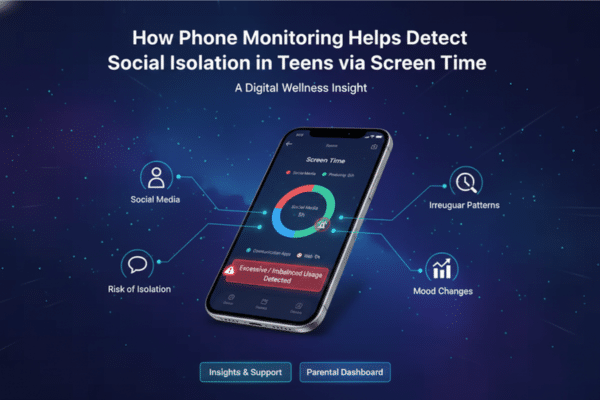
Usage Patterns: How Phone Monitoring Helps Detect Social Isolation in Teens via Screen Time
One of the primary ways How Phone Monitoring Helps Detect Social Isolation in Teens is by revealing the granular breakdown of screen time usage. Total hours spent on a device are less important than where those hours are spent. Monitoring software provides the necessary data to distinguish between healthy socialization and isolating escapism. If a teen spends four hours on multiplayer games chatting with friends, they are socializing. If they spend four hours silently scrolling TikTok without interacting, they are isolating.
Differentiating Active Engagement from Passive Consumption
Effective device monitoring categorizes app usage. A healthy digital diet includes “Active Engagement”—messaging apps (WhatsApp, Messenger) or interactive gaming (Roblox, Discord). Isolation is characterized by a massive spike in “Passive Consumption”—streaming services (Netflix, YouTube) or algorithmic social feeds (Instagram Reels) where the user is an observer, not a participant.
When screen time management reports show a sudden migration from communication apps to solitary entertainment apps, it serves as a red flag. This shift often correlates with a withdrawal from real-world stressors, indicating that the teen is using the device as a bunker rather than a bridge.
The Warning Signs of “Doom Scrolling”
“Doom scrolling”—the act of compulsively consuming negative or numbing content—is a common behavior among isolated teens. Advanced parental monitoring apps can track the duration of sessions.2 A teen who is socially connected typically has fragmented usage (checking messages, replying, putting the phone down). A teen who is socially isolated often displays “binge” patterns: locking the phone screen on a single feed for hours at a time, often late at night. Recognizing this pattern is critical for maintaining digital well-being.
How Phone Monitoring Helps Detect Social Isolation in Teens Through Silence
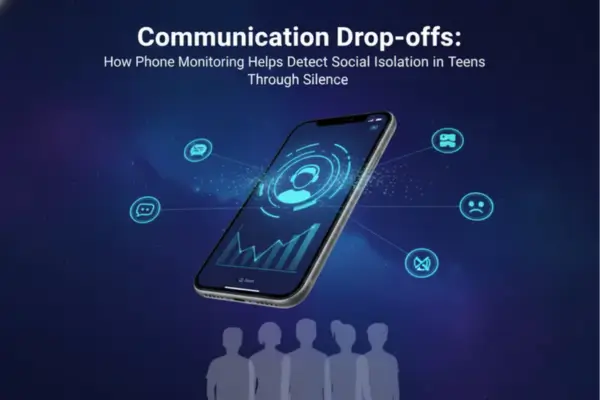
Communication Drop-offs: How Phone Monitoring Helps Detect Social Isolation in Teens Through Silence
Silence is data. How Phone Monitoring Helps Detect Social Isolation in Teens is most effectively demonstrated when analyzing communication logs. A sudden, unexplained drop in outgoing messages or calls is one of the most reliable indicators of a mental health decline. While a parent might not see who their child sits with at lunch, online safety tools provide an objective record of who they are—or aren’t—talking to after school.
Analyzing Text and Call Frequency with Parental Monitoring Apps
Adolescence is typically a period of hyper-communication. If a teen’s log shows a consistent average of 50 outgoing texts a day, and that number suddenly plummets to near zero over a week, something is wrong. Device monitoring software visualizes these trends.
This drop-off suggests the teen is withdrawing from their established support network. They may be ignoring reach-outs from friends or have been ostracized from a group (cyberbullying). By identifying this silence early, parents can initiate a conversation before the isolation becomes entrenched.
Recognizing “Digital Ghosting” of Peer Groups
Is your teen “ghosting” their friends? Monitoring tools allow you to see if incoming messages are being read but ignored. A backlog of unread notifications from close friends is a digital cry for help. It indicates a lack of emotional energy to maintain relationships. This insight allows parents to focus on cyber risk prevention by addressing the root cause—whether it be depression, anxiety, or an online conflict—rather than simply punishing the behavior
How Phone Monitoring Helps Detect Social Isolation in Teens Using Location Data
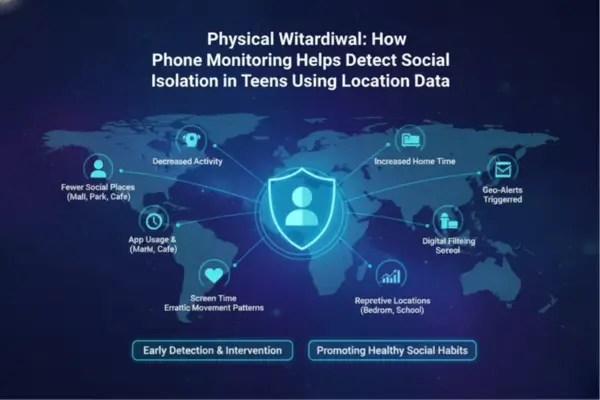
Physical Withdrawal: How Phone Monitoring Helps Detect Social Isolation in Teens Using Location Data
Isolation is not just digital; it is physical. How Phone Monitoring Helps Detect Social Isolation in Teens extends to the physical world through location tracking accuracy. GPS data provides an undeniable map of a teen’s social footprint. A healthy teen typically has a routine that involves third places: schools, parks, friends’ houses, or sports practice. A contracting world map is a symptom of a contracting social life.
Location Tracking Accuracy as a Behavioral Indicator
When a teen is isolating, their GPS history becomes monotonous. The data will show a pattern of “School -> Home” with zero deviation. If location tracking accuracy shows that they have stopped visiting their best friend’s house or have quit their extracurricular activities (indicated by a lack of presence at the sports field), this is objective evidence of withdrawal.
This data is crucial because teens often lie to cover up their isolation (“I’m just tired,” or “practice was canceled”). The monitoring app provides the truth, allowing parents to confront the issue with facts rather than suspicion.
Geofencing the Safe Zones of Social Interaction
Parents can set Geofences around key social hubs.3 If a teen is supposed to be at a social gathering but the mobile security practices on their phone indicate they never left the house—or went to a secluded area like a park alone—the system triggers an alert. This immediate notification allows parents to check in instantly, preventing the teen from sinking deeper into solitude.
How Phone Monitoring Helps Detect Social Isolation in Teens via Search Trends
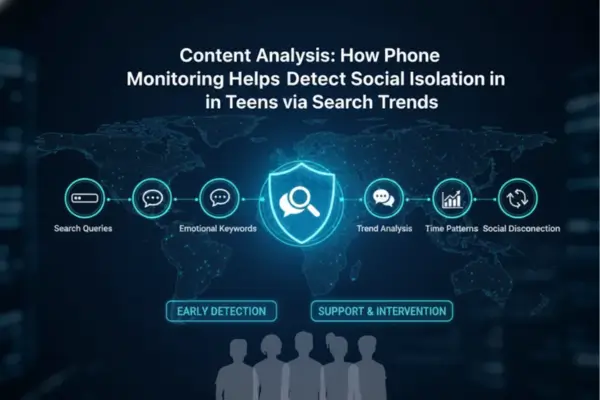
Content Analysis: How Phone Monitoring Helps Detect Social Isolation in Teens via Search Trends
The most direct insight into a teen’s mind often comes from what they type into a search bar. How Phone Monitoring Helps Detect Social Isolation in Teens includes the capability to monitor search queries and typed text. Teens who feel isolated often turn to Google or AI chatbots for the support they aren’t getting from humans.4
Keystroke Tracking for Emotional Distress Signals
Keystroke tracking features in high-end monitoring software can flag specific keywords.5 Phrases like “how to make friends,” “why does everyone hate me,” “symptoms of depression,” or “loneliness” are explicit indicators of social distress.
Detecting these search terms allows for cyber risk prevention in its purest form. It reveals the internal narrative of the child. Instead of waiting for a breakdown, a parent who sees these searches can proactively suggest therapy, family time, or structured social activities, addressing the digital well-being of the child directly.
Cyber Risk Prevention and Early Intervention
Isolation makes teens vulnerable. A lonely teen is a prime target for online predators or extremist radicalization. Monitoring content helps identify if their isolation is leading them toward dangerous online communities (e.g., “incel” forums or pro-anorexia groups) that prey on the lonely. By catching these interactions early, parents can sever the connection to toxic communities and redirect the teen toward healthy support systems.
Table 2: Ethical Monitoring Plan
| What you monitor | Best practice (minimum needed) | What you don’t monitor | Consent + wording that builds trust | Review cadence | Data hygiene |
|---|---|---|---|---|---|
| Screen time categories | App category totals + session length trends (active vs passive) | Content of what they watch/read | “I’m not judging content—only patterns that show you might be struggling.” | Weekly 5 minutes | Keep only short history; focus on trends not “gotcha” moments |
| Communication frequency | Counts of calls/texts (trendlines) | Full message bodies by default | “I’m watching for silence, not your private conversations.” | Weekly or biweekly | Avoid storing message content unless legally/ethically required |
| Location for safety | Arrivals/departures + limited “safe zone” geofences | 24/7 live map tracking for reassurance | “Location is a safety net—used for check-ins, not controlling you.” | Only alerts + exceptions | Retain minimal location history; don’t build detailed timelines |
| Search trends (risk signals) | Flag high-risk searches as prompts for support | “Reading their mind” or shaming them | “If I see you searching for help, I’ll offer help—not punish you.” | As-needed | Treat as sensitive mental-health data; secure access + limit sharing |
| Escalation rules | Step up monitoring only with specific risk (bullying, threats, disappearing) | Secret expansion without notice | “If safety risk rises, we’ll adjust settings together.” | Time-limited | Document decisions; de-escalate when stable |
Balancing Privacy, Consent, and Safety
Implementing these strategies requires a delicate ethical balance. The goal of understanding How Phone Monitoring Helps Detect Social Isolation in Teens is support, not surveillance.
Establishing Privacy Policy and Consent
Transparency is vital for parenting in the digital age. Parents should discuss privacy policy and consent with their teens. Explain that the monitoring is a safety net for their mental health, not a tool to police their gossip. “I am not reading your texts to spy; I look for patterns that show you might be hurting.” This framing builds trust.
Compliance with Regulations and Data Security
When selecting software, ensure compliance with regulations (like COPPA) and robust mobile security practices. You are collecting sensitive mental health data; it must be encrypted and secure.
The healthiest monitoring setups use alerts to reduce anxiety—for parents and teens—instead of encouraging 24/7 checking. Think “arrivals and emergencies,” not “every move.” Explore a family safety app with alerts, not constant checking
Frequently Asked Questions (FAQs)
1) Can phone monitoring really detect social isolation?
It can spot pattern changes (less communication, more late-night scrolling), which are early clues—not a diagnosis.
2) What are the first signs I should watch for?
A sudden drop in calls/texts, shrinking routines (home–school only), and long passive screen-time sessions.
3) Should I read my teen’s messages to know what’s going on?
Usually no. Start with time/app trends and have a conversation first.
4) Is 24/7 location tracking necessary?
No. Use geofence alerts (arrive/leave school/home) instead of constant tracking.
5) What if my teen says monitoring is “spying”?
Agree on boundaries: what you track, what you don’t, and why—then keep it consistent.
6) How often should I review the data?
Keep it light: 5 minutes once a week, plus alerts only for safety issues.
7) What’s the biggest mistake parents make?
Using the app to punish or “catch” them. That usually increases secrecy and stress.
8) When should I get professional help?
If withdrawal lasts 2+ weeks, mood drops, school/functioning declines, or you see self-harm or crisis
Conclusion: From Detection to Connection
The digital world can be a lonely place, despite the illusion of hyper-connectivity. By understanding How Phone Monitoring Helps Detect Social Isolation in Teens, parents acquire a powerful diagnostic tool. It allows them to look beneath the surface of the screen and see the emotional reality of their child’s life.
From analyzing shifts in screen time management to identifying communication drop-offs and utilizing location tracking accuracy, these online safety tools provide the objective data needed to identify a crisis in the making. However, detection is only the first step. The ultimate goal of device monitoring is to facilitate reconnection—to help the teen lift their eyes from the screen and re-engage with the world around them. With ethical implementation and a focus on cyber risk prevention, technology becomes the very thing that saves our children from being lost within it.
Before you monitor any teen’s phone, it’s smart to understand the legal and ethical foundation—especially around consent, disclosure, and device ownership. This protects your teen’s trust and protects you. Review parental monitoring laws and consent basics
For daily updates, subscribe to PhoneTracker’s blog!
We may also be found on Facebook!