If you are trying to protect a child, recover a lost device, or manage a company phone, the big question is always the same: Is It Legal To Track A Phone Location. The short truth is that legality rarely depends on one factor. It usually comes down to consent, authorized access, a legitimate purpose, and whether the tracking is transparent and limited to what is truly necessary.
2026 Update: What Changed and Why It Matters
In 2026, the safest rule is not “track or don’t track,” it’s “track only when you can explain it clearly.” If you are asking Is It Legal To Track A Phone Location, start by thinking like a neutral third party: what permission was given, what access is truly authorized, and what problem you are solving right now, not what you fear might happen later. Most legal trouble comes from vague assumptions, tracking that never turns off, or using location as leverage in a conflict.
1. What Changed in 2026
- Expectations are sharper: “they know” does not equal “they agreed.”
- Hidden tracking creates the fastest escalation, both legally and socially.
- The new baseline is narrow scope: a clear reason, a clear time window, and minimal history.
2. Key Takeaways
- Consent plus authorized access is the strongest foundation.
- Paying the bill or owning the device does not automatically justify monitoring another person’s movements.
- Transparent setup, limited collection, and short retention reduce risk and reduce conflict.
3. The 60-Second Answer
Tracking a phone location is typically lawful when you have explicit consent or clear legal authority, you are authorized to access the device or account, and the purpose is legitimate, such as safety, recovery, or a defined business need. It becomes high-risk when it is covert, unauthorized, or used to pressure or control someone. Laws vary by country and state, so if you are unsure, choose consent-first tools, keep the window short, and avoid building a long timeline. This is the simplest way to answer Is It Legal To Track A Phone Location without guessing.
4. Quick Decision Tree
- Do you own the device or the account you are accessing?
- Do you have explicit consent or lawful authority?
- Is tracking visible and easy to pause or stop?
- Is the purpose safety or business necessity, not control?
- Are you collecting only what you need, not continuous history by default?
- Could you explain the setup calmly to the person involved and a third party?
If any answer feels shaky, treat it as a signal to step back and tighten consent, scope, and transparency before you continue asking Is It Legal To Track A Phone Location.

What “Phone Location Tracking” Means
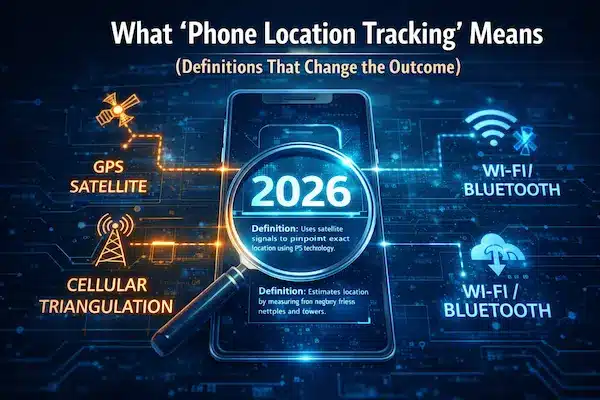
Before you decide Is It Legal To Track A Phone Location, get specific about what “tracking” means in your situation. The method you use often matters as much as your reason.
1. Real-time location vs location history
Real-time is “where it is now.” History is a timeline of where it has been. Risk usually increases when you store long timelines without a tight, time-bound purpose.
2. Location sharing vs monitoring software
Built-in sharing is typically visible, revocable, and easier to defend. Monitoring software can run continuously and may feel covert if it is not clearly explained. If you are asking Is It Legal To Track A Phone Location, start with the least invasive option that solves the problem.
3. Device vs person
A phone carried all day becomes a proxy for the person’s routines. That is why location data is sensitive. Define purpose, boundaries, and who can view it, instead of relying on “it’s just the phone.”
4. Share vs access vs install
- Share: They turn it on or clearly agree, and can stop anytime.
- Access: You view it through an account or device, which is risky if access is not truly authorized.
- Install: You add software to collect location, which is high-risk if hidden or broader than necessary.
5. Quick check
What are you collecting, who turned it on, how can it be stopped, and when does it end? Answer those clearly and Is It Legal To Track A Phone Location becomes much easier to judge.
The Key Legal Rules That Decide Most Cases
When people ask Is It Legal To Track A Phone Location, the real answer usually comes down to a few repeatable rules. Get these right and your setup is far easier to defend. Get them wrong and even “good intentions” can turn into a problem.
1. Consent and notice
Strong consent is clear and informed. The person should understand what is being shared (real-time vs history), who can see it, when it runs, and how to turn it off. If they would be surprised by what you collect, consent is likely weak.
2. Authorization and access
Technical access is not the same as permission. Shared passwords, old logins, or “I pay the bill” do not automatically make tracking OK. Ask whether a neutral third party would agree you were authorized to access the account and use it to view location.
3. Purpose and proportionality
Your “why” should be specific, and your setup should match it. Use the smallest amount of tracking that solves the problem, for the shortest time window. Always-on history and broad access are the fastest ways to raise risk.
If you apply these three rules, it becomes much easier to judge Is It Legal To Track A Phone Location in the scenarios that follow, and you avoid the most common mistakes people make.

When Tracking Is Usually Legal
Most people who search Is It Legal To Track A Phone Location are trying to solve a real problem, not start a privacy fight. These scenarios are often lawful when access is authorized, the setup is visible, and the tracking is limited to a clear purpose and time window.
1. Tracking your own phone you control (lost or stolen recovery)
If the device and the account are yours, using built-in tools to locate it is typically the lowest-risk situation. Keep the scope tight: find the device, recover it, then disable any temporary sharing or alerts you turned on during the incident.
2. Parents tracking a child’s phone (with age-appropriate boundaries)
For younger children, safety-based location sharing is commonly accepted when parents are managing the device and the rules are clear. For teens, the safest approach is explicit agreement, limited hours, and a straightforward way to pause. Done this way, Is It Legal To Track A Phone Location becomes far easier to defend because the boundaries are visible and reasonable.
3. Employers tracking a company device (policy, purpose, and time limits)
Employer tracking is most defensible when it is tied to a business need, applied to company-owned devices, and governed by written policy with clear notice. Limit it to work hours where possible, restrict who can view location, and keep retention short. If your workplace cannot explain the purpose and limits, Is It Legal To Track A Phone Location usually turns into a risk management problem, not a technical feature.
4. Safety-driven urgent situations
If there is an immediate safety concern, the best move is often faster escalation, not broader tracking. Platform support, workplace security, or local authorities can reduce mistakes and help keep the response lawful and proportionate.
Table 1: Quick Legality Checklist by Scenario
| Scenario | Device/account ownership | Consent status | Safer alternative | Risk level |
|---|---|---|---|---|
| Lost phone recovery | You | Not needed if it is your device/account | Built-in Find My or Google tools | Low |
| Parent tracking minor child | Parent manages device/account | Best practice: clear family notice | Family sharing with boundaries | Low to Medium |
| Parent tracking teen | Parent manages device/account | Strongly recommended explicit agreement | Limited alerts, short retention | Medium |
| Employer tracking company phone | Company | Written policy plus notice | Work-hours only tracking | Low to Medium |
| BYOD tracking for work | Employee owns device | Explicit opt-in required | Work profile only, no personal location | Medium to High |
| Tracking a partner | Mixed | Often disputed or invalid | Consent-based location sharing | High |
| Tracking an employee after hours | Company device | Needs strict policy limits | Disable after-hours tracking | Medium to High |
Across all of these “usually legal” cases, the pattern is the same: authorized access, clear expectations, and minimal tracking. That is the most reliable way to answer Is It Legal To Track A Phone Location without relying on assumptions.
When Tracking Becomes Illegal or High-Risk Fast
Most problems come from hidden methods, shaky authorization, or tracking used during conflict. If you are asking Is It Legal To Track A Phone Location, use these as red flags that risk is rising quickly.
1. Covert tracking and silent installs
Stealth installs, hidden icons, and “no notification” setups are the fastest way to create legal trouble. If your method depends on the other person not noticing, you are already in the danger zone.
2. Tracking a partner, spouse, or ex during conflict
During a breakup or argument, consent is often disputed and tracking can look like control or intimidation. In this scenario, Is It Legal To Track A Phone Location is heavily shaped by context and perceived coercion, not just the tool.
3. Shared passwords, old logins, and “I pay the bill” access
Being able to log in is not the same as being authorized. Shared credentials, saved passwords, and family-plan access can create technical access without real permission, which raises risk sharply.
4. Consent under pressure
A “yes” given to avoid punishment, job consequences, or an argument may not hold up. If someone cannot realistically opt out, tighten the scope or avoid location collection entirely.
5. Always-on monitoring and harassment patterns
Risk climbs when tracking becomes permanent, obsessive, or used to challenge someone’s movements. Set a clear purpose, a short time window, and review whether it is still needed, or Is It Legal To Track A Phone Location can turn into a serious problem fast.

Country and State Differences That Change the Outcome
The same setup can be treated very differently depending on where you live and where the people involved are located. That is why the real answer to Is It Legal To Track A Phone Location often depends on which legal bucket your situation falls into, privacy rules, anti-stalking rules, unauthorized access rules, or workplace monitoring rules.
1. Why outcomes differ
Some places focus heavily on notice and consent. Others focus more on whether the behavior looks like harassment or intimidation. Many treat covert account access as a separate issue, even when the intent is “safety.”
2. Fast checklist to verify locally
To judge Is It Legal To Track A Phone Location without guessing, check:
- Is explicit consent required for ongoing tracking or location sharing?
- Do anti-stalking or harassment laws cover tracking behavior?
- Is unauthorized account access illegal even if you know the password?
- For work: are notice and written policies required, and is after-hours tracking restricted?
- For family: are there stronger expectations for teen privacy?
3. High-level regional snapshot
- United States: varies by state and context, disputes often hinge on authorization and harassment patterns.
- EU and UK: stronger privacy expectations, purpose limits and transparency matter a lot.
- Canada and Australia: clear notice and legitimate purpose are key, especially for workplaces.
- Asia-Pacific: varies widely, safest baseline is consent-first and minimal collection.
4. Cross-border reality
If people, devices, or data storage cross borders, complexity increases. A safer default is explicit consent, clear boundaries, short retention, and no covert methods, which helps keep Is It Legal To Track A Phone Location defensible across jurisdictions.

Consent That Actually Holds Up
If you are trying to answer Is It Legal To Track A Phone Location, consent is usually the first place things break down. The safest approach is to treat consent like a clear agreement with boundaries, not a vague understanding that can be argued later.
1. What valid consent looks like in real life
Valid consent is informed, specific, and easy to withdraw. That means the person understands what is being shared (real-time vs history), who can see it, when it runs, and how to turn it off. If they would be surprised by your settings, consent is not strong enough.
2. How to make consent “defensible” without being legalistic
Keep it simple and practical. A defensible setup usually includes:
- A clear purpose in one sentence (safety, pickup coordination, work dispatch)
- A clear time window (commute hours, shift hours, travel nights)
- A clear off switch (pause anytime, no questions asked)
- Limited access (only the people who truly need it)
- Short retention (avoid building a long timeline by default)
This is also where many people get clarity on Is It Legal To Track A Phone Location because the “why” and the “how long” become explicit, not assumed.
3. How to document consent (quick, realistic options)
You do not need complicated paperwork. You just need a record that shows understanding and agreement, such as:
- A text message thread where the person says yes to the boundaries
- A short written policy acknowledgement for company devices
- A shared note that states purpose, hours, and who has access
- A monthly check-in message that reconfirms or adjusts the rules
Table 2: Copy-paste consent templates (messages and agreements)
| Use case | Copy-paste template |
|---|---|
| Parent to teen agreement | “For safety, I’d like to use location sharing during school commute hours only. You can pause it anytime, and we will review it together monthly. Are you OK with this?” |
| Co-parenting coordination | “To coordinate pickups, can we share location during handoff windows only? We will turn it off outside those times.” |
| Employer notice (company device) | “This company device may collect location during working hours for operations and safety. Location tracking is off after hours unless you are on-call. By using this device, you acknowledge this policy.” |
| Pause or stop message | “I’m pausing location sharing now. If we need it again for a specific reason, we’ll agree on a time window first.” |
| Emergency-only option | “Let’s keep location sharing off by default and enable it only during travel, late-night rides, or emergencies.” |
4. A quick consent check before you track
Ask yourself two questions:
- Could the other person describe the rules the same way you would?
- Would you be comfortable if a neutral third party read your agreement?
If the answer is no, tighten boundaries first, because that is often the difference between “maybe” and “yes” when you ask Is It Legal To Track A Phone Location.
Setup Playbook (Track Less, Protect More)
A safer setup is usually simpler. If you are asking Is It Legal To Track A Phone Location, focus on consent, visibility, and tight boundaries, not extra features.
1. Start with built-in tools (lowest risk)
Built-in location sharing and lost-device features are easier to explain, easier to turn off, and typically create clearer consent signals.
2. If you use a third-party tool, choose transparency
Prefer visible installs, clear permission prompts, easy pause and revoke options, and limited viewer access. The cleaner the setup, the easier it is to defend.
3. Avoid stealth and “surprise” features
Hidden tracking, silent behavior, or anything designed to be unnoticed creates the fastest legal and relationship risk. If you would not explain it openly, do not use it.
4. Set simple boundaries
Define when tracking is on, what is collected (real-time vs history), who can view it, how long it is kept, and how to stop. Do this and Is It Legal To Track A Phone Location becomes much easier to answer safely.
Data Minimization and Retention
If you want a defensible answer to Is It Legal To Track A Phone Location, treat location data like sensitive personal information, because that is how it is often viewed in disputes. The safest setups collect less, share with fewer people, and delete sooner.
1. Collect only what you need
Match the data to the purpose. For a school commute, real-time sharing during a short window is usually enough. Avoid building a full timeline unless you have a clear, documented reason. If your purpose cannot justify the extra detail, do not collect it.
2. Limit who can view location and why
Location access should be need-to-know, not “anyone in the family” or “any manager.” Decide who can view it, what situations allow access, and how you will handle requests to expand access. Tight access control reduces both privacy risk and misunderstandings.
3. Set a simple retention schedule
Long retention creates long risk. Keep location history for the shortest period that still supports the purpose, then delete it on a routine schedule. A short retention habit also helps if someone later asks why you still had old location data.
4. Make the rules visible and easy to follow
Write your boundaries in plain language: when tracking is on, what is collected (real-time vs history), who can see it, and when it auto-stops. Clear rules make it easier to justify the setup if you ever need to explain why Is It Legal To Track A Phone Location in your specific situation.
When you minimize data and retention, you are not just reducing legal exposure, you are reducing conflict. That is often the difference between a reasonable safety practice and a setup that feels like surveillance while answering Is It Legal To Track A Phone Location.
Mini Case Studies
These quick stories show how small choices change outcomes. If you are still asking Is It Legal To Track A Phone Location, focus on what made the setup clear, limited, and easy to justify.
Case 1. Parent and teen rebuild consent after a conflict
After a heated argument, a parent kept checking their teen’s location “just to be safe,” which only made trust worse. They reset the approach in one conversation: location sharing would be on only for school commute hours, with a simple rule that the teen could pause anytime without punishment. They also agreed not to use location history for interrogations, only for safety. Two weeks later, conflict dropped because the teen felt respected and the parent still had a safety net when it mattered.
What we learned: narrow time windows and a real off switch reduce both risk and resentment.
Case 2. Employer rewrites policy to prevent after-hours tracking
A small delivery company used location tracking on company phones but never defined hours or access. Complaints started when supervisors checked drivers on weekends and questioned their movements. HR updated the policy: tracking on during scheduled shifts only, disabled after hours, access limited to dispatch and safety leads, and retention reduced to a short operational window. The company also added a plain-language notice in onboarding so employees understood exactly what was collected and why. That change made the practice easier to defend when employees asked, Is It Legal To Track A Phone Location in this workplace.
What we learned: policy plus limits is more protective than any “advanced feature.”
Case 3. Partner tracking incident and the safer alternative
A couple shared a tablet account years ago. During a stressful period, one partner used saved credentials to view location without discussing it first. When the other discovered it, the issue became trust, not safety. They switched to a mutual, consent-based location share with a clear purpose: travel nights and late pickups only, with an agreement to turn it off outside those windows. They also changed passwords and removed old device access to prevent accidental overreach.
What we learned: consent-based sharing and account cleanup prevent “it was just access” from becoming a crisis.
If you want the most defensible pattern across these cases, treat location like sensitive data, keep it time-bound, and make it easy to stop. That is how most people move from doubt to a safer answer on Is It Legal To Track A Phone Location.
Common Mistakes That Trigger Legal Trouble
Most people do not get into trouble because they wanted to do harm. They get there through sloppy assumptions, unclear permission, or tracking that quietly expands over time. If you are asking Is It Legal To Track A Phone Location, these are the mistakes that most often turn a “reasonable idea” into a real risk.
1. Assuming ownership equals permission
Paying for a phone plan or buying the device does not automatically grant unlimited rights to monitor another person’s movements. Ownership can support your case in some contexts, but it is not a blanket pass.
2. Treating “they know” as consent
A casual comment, a vague understanding, or “we share everything” can fall apart fast when there is conflict. Clear consent means the person understands what is shared, who sees it, and how to stop it.
3. Using account access as a shortcut
Saved passwords, shared Apple ID or Google logins, old devices still signed in, these create technical access that may not be authorized. This is where many people think they are safe but still end up in the danger zone when asking Is It Legal To Track A Phone Location.
4. Leaving tracking on forever
Even a lawful setup can drift into something that feels like surveillance if it never turns off. Long timelines, constant checks, and unlimited history create unnecessary exposure.
5. Expanding who can view location
Location data should be need-to-know. The more viewers you add, the higher the chance of misuse, misunderstanding, or leaking sensitive routines.
Quick fix checklist: define the purpose in one sentence, set a time window, keep it visible and easy to pause, restrict viewers, and delete old history on a schedule. Do that consistently and Is It Legal To Track A Phone Location becomes much easier to answer safely.
What To Do If You Think Someone Is Tracking Your Phone
If you suspect tracking, prioritize safety and account control first. Many people search Is It Legal To Track A Phone Location after something feels off, and the safest response is to secure access, not escalate.
1. Immediate safety and account steps
- If you feel unsafe, contact someone you trust and get to a safe place.
- Change key passwords from a trusted device (email first, then Apple ID or Google).
- Turn on two-factor authentication.
- Review signed-in devices and remove anything you do not recognize.
2. Quick checks without overcomplicating it
- Review location sharing lists (who can see you).
- Review app permissions for location access.
- Look for unknown admin settings or device profiles.
- On a work phone, involve IT because policies and tools can overlap.
3. Preserve clarity and know when to escalate
Keep simple notes and screenshots in case you need them. If there are threats, harassment, or stalking concerns, escalate through platform support, workplace security, or authorities. That is often the safest way to resolve the situation while you are still asking Is It Legal To Track A Phone Location.
For company phones and fleets, legality often hinges on written notice, scope limits, and disabling tracking off-duty. Use this compliance checklist to avoid the most common legal mistakes: 10 rules for legal employee monitoring.
FAQs – Whether It’s Legal To Track A Phone Location
1. Is It Legal To Track A Phone Location if the phone is in my name?
Sometimes, but not automatically. If another adult uses the phone, you may still need clear consent and authorized access.
2. Is It Legal To Track A Phone Location for my child?
Often for safety, especially for younger children. For teens, explicit agreement and clear boundaries are the safer standard.
3. Is It Legal To Track A Phone Location for employees on a company phone?
Often yes with a written policy, clear notice, and a legitimate business purpose. Limit tracking to work hours where possible.
4. Is It Legal To Track A Phone Location after work hours?
Higher risk. After-hours tracking usually needs strict justification, clear disclosure, and alignment with local rules.
5. Is It Legal To Track A Phone Location using built-in location sharing?
Usually lower risk because it is visible and easy to turn off. It still works best with explicit consent and time limits.
6. Is It Legal To Track A Phone Location by logging into someone’s account?
Not necessarily. Saved passwords or shared logins do not always equal permission and can create serious risk.
7. Is It Legal To Track A Phone Location with hidden apps or stealth mode?
Usually high-risk and often illegal, especially in relationship contexts. Covert tracking is the fastest path to trouble.
8. Is It Legal To Track A Phone Location if I suspect danger or harassment?
Safety comes first, but avoid escalating with covert tracking. Secure accounts, document concerns, and use official support or authorities when needed.
Conclusion: The Consent-First Standard in 2026
The most reliable way to answer Is It Legal To Track A Phone Location is to step away from assumptions and look at your setup the way a neutral third party would. If the tracking is transparent, time-bound, and tied to a legitimate purpose, it is far easier to defend. If it is covert, open-ended, or fueled by conflict, risk rises fast.
Quick Summary Table
| Situation | Safer default | What to avoid |
|---|---|---|
| Family safety | Built-in sharing, clear rules, short windows | Always-on tracking, “surprise” checks |
| Lost device | Official recovery tools, account security | Logging into someone else’s account |
| Workplace | Written policy, work-hours scope, limited access | After-hours tracking without strict limits |
What to do next
If you are unsure whether Is It Legal To Track A Phone Location in your specific case, tighten three things first: consent, scope, and retention. Get explicit agreement where possible, limit tracking to the shortest window that solves the problem, restrict who can view location, and delete history on a routine schedule. These steps do not just reduce legal exposure. They also reduce the relationship damage that often comes from “tracking creep,” where a temporary safety measure quietly becomes constant monitoring.
Practical next step
If you want a consent-first approach that is easier to explain and easier to control, use a transparent solution that supports clear boundaries and minimal collection. For a safer, policy-friendly setup, choose PhoneTracker247 to help keep location sharing visible, limited, and defensible when you are still asking Is It Legal To Track A Phone Location.
For daily updates, subscribe to PhoneTracker’s blog!
We may also be found on Facebook!