Last updated: December 14, 2025
Reviewed by: Compliance Editor (privacy operations and customer support QA)
Many people assume call recording is either always legal or always risky. The truth is more practical: legality depends on consent, notice, who is on the line, where the call takes place, and what you do with the audio afterward. This guide explains when call recording becomes illegal in plain English, with copy-ready steps you can apply in customer service, sales, and internal team calls. This is educational information, not legal advice.
Contents
- 1 1. When Call Recording Becomes Illegal (Fast Answer)
- 2 2. What’s New (Updated on December 14, 2025)
- 3 3. What Counts as Call Recording (And Why It Matters)
- 4 4. Consent Rules That Flip Recording From Legal to Illegal
- 5 5. EU and UK Privacy Rules (Where Recording Can Become Illegal Later)
- 6 6. Purpose Creep (When a Legal Recording Becomes Illegal After the Call)
- 7 7. High-Risk Scenarios That Commonly Create Violations
- 8 8. Customer Service and QA Playbook (Copy-Ready Templates)
- 9 9. Security, Retention, and Requests (The Silent Violation Zone)
- 10 10. If You Already Recorded Illegally (What to Do Next)
- 11 FAQs – Call Recording Legality
- 12 Conclusion and Next Steps
1. When Call Recording Becomes Illegal (Fast Answer)
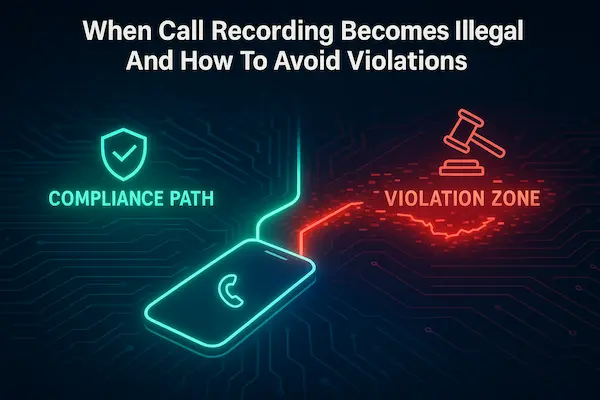
When call recording becomes illegal usually comes down to one of three failures: you did not meet the required consent or notice rule, you recorded a conversation you were not actually part of, or you kept and used the recording in ways that were never clearly disclosed. In practice, many teams get exposed because recording is turned on by default, scripts are skipped, or recordings are stored and shared too casually.
1. The 7 most common illegal triggers
Use this list as a quick “stop sign” checklist for when call recording becomes illegal:
- No valid consent when consent is required (especially in stricter locations)
- No clear notice at the start, before meaningful details are shared
- Recording a call you are not participating in (third-party interception risk)
- Recording with a wrongful purpose, such as harassment, threats, or coercion
- Ignoring the strictest rule when a call crosses states or countries
- Weak security, like shared folders, uncontrolled access, or forwarding files
- Sloppy retention or reuse for new purposes without updated disclosure
2. One-screen decision tree (use before you hit Record)
- Are you a participant in the call? If not, do not record.
- What is the strictest consent rule that could apply to anyone on the call? If unsure, follow the stricter approach.
- Did you announce recording clearly at the beginning?
- If someone declines, can you continue without recording or offer an alternative channel?
- Do you have a clear purpose, access limits, and a retention timeline?
3. Copy-ready scripts that prevent most violations
Short notice + consent: “Hi, this call will be recorded for quality and training. Is that OK?”
Opt-out: “No problem. We can continue without recording. I’m turning it off now.”
Sensitive version: “We record for service quality and dispute prevention. You can opt out and continue without recording. Would you like to proceed?”
2. What’s New (Updated on December 14, 2025)
Call recording compliance is shifting in a practical way: regulators and customers care less about whether you can record and more about whether your process is transparent, consistent, and controlled. In 2026, the biggest risk is not one dramatic mistake. It is small operational gaps that repeat at scale, which is exactly how when call recording becomes illegal turns into a real incident for support teams.
1. “Default recording” is being judged by the quality of your opt-out
More organizations record by default for QA and dispute prevention, but the safer standard is clear: people should understand they are being recorded and have a real path to continue without recording. If your opt-out is confusing, hidden, or punished with worse service, that is when call recording becomes illegal in practice because consent becomes questionable and complaints become easier to validate.
2. Retention and access controls are becoming the main battleground
Teams used to treat recordings like harmless archives. Now the risk is in over-collection and over-retention. If you keep everything “just in case,” share clips across teams, or let vendors access recordings without tight controls, you increase the odds that when call recording becomes illegal is triggered after the call, even if the recording was captured correctly.
3. AI transcription is multiplying compliance scope
More companies are transcribing calls for search, coaching, and analytics. That expands what must be governed: not only the audio, but also transcripts, tags, summaries, and extracted insights. If your notice and purpose statement does not match how you use transcripts, that is a common way when call recording becomes illegal appears later through purpose creep.
4. Update log (short)
- December 14, 2025: Updated opt-out and consent-first call scripts
- December 14, 2025: Updated retention and access control guidance
- December 14, 2025: Expanded AI transcription and reuse risk coverage
3. What Counts as Call Recording (And Why It Matters)
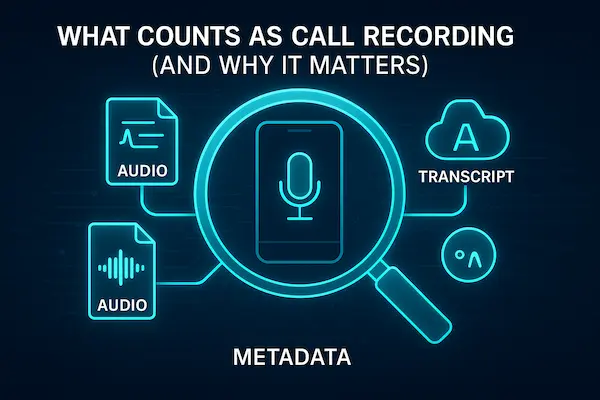
To understand when call recording becomes illegal, you need a clear definition of what you are collecting. Many teams only think about the audio file, but risk can also come from transcripts, summaries, and even the way recordings are labeled and shared. The safest approach is to treat anything that captures or recreates the conversation as regulated content, then control it like you would any sensitive customer data.
1. Audio recordings vs call logs vs transcripts vs summaries
- Audio recording: the actual voice file. This is the highest-risk format because it contains identity cues, tone, and sensitive details.
- Call logs: metadata like time, duration, and numbers. Often lower risk, but still sensitive in many contexts.
- Transcripts: text versions of what was said. A transcript can create new risk if it is searchable, shareable, or used for new purposes.
- Summaries and notes: even short summaries can be risky if they contain personal data or sensitive claims, especially when copied into tickets or CRM systems.
If your team records audio but later relies on transcripts for coaching, training, or analytics, that is a common point where when call recording becomes illegal is triggered through reuse without clear disclosure.
2. Phone calls, VoIP, video calls, and conference lines
From a compliance perspective, the technology does not “magically” reduce risk. Whether it is a mobile call, a VoIP call, a video meeting, or a conference bridge, the same core questions apply: who is on the line, what notice was given, what consent is required, and how the data is stored and used. The difference is technical: VoIP platforms often make it easier to auto-record and auto-share, which increases the chance that when call recording becomes illegal happens at scale through misconfiguration.
3. “Confidential communication” in plain English
Many rules turn on whether the conversation is treated as private. If a reasonable person expects privacy in that context, recording without the proper consent and notice is more likely to be viewed as unlawful. This is why recording sensitive topics, workplace investigations, or personal disputes carries extra risk. In those scenarios, when call recording becomes illegal often happens because teams assume a generic script is enough, even though the situation requires clearer disclosure and tighter controls.
4. Practical takeaway for teams
If your organization records, transcribes, summarizes, or analyzes calls, define each output type in your policy and apply the same basic controls: clear purpose, limited access, secure storage, and retention limits. That framework reduces confusion and reduces the chances that when call recording becomes illegal becomes a question you have to answer after a complaint.
4. Consent Rules That Flip Recording From Legal to Illegal
Most disputes about when call recording becomes illegal are really disputes about consent. Teams think they “covered it” with a vague message, while customers or employees feel surprised, pressured, or misled. The safest operational mindset is simple: follow the strictest rule that could apply to anyone on the call, announce recording early, and make opting out a real option.
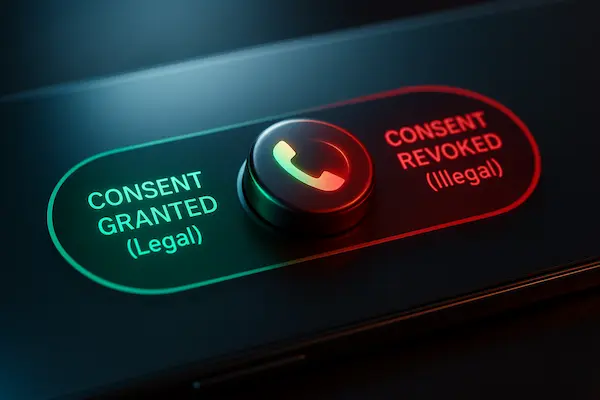
1. One-party vs all-party consent in plain English
- One-party consent: at least one person in the conversation agrees to recording. In many places, if you are on the call, you can record with your own consent, but your organization may still need notice policies.
- All-party consent: everyone on the call must agree before recording. In these settings, recording without clear agreement is one of the fastest ways when call recording becomes illegal gets triggered.
For businesses, the practical approach is to behave as if stricter rules apply whenever you are uncertain, especially on calls that might involve different regions.
2. Express consent vs implied consent (and what is risky)
- Express consent is clear agreement, such as “Yes, I agree to be recorded.” This is the strongest evidence if a complaint appears later.
- Implied consent is where people continue after a notice. Sometimes it may be accepted, but it is also where many arguments start, because the person may claim they did not understand or did not feel they had a choice.
If your workflow relies only on implied consent, that is often where when call recording becomes illegal becomes a real operational risk, especially in strict locations or sensitive calls.
3. Notice timing that prevents violations
Notice should come before the call enters meaningful detail. In customer support, that means the first 5 to 10 seconds, before account numbers, medical info, payment details, or personal disputes. Late notice can feel like a trap, and that is exactly how when call recording becomes illegal can be argued even if your notice exists somewhere in the script.
A safe pattern is: notice, purpose, choice, then proceed.
4. Calls that cross regions (use the strictest-rule play)
Cross-border or cross-state calls are where teams get surprised. One side may be in a stricter consent location even if the other side is not. If you want a single global process that reduces legal exposure, operate with a “strictest rule wins” standard: announce recording, ask for agreement, and provide a non-recorded option. This approach reduces the chance that when call recording becomes illegal happens because someone later claims they were recorded under rules that required stronger consent.
5. Copy-ready consent script (safe default)
“Hi, I want to let you know this call will be recorded for quality and training. If you prefer not to be recorded, tell me and we will continue without recording. Is it OK to proceed?”
This script works because it is clear, early, and gives a real choice, which directly reduces the conditions where when call recording becomes illegal occurs.
5. EU and UK Privacy Rules (Where Recording Can Become Illegal Later)
In the EU and UK, when call recording becomes illegal is often decided after the call, not during it. Even if a person agreed to recording, the recording can still become unlawful if your organization lacks a valid lawful basis, fails transparency, collects too much, keeps it too long, or allows broad access. The practical goal is to make your call recording program explainable: why you record, how you protect it, and when you delete it.
1. Lawful basis: why consent is not always the safest option
Many teams default to “consent” language, but consent can be fragile in customer service and employment contexts because people may feel they cannot refuse. A more stable approach is to clearly define your purpose and choose a lawful basis that matches it, then document that choice in your policy and notices. If your lawful basis does not match your real purpose, that is a common reason when call recording becomes illegal shows up during audits or complaints.
A practical way to stay safe is to record only what you need for a defined purpose, then prove you follow that purpose consistently.
2. Transparency: your notice must match reality
In EU/UK style privacy expectations, transparency is not a checkbox. Your notice should clearly say:
- the purpose for recording
- whether the recording is used for QA, training, dispute resolution, or compliance
- who can access it
- how long it is kept
- whether it may be shared with service providers
If your notice says “quality and training” but you later use recordings for sales coaching, analytics, or AI models without updating the message, that is exactly how when call recording becomes illegal can be triggered through purpose creep.
3. Retention and deletion: the quiet risk that grows over time
A huge number of compliance problems come from “just keep everything.” In EU/UK frameworks, storing recordings longer than necessary for the stated purpose is a classic red flag. Even if your capture was lawful, the ongoing retention can turn into the moment when call recording becomes illegal in practice. The safe pattern is: define a retention window per purpose, automate deletion, and protect “legal hold” as an exception, not the default.
Table 1: EU/UK illegality triggers checklist
| Trigger | Why it becomes illegal | Fast fix | Owner |
|---|---|---|---|
| No clear lawful basis | Recording lacks a justified foundation | Define purpose and lawful basis in policy | Legal |
| Notice is vague or late | People are not properly informed | Move notice to the start, keep it plain | Ops |
| Purpose is unclear | Recording can be misused later | Write one purpose statement per call type | Legal/Ops |
| Purpose creep | New use without updated notice | Update notice and restrict secondary use | Legal |
| Retention is excessive | Data kept longer than needed | Set retention by purpose and auto-delete | Ops/IT |
| Access is too broad | Uncontrolled listening and exporting | Role-based access and audit logs | IT/Sec |
| Insecure storage | Higher breach and misuse risk | Encrypt, restrict export, monitor access | IT/Sec |
| No access/deletion workflow | Rights requests cannot be handled | Create a simple internal process | Ops/Legal |
4. Practical takeaway
If you want to reduce the chance that when call recording becomes illegal becomes a real problem in EU/UK contexts, treat call recordings like sensitive customer data: explain the purpose, control access, minimize what you keep, and delete on schedule. That operational discipline matters as much as consent.
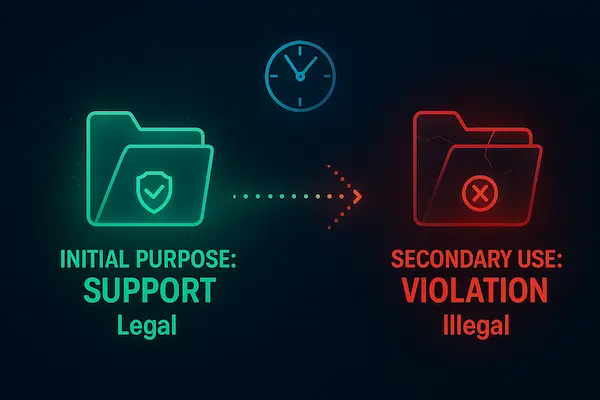
6. Purpose Creep (When a Legal Recording Becomes Illegal After the Call)
Purpose creep is a common reason when call recording becomes illegal appears later, even if the call was recorded with notice. The risk grows when recordings are reused for new goals, shared too widely, or kept without clear limits.
1. New use without updated notice
If you recorded for QA or dispute resolution, reusing audio for training, performance scoring, marketing, or AI analytics can create problems if your notice and policy do not match the new purpose. That mismatch is a frequent trigger for when call recording becomes illegal during complaints or audits.
2. Sharing and exporting without tight controls
Many issues come from convenience: exporting clips, forwarding files in chat, or storing recordings in shared folders. Even lawful recordings can become risky when access is broad, downloads are uncontrolled, or exports are not logged.
3. Vendors, transcription, and analytics expand scope
Outsourced QA and transcription can multiply compliance obligations. Keep vendor access limited, restrict downloads, align retention, and document who can access what. Otherwise, when call recording becomes illegal can be triggered through third-party handling.
4. Simple takeaway
Record for one clear purpose, limit access, avoid exports, and delete on schedule. That discipline prevents the “legal at capture, illegal later” problem.
7. High-Risk Scenarios That Commonly Create Violations
This section shows the situations where when call recording becomes illegal is most likely to happen in real life. These are not rare edge cases. They are everyday workflows where teams move fast, rely on defaults, and assume a generic notice line covers everything.
1. Recording customers without a real opt-out
Many support lines record by default, but the risk spikes when “opt-out” is not truly available. If the customer cannot continue service without being recorded, or the opt-out is hidden behind long menus, that is where when call recording becomes illegal can be argued because consent may not be meaningful.
Safe pattern: announce recording immediately, offer a non-recorded path, and keep service quality consistent.
2. Recording employees or contractors (monitoring risk)
Workplace recording adds a power imbalance. Even when company policy allows recording, disputes often arise if notice is unclear, policies are outdated, or recordings are used for discipline in ways people did not expect. In these cases, when call recording becomes illegal is often tied to poor transparency and overly broad use.
Safe pattern: written policy, clear notice, limited purpose, short retention, restricted access.
3. Speakerphone and surprise participants
A common failure is “hidden listeners.” One person puts a call on speakerphone, adds someone in the room, or silently merges another line. If other participants are not told, this is a high-risk way when call recording becomes illegal shows up because consent assumptions break instantly.
Safe pattern: ask who is present, confirm all participants, then record only after notice and agreement.
4. Recording calls “to collect evidence” during disputes
People often record calls when they feel wronged, but disputes create emotional decisions and sloppy notice. If the recording is later shared, posted, or used to pressure someone, when call recording becomes illegal becomes far more likely.
Safe pattern: keep it transparent, avoid publishing, and use formal complaint channels and written confirmations instead of relying on hidden recordings.
5. Cross-border calls treated as “local”
Global teams often record the same way everywhere. The moment a call crosses regions with stricter rules, the default workflow can fail. This is one of the fastest ways when call recording becomes illegal happens at scale because the team does not realize the strictest rule changed.
Safe pattern: adopt one global “strictest rule” workflow: early notice, explicit agreement, and a real opt-out.
6. One-minute prevention checklist for these scenarios
- Announce recording in the first 5 to 10 seconds
- Confirm who is on the line and who is listening
- Capture consent when the strictest rule requires it
- Offer a non-recorded option without penalty
- Limit access, avoid exports, and delete on schedule
8. Customer Service and QA Playbook (Copy-Ready Templates)
This playbook turns policy into daily operations, because when call recording becomes illegal is usually caused by inconsistent scripts, missing opt-outs, and uncontrolled access. Use the templates below to standardize notice, consent, and handling across support, sales, and QA.
1. Call opening script (short version)
“Hi, this call will be recorded for quality and training. Is that OK?”
If you need a softer tone:
“Hi, we record calls to improve service quality. Is it OK if we record this call?”
2. Call opening script (sensitive or regulated version)
“Before we continue, I want to let you know we record calls for service quality and dispute prevention. You can opt out and continue without recording. Would you like to proceed with recording?”
3. Opt-out and alternative channel script
“No problem. I can continue without recording. I’m turning recording off now.”
If your workflow requires a different channel:
“No problem. We can continue without recording by switching to chat or email. Which do you prefer?”
Table 2: Operational controls that prevent illegal recording
| Control | What it prevents | Where to implement | Proof |
|---|---|---|---|
| Non-bypassable notice at call start | Hidden recording | IVR, agent script | Call flow config + QA checks |
| Consent capture when required | Consent disputes | Agent workflow, CRM fields | Timestamped consent log |
| Pause/Resume button | Recording sensitive details | Agent UI | Pause events in logs |
| Role-based access | Uncontrolled listening | Recording platform | Access audit trail |
| Export restrictions | Forwarding files | Admin controls | Export logs + permissions |
| Retention timer | “Keep forever” risk | Storage policy | Auto-delete reports |
| Encryption at rest | Breach risk | Storage layer | Security policy evidence |
| Vendor access limits | Third-party misuse | Vendor accounts | Vendor access logs |
| Staff training checklist | Script skipping | QA program | Training completion records |
4. Monthly audit checklist (quick, practical)
- Spot-check 10 random calls for notice at the start
- Verify consent logs exist where required
- Confirm opt-out works and does not block service
- Review access logs for unusual downloads or exports
- Confirm retention deletion ran on schedule
- Re-check vendor access and remove unused accounts
- Review one sensitive call category and confirm pause usage
5. The “safe default” workflow for teams
Announce recording early, capture consent when needed, offer a real opt-out, restrict access, and delete on schedule. When this is consistent, your risk of when call recording becomes illegal drops dramatically.
9. Security, Retention, and Requests (The Silent Violation Zone)
Even if the call was recorded correctly, when call recording becomes illegal often shows up later through weak security, unlimited retention, or sloppy handling of access and deletion requests. This section is about preventing “legal at capture, risky afterward.”
1. Storage security essentials
- Store recordings in a controlled system, not shared drives or inboxes.
- Use role-based access so only approved roles can listen or export.
- Keep audit logs for listening, exporting, and sharing actions.
- Encrypt recordings at rest and protect backups the same way.
- Remove access quickly when staff roles change.
2. Retention schedules by purpose
A simple retention plan prevents most long-term risk:
- QA and coaching: keep only as long as needed for reviews and training cycles.
- Dispute resolution: keep long enough to resolve disputes, then delete.
- Compliance or legal hold: keep only under formal hold rules, not as default.
If you cannot explain why a recording still exists, that is often when call recording becomes illegal in practice because the data is no longer necessary for the stated purpose.
3. Access, deletion, and “provide a copy” workflows
Build a lightweight internal process:
- Identify who receives requests (support or privacy owner).
- Confirm identity and scope, then locate the recording.
- Provide access or deletion through controlled tools, not by forwarding files.
- Log the action and close it with a clear record.
When teams improvise with exports and email attachments, when call recording becomes illegal risk increases fast.
4. AI transcription and analytics controls
If you transcribe calls, treat transcripts like a new dataset:
- Limit who can search and download transcripts.
- Align transcript retention with audio retention.
- Prevent copying transcripts into uncontrolled systems.
- Make sure your notice and policy match how transcripts are used.
5. Quick takeaway
If you lock down access, automate retention, and handle requests with a clear workflow, you reduce the silent pathways where when call recording becomes illegal happens long after the call ended.
10. If You Already Recorded Illegally (What to Do Next)
If when call recording becomes illegal already happened, focus on containment and fixing the process. The biggest mistake is spreading the file.
1. Stop and scope
- Pause recording on the affected call flow.
- Identify the call, where the recording and transcript are stored, and who accessed or exported them.
2. Restrict access fast
- Limit access to a small internal group (privacy, legal, security, ops lead).
- Disable exports and downloads if possible.
- Do not forward the file in email or chat.
3. Preserve logs, not copies
- Document actions and keep system logs.
- Avoid creating duplicates that are hard to control and delete.
4. Fix the root cause
- Move notice to the first 5 to 10 seconds of the call.
- Add consent capture where needed and ensure opt-out is real.
- Tighten role-based access and set retention with auto-delete.
5. Prevent repeat incidents
- Train teams on one script and one opt-out path.
- Run a quick audit of recent calls to confirm compliance.
That combination reduces harm now and lowers the chance that when call recording becomes illegal happens again.
FAQs – Call Recording Legality
1. When does call recording become illegal?
Call recording becomes illegal when required consent or notice is missing, when you record a conversation you are not part of, or when you store and use recordings in ways that violate privacy expectations.
2. Is “this call may be recorded” enough?
Sometimes, but it is risky if the wording is vague, late, or does not give a real choice. The safer approach is clear notice at the start plus confirmation, especially where stricter rules apply.
3. What if the other person says no?
Stop recording and continue without recording, or offer an alternative channel like chat or email. Ignoring a refusal is a common way when call recording becomes illegal.
4. What if the call crosses states or countries?
Use the strictest rule that could apply to anyone on the call. If unsure, follow an all-party consent approach with clear notice and a real opt-out.
5. Can employers record employee calls?
Often yes with policy and notice, but it becomes risky when transparency is weak, use is overly broad, or recordings are used beyond the stated purpose.
6. Can I record a call for proof in a dispute?
Disputes raise risk because people skip notice and later share clips. The safest route is transparent recording, limited sharing, and using formal complaint channels.
7. How long should businesses keep call recordings?
Keep recordings only as long as needed for the stated purpose, then delete. Unlimited retention increases the chance that when call recording becomes illegal appears later.
8. What is the safest compliant workflow?
Announce early, confirm consent when required, offer a non-recorded option, restrict access, avoid exports, and delete on schedule.
Conclusion and Next Steps
Call recording is not automatically safe or automatically illegal. The real risk is process failure: unclear consent, late notice, cross-border confusion, and careless handling after the call. In 2026, the fastest way to reduce exposure is to standardize one workflow that works across teams and locations, then prove it with logs, retention timers, and regular audits. That is how you avoid the moments when when call recording becomes illegal becomes a costly problem.
Quick Summary Table
| Scenario | Why recording becomes illegal | Safe alternative |
|---|---|---|
| All-party consent situations | No clear agreement from everyone | Announce early, ask for explicit consent, offer opt-out |
| Cross-border or cross-state calls | Different rules, strictest not followed | Use strictest-rule workflow for every call |
| Speakerphone with surprise listeners | Hidden participants, broken consent | Confirm who is present before recording |
| Customer support “record by default” | Opt-out is unclear or not real | Provide a real non-recorded path |
| Reuse for training or analytics | Purpose creep without updated notice | Update notice, limit use, restrict access |
| Weak storage and broad access | Uncontrolled sharing or exports | Role-based access, audit logs, export limits |
| Unlimited retention | Data kept beyond purpose | Set retention per purpose, auto-delete |
One-Minute Checklist to Avoid Violations
- Announce recording in the first 5 to 10 seconds
- Confirm who is on the call and who is listening
- Capture consent when the strictest rule requires it
- Offer a real opt-out without worse service
- Restrict access and block casual exports
- Set retention by purpose and automate deletion
- Audit notice, consent logs, and access monthly
Start Today With PhoneTracker247 (Compliance-Ready Operations)
If your team records calls for customer service or QA, the most practical improvement is operational consistency. Use PhoneTracker247 to support a safer workflow with clear documentation habits, standardized checklists, and accountability-friendly tracking of actions and follow-ups. When you combine consistent scripts with clean access control and retention discipline, you lower the risk that when call recording becomes illegal becomes an incident you have to explain later.
For daily updates, subscribe to PhoneTracker’s blog!
We may also be found on Facebook!