
Master the strategies for Protecting Kids From Sextortion: Monitoring Signals Parents Must Notice. Learn how device monitoring and cyber risk prevention tools can save your child from digital exploitation.
Contents
- 1 1. Why We Must Focus on Protecting Kids From Sextortion: Monitoring Signals Parents Must Notice
- 2 2. Behavioral Red Flags: The Human Side of Sextortion Detection
- 3 3. Digital Footprints: Technical Signals Parents Must Notice for Sextortion Prevention
- 4 4. The Role of Device Monitoring in Preventing Sextortion Escalation
- 5 5. Ethical Surveillance: Balancing Safety with Privacy Policy and Consent
- 6 6. Immediate Response Protocol: What to Do If You Detect Signals
- 7 Frequently Asked Questions (FAQs)
- 8 Conclusion: A Proactive Stance on Safety
1. Why We Must Focus on Protecting Kids From Sextortion: Monitoring Signals Parents Must Notice
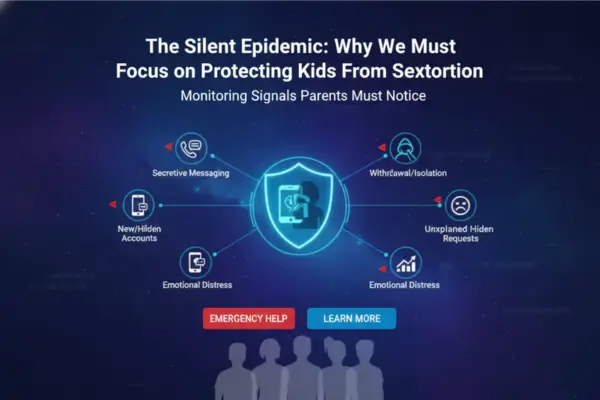
The Silent Epidemic: Why We Must Focus on Protecting Kids From Sextortion: Monitoring Signals Parents Must Notice
In the rapidly evolving landscape of 2026, financial sextortion has morphed from a rare cybercrime into a pervasive industrial-scale threat targeting adolescents. The task of Protecting Kids From Sextortion: Monitoring Signals Parents Must Notice has become the single most critical challenge for modern guardians. Unlike traditional bullying, sextortion operates in the shadows, often driven by organized crime syndicates that use fear, shame, and speed to coerce victims into paying money or producing explicit content. The predator’s weapon is secrecy; the parent’s defense is visibility.
For parents navigating the complexities of parenting in the digital age, understanding the specific indicators of this crime is essential. It is no longer sufficient to simply limit internet hours. Today’s parental control app for kids phone must be deployed to detect the subtle shifts in children’s online behavior that precede a crisis. This article provides a comprehensive, expert-led breakdown of the behavioral and technical signals that every parent must recognize to intervene before a digital threat becomes a real-world tragedy. By leveraging advanced device monitoring and maintaining open lines of communication, we can dismantle the isolation that sextortionists rely upon.
Table 1: Sextortion Warning Signs Parents Should Monitor
This table helps parents identify early sextortion signals by combining offline behavior changes with device-level indicators, so they can intervene before threats escalate.
| Signal Type | What Parents May Notice | Why It Matters | What to Do Next |
|---|---|---|---|
| Behavioral Shift | Sudden secrecy, mood swings, panic around phone use | Fear and shame often appear before a child asks for help | Stay calm, start a non-judgmental conversation |
| Sleep / Routine Changes | Late-night phone use, poor sleep, school avoidance | Sextortion often escalates fast and may happen at night | Check screen-time patterns and unusual activity hours |
| Money Pressure | Urgent requests for cash, gift cards, crypto, or prepaid cards | Financial sextortion commonly demands fast payment | Ask direct but supportive questions; do not shame |
| New Risky Apps | New encrypted chat apps or “vault”/hidden apps | Predators often move chats to harder-to-monitor spaces | Review new installs and verify app purpose |
| High-Risk Language | Messages about secrecy, payment, threats, or “don’t tell” | Coercion language is a strong escalation signal | Save evidence immediately and prepare to report |
| Screen-Protection Behavior | Child hides screen, deletes chats fast, changes passwords abruptly | Indicates fear of discovery or active blackmail | Focus on safety, not punishment |
| Emotional Distress | Shame, isolation, crying, anger, withdrawal from hobbies | Sextortion can cause trauma-like responses | Reassure the child they are not in trouble |
2. Behavioral Red Flags: The Human Side of Sextortion Detection

Behavioral Red Flags: The Human Side of Sextortion Detection
Protecting Kids From Sextortion: Monitoring Signals Parents Must Notice begins with observing changes in the child’s offline demeanor, as the psychological pressure of coercion often manifests physically before digital evidence is found. Victims of sextortion typically display distinct, rapid behavioral shifts—such as extreme mood swings, sudden isolation from family events, or a terrified attachment to their device—which serve as the earliest warning signs that cyber risk prevention measures have been breached.
While parental monitoring apps provide the hard data, parental intuition remains a vital component of the safety ecosystem. Sextortion relies on inducing panic. If a child who was previously open about their digital life suddenly becomes secretive, shielding their screen when you enter the room or abandoning hobbies they once loved, these are not just “teenage phases.” They are potential symptoms of a high-stakes crisis impacting their digital well-being.
Sudden Withdrawal and Anxiety
One of the most consistent indicators is a sudden, unexplained drop in digital well-being. A child being extorted lives in a state of constant “fight or flight.” You may notice them checking their phone obsessively, not for enjoyment, but with visible dread. They may suffer from sleep disturbances, avoiding school, or displaying uncharacteristic aggression when asked about their online friends. These are trauma responses. In this context, Protecting Kids From Sextortion: Monitoring Signals Parents Must Notice involves recognizing that the phone has transformed from a source of entertainment into a source of terror.
Financial Secrecy and Gift Card Requests
Financial sextortion is driven by profit. A major red flag occurs when a child suddenly needs money without a clear explanation. They might ask for gift cards (a common untraceable currency for predators), attempt to borrow money from siblings, or even steal from parents. Monitoring banking apps and being alert to requests for cryptocurrency or prepaid cards is a crucial aspect of mobile security practices. If a teen is desperate for cash late at night, immediate investigation is required.
3. Digital Footprints: Technical Signals Parents Must Notice for Sextortion Prevention
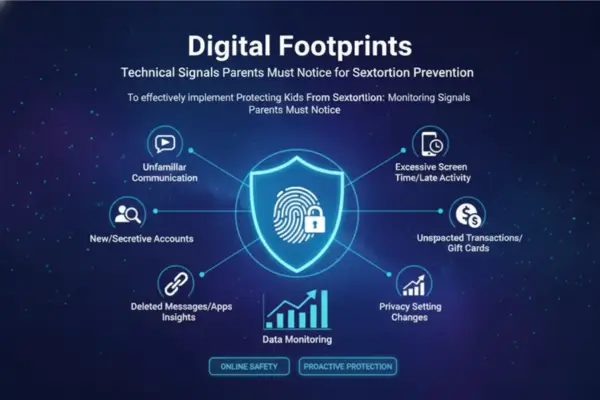
Digital Footprints: Technical Signals Parents Must Notice for Sextortion Prevention
To effectively implement Protecting Kids From Sextortion: Monitoring Signals Parents Must Notice, parents must look beyond behavior and analyze the technical footprint left on the device. Sextortionists often force victims to migrate conversations to encrypted platforms (like Signal, Telegram, or Discord) or demand the installation of “vault apps” to hide content. Advanced device monitoring software is often the only way to detect these installation events and the specific communication patterns associated with grooming and coercion.
The sophistication of modern predators requires an equally sophisticated response. Utilizing tools that provide deep insights into app usage and communication logs allows parents to see the “smoke” before the fire engulfs the child’s life. This technical vigilance is a cornerstone of cyber risk prevention.
Unexplained New Apps and Vaults
A critical technical signal is the sudden appearance of unknown applications. Predators often instruct victims to download specific messaging apps that feature “disappearing messages” or to install decoy apps that look like calculators or audio managers but actually hide photos and chats.
Protecting Kids From Sextortion: Monitoring Signals Parents Must Notice requires auditing the device for these anomalies. Robust online safety tools, such as those reviewed on PhoneTracker247.com, can alert parents instantly when a new app is installed, allowing for immediate verification of its purpose.
High-Risk Keyword Alerts in Parental Monitoring Apps
Modern parental monitoring apps utilize AI-driven algorithms to flag high-risk content. Signals include keywords related to:
- Payment: “CashApp,” “Gift card,” “Send money,” “Crypto.”
- Secrecy: “Don’t tell,” “Delete this,” “Secret mode,” “Private.”
- Coercion: “Post it,” “Leak,” “Send to your friends,” “Or else.”
receiving a real-time alert for these terms is often the difference between a prevented attempt and a successful extortion. This is device monitoring at its most critical level.
4. The Role of Device Monitoring in Preventing Sextortion Escalation

The Role of Device Monitoring in Preventing Sextortion Escalation
The strategy for Protecting Kids From Sextortion: Monitoring Signals Parents Must Notice relies heavily on the capabilities of the monitoring software chosen by the family. High-quality E-E-A-T compliant software provides a safety net that human supervision alone cannot achieve. By integrating features like keystroke logging and screen recording, parents gain context. Seeing what was typed—even if it was deleted—provides the necessary evidence to involve law enforcement if necessary.
Effective mobile security practices involve more than just tracking location; they involve analyzing the intent and tone of communications. When parents use these tools proactively, they shift the power dynamic away from the predator.
Using Keystroke Tracking to Uncover Coercion
Keystroke tracking is an invaluable feature for Protecting Kids From Sextortion: Monitoring Signals Parents Must Notice. Predators almost always demand that victims delete chat histories to remove evidence. However, a keylogger captures the input before deletion. If a parent sees a log of their child pleading “Please don’t send that” or “I don’t have any money,” the context is undeniable. This tool bypasses the secrecy of encrypted apps, providing a raw feed of the child’s distress and allowing for rapid intervention.
Screen Time Management as a Defense Mechanism
Predators often operate across time zones or target children late at night when parental supervision is lowest. Screen time management tools that enforce a “digital curfew” (disabling social apps after bedtime) significantly reduce the window of opportunity for predators. Furthermore, sudden spikes in screen time during unusual hours (e.g., 2:00 AM) serve as a data-driven signal that children’s online behavior has deviated from the norm, warranting an immediate check-in.
Table 2: Parent Response Protocol After a Sextortion Alert
This table gives parents a clear, step-by-step response plan after detecting a possible sextortion case, with a focus on safety, evidence preservation, and official reporting channels.
| Step | What To Do | Why It Matters | Trusted Resource / Channel |
|---|---|---|---|
| 1. Stabilize the Child | Reassure them: “You are not in trouble. We will handle this together.” | Reduces panic and prevents the child from hiding details | Parent / caregiver support |
| 2. Do Not Pay | Do not send money, gift cards, or crypto | Paying rarely stops blackmail and may trigger more demands | FBI guidance |
| 3. Preserve Evidence | Save screenshots, usernames, chat logs, threats, and payment requests | Evidence helps law enforcement identify the offender | Keep originals stored safely |
| 4. Block + Report the Account | Report the predator on the platform and block contact | Stops immediate contact and creates platform records | Platform safety/report tools |
| 5. File an Official Report | Report the case to law enforcement and child-exploitation channels | Speeds up intervention and case routing | FBI tips + NCMEC CyberTipline |
| 6. Use Image-Removal Tools | If images may be shared, use a removal-prevention tool | Helps limit spread on participating public platforms | NCMEC Take It Down |
| 7. Seek Mental Health Support | Get trauma-informed support for the child | Sextortion can cause severe fear, shame, and ongoing distress | Licensed counselor / crisis support |
| 8. Review Device Safety Setup | Tighten privacy settings, app permissions, and monitoring alerts | Prevents repeat targeting and improves visibility | Family digital safety plan |
5. Ethical Surveillance: Balancing Safety with Privacy Policy and Consent

Ethical Surveillance: Balancing Safety with Privacy Policy and Consent
Implementing the protocols for Protecting Kids From Sextortion: Monitoring Signals Parents Must Notice must be done within an ethical and legal framework. While safety is paramount, maintaining the child’s trust is vital for their long-term digital well-being. Surveillance should not be a secret operation but a transparent safety agreement. Parents should explain that device monitoring is a non-negotiable condition of having a smartphone, specifically designed to catch bad actors, not to spy on friendships.
Compliance with Regulations and Data Safety
When selecting software, parents must ensure compliance with regulations regarding data privacy (such as COPPA or GDPR). The tools used to protect children must themselves be secure. Reputable providers will have a transparent privacy policy and consent statement, ensuring that the sensitive data collected—including location tracking accuracy and chat logs—is encrypted and never sold. Using compliant tools ensures that the family’s fight against sextortion doesn’t open the door to other data privacy risks.
Establishing Trust in Parenting in the Digital Age
The conversation should be framed around partnership. “I am using this app to help with Protecting Kids From Sextortion: Monitoring Signals Parents Must Notice. If you are ever in trouble, I will see the signal, and I will help you, not punish you.” This approach encourages the child to come forward voluntarily if they feel threatened, knowing that the parent is an ally in cyber risk prevention.
6. Immediate Response Protocol: What to Do If You Detect Signals
If the indicators for Protecting Kids From Sextortion: Monitoring Signals Parents Must Notice trigger an alarm, parents must act immediately but calmly. Panic can cause the child to shut down or the predator to escalate.
- Do Not Pay: Never pay the ransom. Payment does not stop the extortion; it marks the child as a “paying target” and often leads to further demands.
- Preserve Evidence: Do not delete the device or the apps. Take screenshots of threats, profiles, and payment demands. Use the logs from your parental monitoring apps to back up this evidence.
- Block and Report: Block the predator on all platforms. Report the account to the social media platform and to local law enforcement or cybercrime divisions (such as the FBI’s IC3 in the US).
- Reassure the Child: Reinforce that they are the victim, not the criminal. Their safety is more important than any embarrassing photo.
- Seek Professional Help: Sextortion is traumatic. engage mental health professionals to support the child’s digital well-being recovery.
Frequently Asked Questions (FAQs)
1. What is sextortion?
Sextortion is when someone threatens a minor to get money or more explicit content. The FBI says cases involving minors have increased.
2. Where can sextortion happen?
It can happen on any app, site, messaging platform, or game where kids chat with others online.
3. What are the first warning signs?
Watch for sudden secrecy, mood swings, isolation, and fear-based phone use.
4. Why are money requests a red flag?
Many cases are financially motivated, so urgent requests for cash, gift cards, or crypto are serious warning signs.
5. What digital signs should parents check?
Look for new encrypted apps, vault apps, deleted chats, or suspicious payment/threat keywords.
6. Can monitoring apps help?
Yes. They can alert parents to risky apps, keywords, and unusual behavior before things escalate.
7. What should parents do first?
Stay calm, do not pay, and reassure your child they are not at fault.
8. Should parents delete messages right away?
No. Save screenshots and evidence first, then report and block.
9. Where should sextortion be reported?
Report it to the platform and local law enforcement (the article also mentions FBI IC3 in the U.S.).
10. Can images be removed from the internet?
Sometimes. NCMEC’s Take It Down is a free tool that helps stop or remove qualifying images taken before age 18.
Conclusion: A Proactive Stance on Safety
The threat of sextortion is a grim reality of the modern era, but it is not insurmountable. By dedicating themselves to Protecting Kids From Sextortion: Monitoring Signals Parents Must Notice, parents reclaim control from the predators. The combination of vigilance regarding behavioral changes—such as withdrawal and anxiety—and the deployment of advanced technical safeguards creates a robust shield around the child.
Utilizing expert online safety tools, maintaining rigorous mobile security practices, and fostering an environment of open communication regarding privacy policy and consent are the pillars of effective defense. We cannot scrub the internet of all dangers, but by recognizing the signals early and acting decisively, we can ensure that our children survive their digital adolescence without falling victim to exploitation. The key is to watch, to listen, and to be ready to act.
For daily updates, subscribe to PhoneTracker’s blog!
We may also be found on Facebook!