Discover How AI Helps Detect Dangerous Behavior on Kids’ Devices using advanced algorithms. Learn about the future of cyber risk prevention and digital safety.
1. Introduction: The Era of Intelligent Guardianship
Introduction: The Era of Intelligent Guardianship
In the complex landscape of parenting in the digital age, manual supervision is no longer sufficient. The sheer volume of data generating on a teenager’s smartphone—thousands of texts, hours of video, and endless social media feeds—exceeds any parent’s ability to review.
This is where artificial intelligence has revolutionized the field. Understanding How AI Helps Detect Dangerous Behavior on Kids’ Devices is essential for modern families, as it represents the shift from reactive snooping to proactive, privacy-preserving protection.
AI-driven online safety tools act as a tireless filter, sifting through the digital noise to identify genuine threats without requiring the parent to read every harmless interaction.
By leveraging machine learning, these systems can distinguish between friendly banter and cyberbullying, or between a biological curiosity and predatory grooming. This technological leap allows for effective cyber risk prevention, ensuring that intervention happens before a digital conversation turns into a real-world tragedy.
Table 1: AI Risk Signals vs What They Catch vs What Parents Should Do
| AI signal (what it looks for) | What it can help detect | Common false positives | Best parent response |
|---|---|---|---|
| Aggressive or hostile language patterns | Cyberbullying, harassment, escalating arguments | Jokes, gaming trash-talk, sarcasm | Check context, ask calmly, document if repeated |
| Unknown or fast-growing contact list | New strangers, possible grooming attempts | New classmates, group projects | Verify who the contact is, tighten messaging privacy settings |
| Suspicious links and scam-like wording | Phishing, sextortion scams, unsafe downloads | Promo links, meme links | Teach “don’t click”, block sender, report suspicious accounts |
| Late-night spikes in activity | Secretive chats, doomscrolling, risky browsing windows | School deadlines, time-zone chats | Set bedtime limits, review which apps are active at night |
| Repeated attempts to access restricted content | Exposure to explicit or age-inappropriate material | Curiosity searches, accidental clicks | Turn on filters, explain why it is unsafe, set clear boundaries |
| Crisis language patterns | Possible emotional distress signals | Song lyrics, quotes, dark humor | Prioritize a supportive talk, involve a trusted adult if needed |
2. The Shift from Static Blocking to Intelligent Analysis
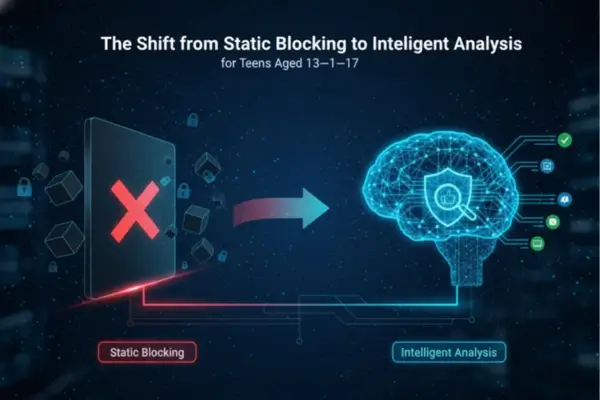
The Shift from Static Blocking to Intelligent Analysis
Understanding How AI Helps Detect Dangerous Behavior on Kids’ Devices begins with recognizing the limitations of old keyword lists. Traditional parental monitoring apps relied on “blocklists”—if a child typed a specific curse word, it triggered an alert.
AI, however, uses contextual awareness to understand the intent behind the words, analyzing sentence structure, slang, and emoji usage to determine if a conversation poses a genuine risk or is simply teenage slang.
This evolution is critical for device monitoring. A static filter might flag the phrase “I’m going to kill you” inside a video game chat (where it is likely harmless competitive banter) and treat it the same as a text message sent to a peer at 2:00 AM. AI contextualizes this data. It looks at the app being used, the time of day, and the relationship between the contacts.
By doing so, it provides a sophisticated layer of mobile security practices that respects the nuance of human communication.
Natural Language Processing (NLP) in Action
Natural Language Processing (NLP) is the engine behind this capability. It allows the software to “learn” the evolving lexicon of Gen Z and Gen Alpha. Slang terms for drugs, weapons, or self-harm change rapidly; static lists cannot keep up. AI models are updated continuously, ensuring that children’s online behavior is monitored against the most current threat landscapes.
Reducing False Positives in Device Monitoring
One of the biggest friction points in digital parenting is the “false alarm.” Constant, irrelevant notifications cause “alert fatigue,” leading parents to ignore the app entirely. AI significantly reduces this by filtering out benign interactions. This precision ensures that when a parent receives an alert, it is actionable, thereby supporting better screen time management strategies and reducing conflict within the home.
3. Identifying Predatory Patterns and Grooming Risks
A critical application of this technology is How AI Helps Detect Dangerous Behavior on Kids’ Devices regarding online predation. Predators rarely start with explicit language; they begin with “grooming”—a process of building trust, offering compliments, and isolating the victim.
AI is trained to detect these specific behavioral patterns, such as an older user attempting to move a conversation from a public forum to a private, encrypted app, or asking a child to keep secrets from their parents.
By analyzing the metadata and the trajectory of a conversation, AI can flag high-risk dynamics that a human observer might miss in isolation. For example, if a new contact is messaging late at night and using manipulative language typical of grooming (e.g., “Nobody understands you like I do”), the system triggers a cyber risk prevention alert.
Contextual Analysis of Children’s Online Behavior
AI looks for anomalies. If a child who typically interacts with school friends suddenly begins communicating extensively with an unknown adult profile, or if there is a sudden spike in data usage on encrypted messaging apps, the AI notes this deviation. This is where location tracking accuracy can also be integrated; if digital grooming escalates to a request for a meet-up, the AI creates a composite risk score based on both communication and location intent.
Breaking the Cycle of Secrecy
Predators rely on secrecy. AI disrupts this by shining a light on the specific “hooks” used to manipulate children. For parents, having access to these online safety tools means they can intervene during the manipulation phase, long before any physical contact occurs. For deeper insights into these patterns, resources like PhoneTracker247.com/blog/ offer extensive case studies.
4. Cyberbullying Detection and Sentiment Analysis
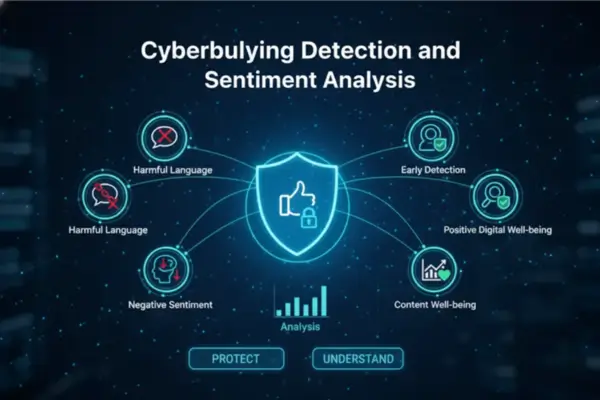
Cyberbullying Detection and Sentiment Analysis
When addressing bullying, How AI Helps Detect Dangerous Behavior on Kids’ Devices involves sentiment analysis—the ability of a machine to determine the emotional tone of a text. Cyberbullying is often subtle; it can be sarcastic, passive-aggressive, or exclusionary without using overt profanity.
AI algorithms analyze the sentiment to detect sustained hostility, harassment, or distress in the child’s outgoing messages, offering a safety net for digital well-being.
This is particularly vital because victims of bullying often suffer in silence. They may not tell their parents for fear of having their devices confiscated. An AI-enabled parental monitoring app works in the background, identifying the signs of victimization—or perpetration—allowing parents to step in with support rather than punishment.
Reading Between the Lines for Digital Well-being
AI can detect the difference between “roasting” among friends and genuine harassment. It analyzes the frequency and intensity of negative sentiment. If a child is receiving a barrage of negative messages from a specific group, the AI flags this as a bullying event. This capability is essential for preserving a child’s mental health in an always-connected world.
Real-Time Intervention Protocols
The speed of AI allows for near real-time alerts. In severe cases of bullying or sextortion, seconds matter. By notifying parents immediately when high-risk sentiment is detected, families can use screen time management features to lock the device or block the aggressor instantly, preventing further psychological damage.
5. Visual Threat Recognition: Beyond Text
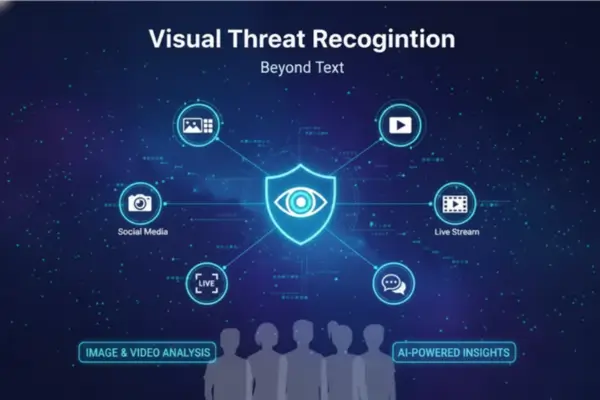
Visual Threat Recognition: Beyond Text
Visual processing is another frontier where How AI Helps Detect Dangerous Behavior on Kids’ Devices demonstrates immense value. Modern threats are not just textual; they are photographic and video-based. Computer Vision (a subset of AI) scans images and videos saved on the device or sent via chat apps to identify nudity, weapons, drugs, or evidence of self-harm (such as cutting), providing a comprehensive shield for mobile security practices.
This technology runs locally on the device in many advanced applications, meaning the images don’t necessarily need to be uploaded to the cloud to be analyzed, which preserves privacy. It looks for pixel patterns that match known threat databases.
Image Processing and Mobile Security Practices
For example, if a child takes a photo that the AI recognizes as a weapon or illicit substance, the system can quarantine the image and alert the parent. Similarly, in the fight against “sextortion,” AI can detect if a child is being coerced into taking or sending explicit images, intervening before the file is transmitted.
Detecting Self-Harm and Substance Abuse Signals
Visual AI is particularly effective at identifying body image issues and self-harm. It can flag content related to “thinspiration” or images of physical injury. Combined with text analysis, this gives parents a holistic view of their child’s mental state, allowing for medical or therapeutic intervention before a crisis escalates.
Table 2: Compare Safety Options for AI-Based Detection on Kids’ Devices (2026)
| Option | Best for | Strengths | Limitations | Setup effort |
|---|---|---|---|---|
| PhoneTracker247 (AI Safety Alerts) | Parents who want proactive risk alerts across apps | Smart alerting, trend detection, centralized dashboard | Needs clear family rules to protect trust and privacy | Medium |
| Built-in OS controls (iOS Screen Time, Google Family Link) | Simple limits and basics | Free, reliable, easy restrictions | Limited cross-app behavior insights | Low |
| Router or DNS filtering | Whole-home web filtering | Works for all devices on Wi-Fi | No visibility off Wi-Fi, weak for in-app risks | Medium |
| School MDM or supervised profiles | School-managed devices | Strong control on managed apps and settings | Usually limited to school context, not home life | Medium to high |
| Basic monitoring apps (non-AI alerts) | Parents who only need usage logs | Straightforward reports | More manual review, fewer early warnings | Medium |
6. Balancing Privacy and Safety with AI
Ethically implementing How AI Helps Detect Dangerous Behavior on Kids’ Devices requires strict adherence to privacy standards and transparency. The goal of using AI is not to create a surveillance state within the home, but to identify specific dangers. Therefore, the best systems are designed to ignore safe, private conversations and only record or alert when a specific safety threshold is crossed, respecting the privacy policy and consent established within the family.
Privacy Policy and Consent in AI Systems
Parents should discuss the use of these tools with their children. Transparency is key to parenting in the digital age. Explaining that “The AI is looking for bullies and predators, not reading your diary” helps build trust. Furthermore, reputable software providers ensure that the data processed by AI is anonymized and encrypted.
Compliance with Regulations and Data Ethics
Top-tier solutions found on PhoneTracker247.com adhere to compliance with regulations like COPPA and GDPR. They ensure that the sophisticated AI models used for detection do not inadvertently harvest personal data for marketing purposes. The focus remains strictly on safety and cyber risk prevention.
FAQs – How AI Helps Detect Dangerous Behavior on Kids’ Devices (2026)
1. What is “dangerous behavior” on a kid’s device?
Bullying, predatory contact, explicit content exposure, self-harm related searches, or risky meet-up planning.
2. How does AI detect risk?
It spots patterns in texts, app activity, links, and searches, then flags unusual or high-risk signals.
3. What AI alerts matter most?
Repeated alerts across multiple apps, unknown adult contacts, suspicious links, and escalating aggressive language.
4. Can AI help with cyberbullying?
Yes. It can catch bullying patterns early so parents can block, report, and step in sooner.
5. Does AI monitoring harm privacy?
It can. Use transparent rules, minimal data settings, and age-appropriate monitoring.
6. Are AI tools always correct?
No. False positives happen, so parents should review context before reacting.
7. What should parents do after an alert?
Pause, check context, talk calmly, adjust safety settings, and save evidence if needed.
8. What is the best way to use AI safety tools in 2026?
Combine AI alerts with clear family rules, device limits, and regular check-ins.
Conclusion: Embracing the Future of Family Safety
The integration of artificial intelligence into parental controls represents a monumental leap forward in family safety. How AI Helps Detect Dangerous Behavior on Kids’ Devices moves the needle from passive observation to active, intelligent protection. It provides a necessary buffer against the overwhelming tide of digital content, allowing parents to focus on what matters most: their relationship with their child.
By identifying predatory patterns, detecting cyberbullying nuances, and recognizing visual threats, AI acts as a 24/7 guardian. However, technology is most effective when paired with empathy and open communication.
Utilizing these advanced online safety tools alongside a commitment to privacy policy and consent ensures that we are not just protecting our children from the world, but preparing them to navigate it safely. As we move through 2025 and beyond, AI will remain an indispensable ally in the complex journey of parenting in the digital age, ensuring that cyber risk prevention keeps pace with the threats of tomorrow.
Quick Summary Table (Conclusion)
| What AI helps parents catch (2026) | Typical signal | Best next step |
|---|---|---|
| Cyberbullying and harassment | Repeated hostile language, targeted insults | Review context, talk calmly, block/report if repeated |
| Predatory or suspicious contacts | Unknown adults, fast contact growth, secret chats | Confirm identity, tighten privacy, restrict DMs |
| Scams and dangerous links | Phishing wording, strange shortened URLs | Teach “don’t click”, block sender, report |
| Explicit or age-inappropriate content | Repeat attempts to open restricted sites/apps | Turn on filters, set boundaries, explain clearly |
| Risky meet-up planning | Location-sharing requests, “meet tonight” patterns | Discuss safety rules, require guardian approval |
| Late-night risk windows | Spikes in activity after bedtime | Set downtime limits, adjust app access hours |
| Emotional distress signals | Crisis language patterns or sudden behavior changes | Supportive check-in, involve a trusted adult if needed |
Ultimately, How AI Helps Detect Dangerous Behavior on Kids’ Devices is about providing parents with the peace of mind that comes from knowing that while they cannot watch every second, a smart, vigilant system is doing exactly that—keeping the digital wolf from the door.
For daily updates, subscribe to PhoneTracker’s blog!
We may also be found on Facebook!