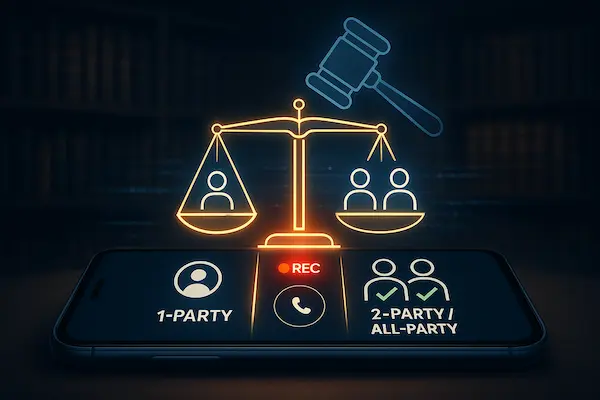
Call recording is now a routine part of customer service, remote work, and personal documentation, but Call Recording Laws and consent requirements still vary widely by jurisdiction. This guide explains what you must know before you hit record, especially when calls cross state or country lines, when recordings are used for quality assurance, and when a simple disclosure can prevent serious legal and reputational risk.
Contents
- 1 1. Call Recording Laws: The Core Concepts That Apply Almost Everywhere
- 2 2. United States Call Recording Laws: Federal Baseline vs State Consent Rules
- 3 3. UK Call Recording Laws: Business Recording, Privacy Duties, and Lawful Use
- 4 4. EU and GDPR: Consent Requirements, Lawful Basis, and Data Rights
- 5 5. Australia Call Recording Laws: State-by-State Reality and Business Compliance
- 6 6. Consent Design: How to Make Consent Clear, Valid, and Low-Friction
- 7 7. Call Recording for Customer Service and QA: The Compliance-First Playbook
- 8 8. Common Mistakes That Trigger Legal Risk
- 9 FAQs (AEO Block)
- 10 Conclusion
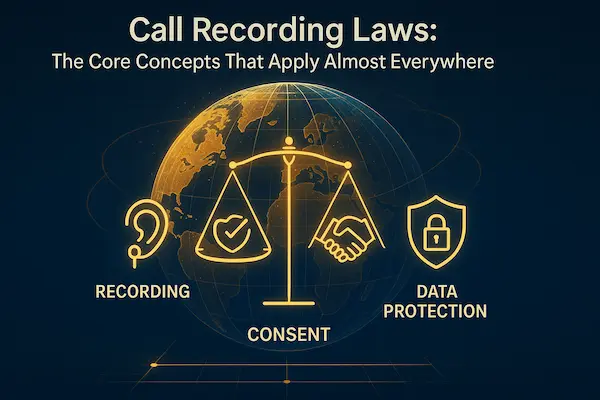
1. Call Recording Laws: The Core Concepts That Apply Almost Everywhere
Before you compare countries or state rules, learn the shared logic behind most Call Recording Laws. Nearly every system asks the same things: are you a party to the conversation, is it private, was there consent or clear notice, and how will the recording be used and stored afterward.
1. What counts as “recording” and what counts as “interception”
Recording is capturing or saving a conversation, whether through phone audio, VoIP, meeting tools, or call center systems. Many laws also treat real-time capture as interception, so treat any tool that captures audio or creates stored transcripts as potentially covered.
2. Consent vs notice vs disclosure, what each term means
Consent is agreement under the required standard. Notice is informing people recording will happen. Disclosure is how you deliver that notice in practice, like an IVR message or an agent script. A common mistake is assuming a quick message always equals valid consent.
3. One-party consent vs all-party consent in plain English
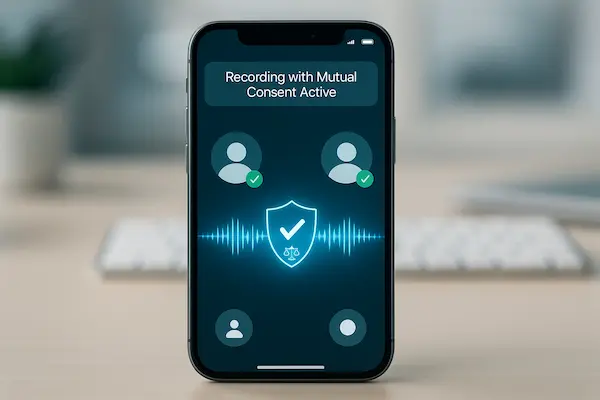
One-party consent generally allows recording if at least one participant consents. All-party consent generally requires everyone to agree, which means clear disclosure and a real chance to refuse.
4. The cross-border problem: whose law can apply on one call
Cross-border calls can trigger multiple jurisdictions at once. The safest operational approach for multi-region teams is consistent disclosure everywhere and adopting the stricter consent standard when rules are unclear, plus a workable no-recording option if someone declines.
2. United States Call Recording Laws: Federal Baseline vs State Consent Rules
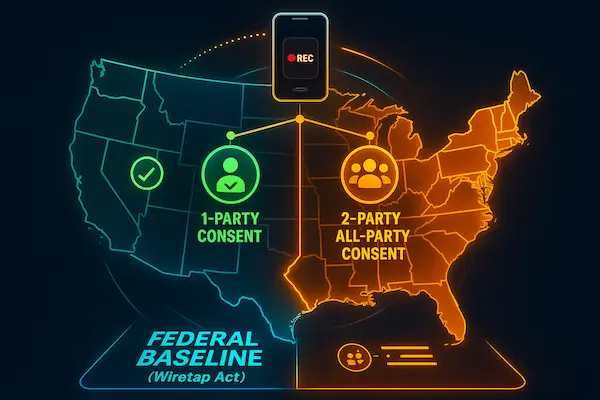
US rules can feel simple until a call crosses state lines. Federal law sets a baseline, but some states require all-party consent, and a multi-state call can expose you to the stricter rule. For Call Recording Laws compliance at scale, many teams choose one consistent disclosure standard across all US calls to reduce uncertainty.
1. Federal baseline and why it matters
At a high level, federal law is often described as allowing recording when at least one party to the conversation consents. That baseline matters because it influences national operations, but it does not eliminate state risk. The practical takeaway is that federal rules do not automatically protect you if the call touches a stricter state.
2. One-party consent states vs all-party consent states, what to do when unsure
Some states are commonly referred to as one-party consent states, while others are commonly referred to as all-party consent states. The operational problem is not memorizing lists. The problem is uncertainty on real calls: you may not know where the customer is, or agents may be distributed across states. The safest approach for nationwide customer service is to use a clear disclosure at the start of every recorded call and offer a non-recorded option when feasible.
3. Cross-state calls: safest disclosure approach for nationwide support teams
A practical, low-friction standard is to disclose recording in IVR and repeat it briefly when the agent joins. Consistency matters more than clever wording. It should be easy to understand, easy to repeat, and easy to audit. If a caller objects, agents should know the next step, such as switching to a non-recorded channel, pausing recording, or escalating to a compliant workflow.
4. Recording in-person conversations vs phone calls, common misunderstandings
Many people assume the rules are identical for phone calls and in-person conversations. In practice, the legal framing and expectations can differ, and the risk is often higher when you record people in physical spaces like offices, clinics, or retail locations. Treat in-person recording as a separate policy area with its own notice, signage, and retention rules.
5. Using and sharing recordings: when legal risk increases
The moment you go beyond private reference, risk rises. Using recordings for coaching, disputes, or compliance may be reasonable, but sharing externally, publishing clips, or using recordings for unrelated purposes can create additional exposure. A safe policy limits access, documents purpose, and ties retention to clear business needs.
3. UK Call Recording Laws: Business Recording, Privacy Duties, and Lawful Use
In the UK, many teams focus only on whether they are “allowed” to record, but the bigger risk is often how recordings are handled afterward. UK compliance tends to hinge on transparency, fairness, security, and purpose limitation. For Call Recording Laws planning, treat recording as a governed process, not just a call center feature.
1. Recording customer service calls: what businesses typically do
Customer service teams commonly record calls for training, quality assurance, and dispute handling. The safest practice is to disclose recording clearly at the start and ensure customers understand the purpose. Even when recording is routine, you should be able to explain what is recorded, why it is recorded, who can access it, and how long it will be kept.
2. Consent vs lawful basis concepts in practical terms
In practice, UK organizations often rely on a lawful basis for processing rather than treating consent as the only route. That does not remove the need for clarity. If you record, your documentation should match your real operational purpose, and you should avoid using recordings later for unrelated reasons. “We might use it for anything” is where trust and compliance break down.
3. Transparency, access requests, and retention expectations
A simple way to stay safer is to write down your retention period and stick to it. Keep access limited, log who listens, and have a clear path to handle access requests. The more organized your process, the less likely you are to face disputes that you cannot answer.
4. Workplace monitoring: notice, proportionality, and documentation
UK workplace recording and monitoring can create cultural and legal risk if it feels hidden or excessive. If employees are recorded, they should be informed, the purpose should be narrow, and the approach should be proportionate. For Call Recording Laws compliance, document the business need, limit who can access recordings, and avoid collecting more data than necessary.
5. Sharing recordings internally or externally: where teams slip
Many problems start when recordings are shared casually, exported, or reused outside the original purpose. Tight controls help: role-based access, audit trails, and clear rules that prohibit forwarding or posting clips. If you cannot answer “who can access this recording and why,” your governance is not finished.

4. EU and GDPR: Consent Requirements, Lawful Basis, and Data Rights
In the EU, Call Recording Laws are tightly linked to GDPR obligations. The question is not only “can you record,” but “can you justify recording, minimize what you capture, secure it, and handle data rights.” If your business serves EU customers, treating Call Recording Laws as a governance program is the safest path.
1. When consent is required vs when it is not
Under GDPR, consent is one possible legal route, but it is not automatically the best one for every scenario. Many businesses record calls for defined purposes like customer service quality assurance, training, dispute resolution, or fraud prevention. The compliance risk usually comes from using the wrong basis, failing to explain the basis clearly, or recording more than needed. In EU-focused Call Recording Laws planning, be prepared to state your purpose in plain language and align your recording workflow with that purpose.
2. Common lawful bases for call recording (QA, training, fraud prevention)
In practice, organizations often rely on lawful bases such as legitimate interests or contractual necessity, depending on the use case, and then build safeguards around that choice. For example, QA and training may be justified when balanced with privacy controls, while fraud prevention may justify tighter access and longer retention for specific cases. The key for Call Recording Laws compliance is consistency: your script, privacy notice, internal policy, and actual operations should all describe the same reason for recording.
3. Data minimization: pausing, redaction, and avoiding sensitive capture
GDPR pushes teams to reduce what they collect. For call recording, that usually means designing the call flow to avoid capturing sensitive details by default. Where sensitive moments are unavoidable, use practical safeguards such as pause and resume recording during payment capture, redaction where available, and clear agent training to steer customers away from sharing unnecessary personal information. If you want EU-ready Call Recording Laws compliance, “record everything” is rarely defensible.
4. Retention, deletion, and access requests: how to stay defensible
Retention should match purpose. If recordings exist mainly for QA, keep retention practical and delete on schedule. If recordings are retained for disputes or regulated needs, document why, restrict access, and review retention regularly. You should also have a clear workflow for access requests and complaints so you can respond without scrambling. Strong retention and rights handling are core parts of EU Call Recording Laws governance, not optional add-ons.
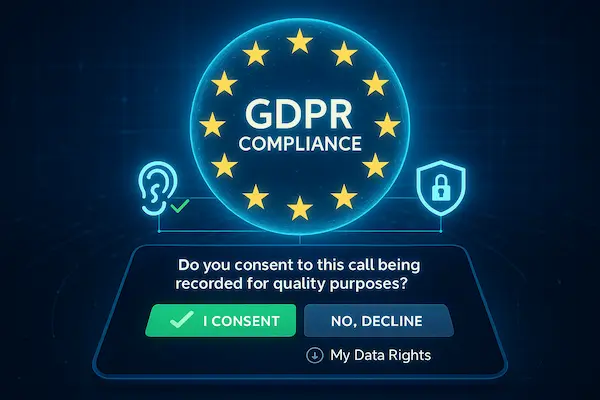
Table 1 (embedded): Call Recording Laws Quick Map
| Region | General consent model | Typical business approach | Key risk to manage |
|---|---|---|---|
| United States | Federal baseline, states may be stricter | Consistent disclosure on recorded calls | Cross-state calls and strict states |
| United Kingdom | Recording may be allowed, privacy duties apply | Notice plus controlled access and use | Secondary use, sharing, and retention |
| EU (GDPR) | Lawful basis plus transparency obligations | Lawful basis plus minimization safeguards | Sensitive data capture and data rights handling |
| Australia | State and territory rules vary | Clear consent where required | Inconsistent local rules and publication limits |
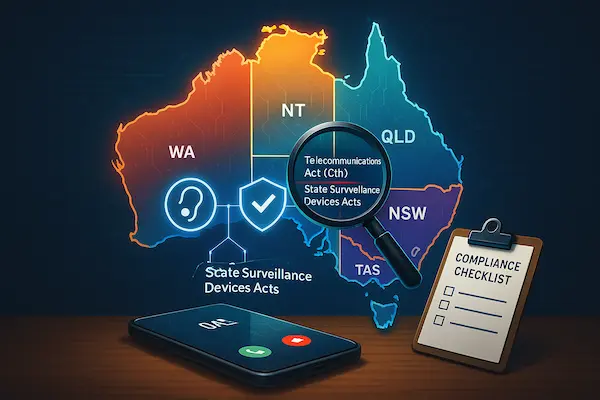
5. Australia Call Recording Laws: State-by-State Reality and Business Compliance
Australia is often confusing because Call Recording Laws can vary by state and territory, and because the rules for recording are not always the same as the rules for using or sharing a recording. If your team handles calls across Australia, the most practical way to reduce risk is to standardize disclosure, apply strong access controls, and keep retention defensible.
1. Why state and territory rules matter
For many businesses, the challenge is not knowing one rule, it is knowing which rule applies on a specific call. Agents and customers may be in different places, and you may not reliably confirm locations in real time. For safer Call Recording Laws compliance, treat uncertain location as a higher-risk scenario and follow a consistent disclosure approach that you can apply across queues.
2. Consent expectations and standard business disclosure patterns
A clear disclosure at the start of the call reduces disputes and makes your process auditable. Many teams use a short IVR message plus a brief agent reminder. Just as important, your policy should define a refusal path: what agents do if someone does not want to be recorded, such as offering a non-recorded channel or pausing recording for part of the call. This kind of operational clarity is a core part of Australia Call Recording Laws readiness.
3. Storage, security, and retention governance for recordings
Even when recording is permitted, weak governance can create real exposure. Use role-based access, audit logs, and export limits so recordings do not spread casually. Set retention based on purpose, for example shorter for QA, longer only when you can justify it for disputes or regulated needs. In practice, storage and retention are where Australia Call Recording Laws risk tends to grow quietly if controls are loose.
4. Publishing or sharing recordings: why risk is often higher than recording
Teams often underestimate how quickly risk escalates when recordings are shared outside the system. Forwarding audio files, posting clips, or reusing recordings for unrelated purposes can create greater legal and reputational risk than the recording itself. A strong Australia policy should treat “use and disclosure” as a separate control area with clear rules, approvals, and accountability, so Call Recording Laws compliance holds up in real operations.
6. Consent Design: How to Make Consent Clear, Valid, and Low-Friction
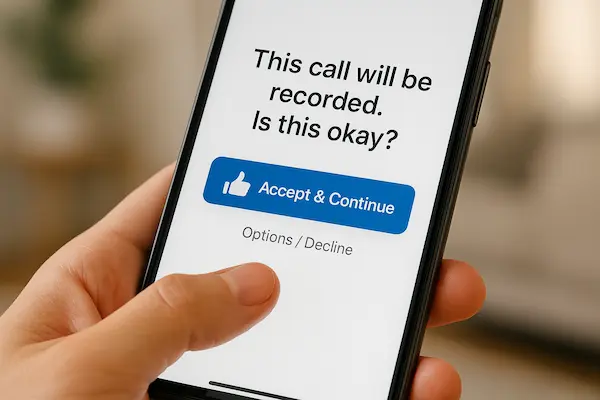
Consent is where most teams accidentally fail. Even when your legal basis is not strictly “consent,” clear notice and an easy-to-understand choice reduces complaints and builds trust. For Call Recording Laws compliance, good consent design is not legal theory. It is a repeatable call flow that agents can follow, customers can understand, and auditors can verify.
1. What valid consent looks like in real call flows
Valid consent, in practice, should be informed and unambiguous when consent is required. That means the caller understands recording is happening, understands why, and has a meaningful way to respond. The safest operational pattern is a short disclosure early in the call, followed by a clear next step. If your script is long, confusing, or buried after sensitive information is already shared, it is hard to defend under Call Recording Laws standards.
2. Opt-in vs opt-out patterns, and which is safer for cross-border calls
Opt-in is usually the cleanest when you need explicit agreement, but it can increase friction. Opt-out can be lower friction but higher risk in stricter jurisdictions or sensitive contexts. If you serve multiple regions, many teams reduce Call Recording Laws risk by using a disclosure that is clear enough to function in stricter environments, combined with a practical refusal path. The key is consistency: one approach, documented, used everywhere.
3. Refusal handling: how to support customers without recording
A refusal path is a compliance feature. Decide what happens if someone says no: move to a non-recorded channel, pause recording, transfer to a queue that can handle the request without recording, or provide self-service alternatives. Agents should not improvise. If you want your Call Recording Laws posture to be defensible, refusal handling must be trained, easy, and measurable.
4. Documenting consent and proving what happened during disputes
If a complaint happens, you need to show what the customer heard and what they chose. That is why documentation matters: IVR messages should be standardized, agent scripts should be consistent, and systems should log recording status changes. This is often overlooked, but it is one of the strongest defenses when Call Recording Laws disputes arise.
5. Special categories: minors, health, and high-sensitivity topics
Consent requirements and risk increase when calls involve minors, health information, or other sensitive topics. The safest design is to minimize capture, use pausing or redaction when possible, and limit access to recordings tightly. In high-sensitivity scenarios, even a technically “legal” recording can become a reputational problem, so Call Recording Laws compliance should include a risk-based approach, not a one-size-fits-all policy.
7. Call Recording for Customer Service and QA: The Compliance-First Playbook
Customer service teams carry the highest day-to-day exposure because they record at scale, across channels, and often across regions. To stay safe under Call Recording Laws, treat recording as a controlled workflow with standard disclosure, minimized sensitive capture, governed access, and defensible retention.
1. Consent scripts for IVR and agents (simple, consistent, auditable)
Use one short script everywhere so no queue becomes the “weak link.” The goal is clarity, not legal jargon. A good script states recording, purpose (QA or training), and what a caller can do if they object. Consistency is your best friend for Call Recording Laws compliance because it is easy to train and easy to prove later.
2. Sensitive data workflows: pause recording, redaction, and secure notes
Most avoidable problems come from capturing payment or highly sensitive details. Design the call flow so agents know exactly when to pause recording, when to switch to a secure method, and how to document outcomes without storing unnecessary data. This is a practical, high-impact control that reduces risk under Call Recording Laws and improves customer trust.
3. Role-based access, audit logs, and least privilege governance
Do not let recordings spread informally. Limit access by role (QA, supervisor, compliance), log who listened and exported, and review access regularly. Least privilege is not a buzzword, it is how you prevent internal misuse and uncontrolled sharing, which is where Call Recording Laws exposure can escalate fast.
4. Retention rules: what to keep, what to delete, and why
Retention should match purpose. If recordings exist for QA, keep them for a practical window and delete on schedule. If you keep recordings for disputes or regulated needs, document the reason, restrict access, and avoid default “keep forever” behavior. Clear retention is a key part of operational Call Recording Laws compliance.
Table 2 (embedded): Launch-Ready Compliance Checklist
| Checklist item | What “good” looks like |
|---|---|
| Disclosure script | One short script used across IVR and agent openings |
| Consent handling | Clear path if a caller refuses recording |
| Sensitive data controls | Pause or redaction for payment and sensitive moments |
| Access governance | Roles plus audit logs, export controls |
| Retention policy | Written duration plus scheduled deletion |
| User rights workflow | Process for access requests and complaints |
| Vendor review | Security, storage region, breach response clarity |
| Training | Agents and QA reviewers trained and tested |
8. Common Mistakes That Trigger Legal Risk
Most violations are not caused by bad intent. They happen when recording is treated as a technical toggle instead of a governed process. If you want Call Recording Laws compliance to hold up under pressure, avoid these predictable failure patterns.
1. Inconsistent disclosure across channels and regions
Teams often disclose recording on phone lines but forget web calling, callback tools, or outsourced queues. Inconsistent disclosure is a classic trigger for complaints because customers experience different rules depending on how they reach you. The fix is simple: one disclosure standard, applied everywhere, and tested regularly for coverage.
2. Keeping recordings too long without a retention rationale
“Store everything just in case” is a risk multiplier. The longer recordings sit, the more likely they are to be accessed unnecessarily, leaked, or pulled into disputes. A defensible retention period tied to purpose is a core element of Call Recording Laws governance, and scheduled deletion proves you mean it.
3. Sharing recordings without strict access controls
Risk rises sharply when recordings leave the system. Forwarded audio files, shared drives, and uncontrolled exports are common sources of exposure. Strong Call Recording Laws compliance requires role-based access, audit logs, export restrictions, and a clear policy that limits sharing to approved cases.
4. Capturing sensitive data by default (payments, health, minors)
Many organizations accidentally record payment details or sensitive personal information because agents have no pause workflow or the system is always-on. This is one of the highest-impact fixes you can make: pause or redact sensitive segments, train agents to redirect customers, and minimize what you collect.
5. No audit trail: you cannot prove who accessed what and when
When a complaint happens, “we think only QA listened” is not enough. If you cannot show access history, you cannot demonstrate control. Audit logs and periodic access reviews are a practical way to strengthen Call Recording Laws compliance and reduce internal misuse risk.
FAQs (AEO Block)
1. Do I need consent to record a phone call?
It depends on the jurisdiction. The safest practice is clear disclosure at the start and a way to continue without recording if needed.
2. What is one-party vs all-party consent?
One-party consent means at least one participant can consent to recording. All-party consent means everyone on the call must agree.
3. If I am in a one-party state, can I record someone in an all-party state?
Cross-border calls can trigger stricter rules. Use disclosure and follow the stricter standard when location is unclear.
4. Do businesses need consent to record customer service calls?
Often they must disclose recording and comply with local consent requirements. Strong access controls and retention rules also matter.
5. Under GDPR, is consent required for call recording?
Not always. GDPR typically requires a lawful basis plus transparency and data minimization.
6. How long should recorded calls be kept?
Only as long as needed for the stated purpose. Use a written retention policy with scheduled deletion.
7. Can I share or publish a recorded call?
Sharing usually increases legal risk. Treat it as a separate decision with stricter controls and approvals.
8. What should happen if someone refuses to be recorded?
Offer a non-recorded option, pause recording if possible, or route to a compliant process without recording.
Conclusion
Last updated: December 2025
As privacy enforcement tightens heading into 2026, call recording is no longer a “small ops decision.” It is a governance issue that can affect customer trust, employee relations, and regulatory exposure. The safest organizations treat Call Recording Laws as a repeatable system: consistent disclosure, a clear consent or lawful-basis approach, minimized sensitive capture, locked-down access, and retention that can be defended.
Quick Summary Table
| Priority | What to do first | Why it matters |
|---|---|---|
| Map jurisdictions | Identify where callers and agents are located | One call can trigger multiple rules |
| Standardize disclosure | Use one short script across all channels | Prevents inconsistent consent failures |
| Minimize capture | Pause or redact sensitive moments | Reduces legal and breach risk |
| Control access | Role-based access plus audit logs | Prevents misuse and uncontrolled sharing |
| Set retention | Keep only what you need, delete on schedule | Limits long-term exposure |
| Document everything | Policy, training, and refusal path | Makes compliance provable |
Build a Safer Compliance Workflow With PhoneTracker247
If your team needs a practical way to standardize recording governance, document consent handling, and keep access controlled, PhoneTracker247 can help you organize your workflow with clear accountability. Start by applying the checklist in this guide, align scripts and retention across teams, then move to a controlled, auditable system that reduces risk as you scale into 2026.
For daily updates, subscribe to PhoneTracker’s blog!
We may also be found on Facebook!