Step-by-Step: How Does Phone Tracker App Work – Guide for Businesses
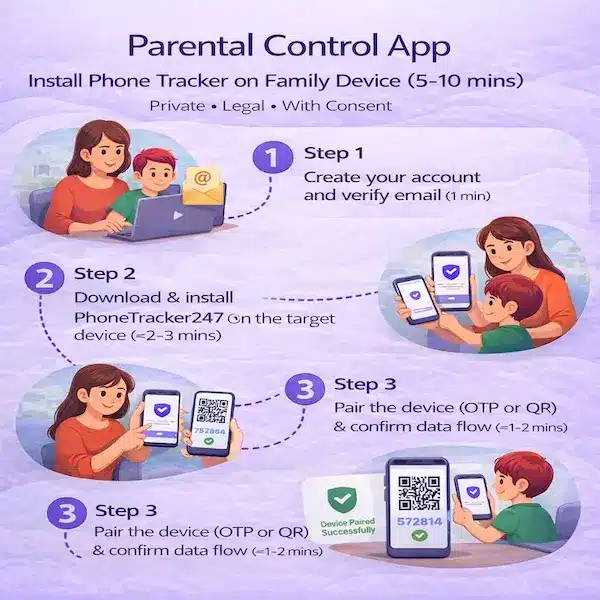
A fast, compliant rollout keeps data fresh, batteries healthy, and audits easy. Use this 5-step flow per device (≈5–10 minutes after initial policy setup).
Step 0: Legal & Consent First
PhoneTracker247 app is for monitoring devices you own or are authorized to manage (e.g., a child’s phone or a company-owned device) with clear consent and in compliance with applicable laws and policies.
Step 1: Create your account and verify email (1 min)
- Sign up with your email or your phone number at: https://dashboard.phonetracker247.com/sign-up/
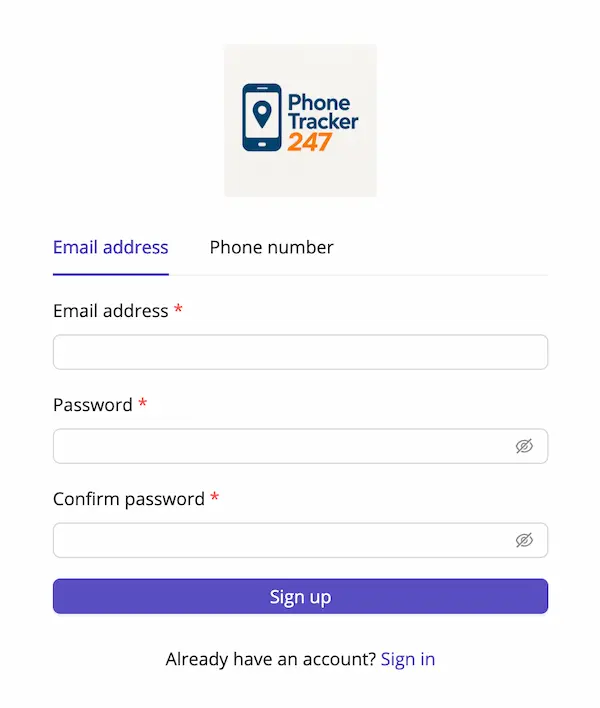
- Open the verification link to activate secure access. Verified accounts prevent unauthorized access before you start to track cell phone online.
Step 2: Prepare the Device, Download & Install PhoneTracker247 App (2-3 mins)
Before downloading the APK file, make sure the target Android device allows installation from outside the Google Play Store.
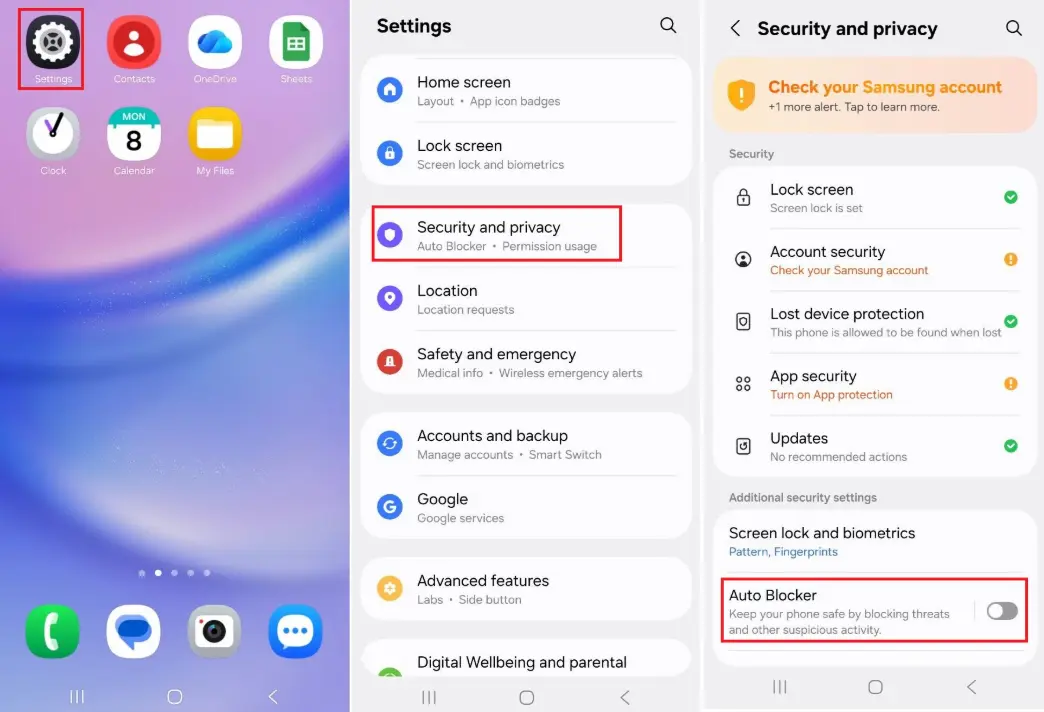
1. Turn off Auto Blocker on Samsung/Android security settings
On the target device, open:
Settings → Security and Privacy → Auto Blocker → Turn Off
This step is required on some Android/Samsung devices because Auto Blocker may prevent APK files from being downloaded or installed.
2. Download the PhoneTracker247 APK file
Go to PhoneTracker247 Download Center to Download PhoneTracker247 app APK file: https://download.phonetracker247.com/
Download the PhoneTracker247 app APK file directly on the device you want to monitor.
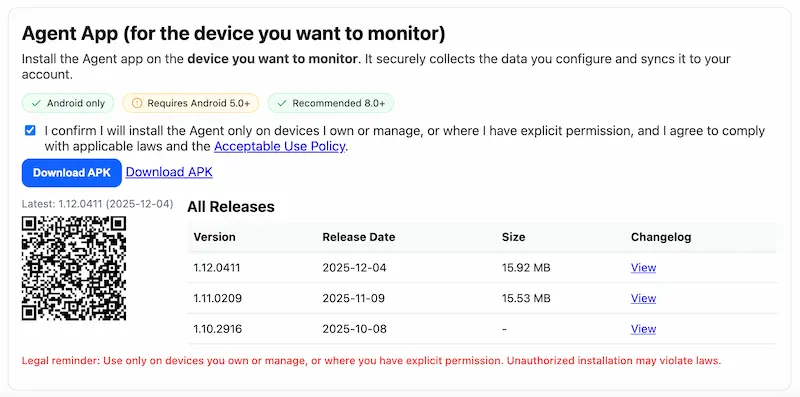
3. Install PhoneTracker247 app on the target device
Open the downloaded APK file, then follow these steps:
Tap Install → Wait for the installation to complete → Tap Open
After installation, continue to the pairing step so the device can be connected to your PhoneTracker247 Dashboard.
Step 3: Sign In and Link Your Device (3-5 mins )
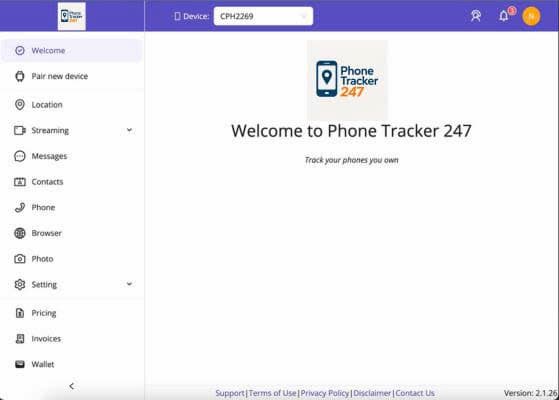
1. Sign in to your dashboard: https://dashboard.phonetracker247.com/sign-in/
2. Tap Pair New Device -> then Click Let’s Get Started to connect a new device
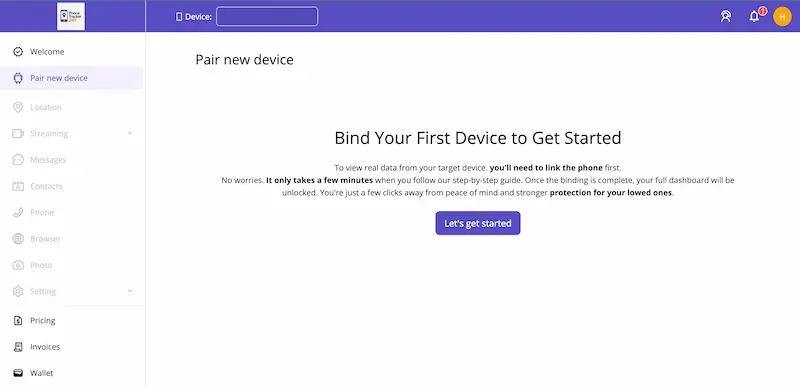
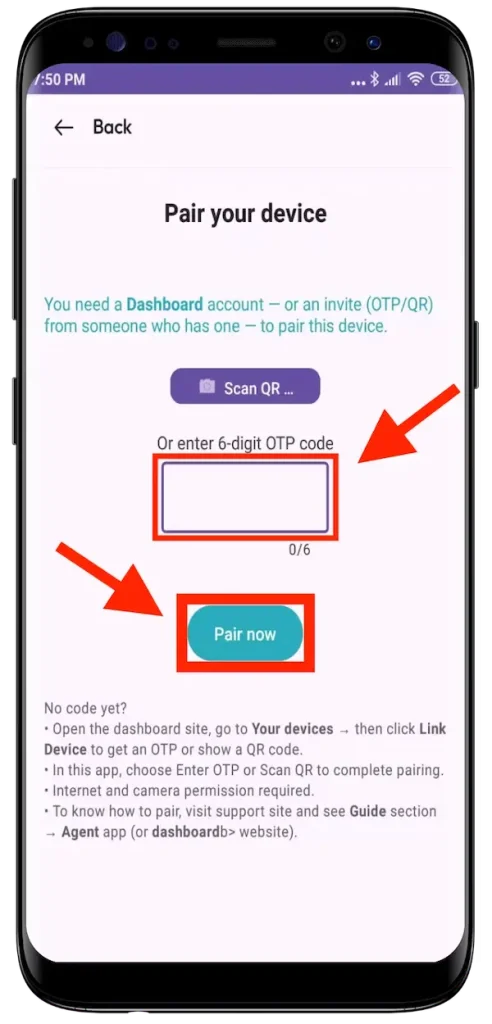
3. Follow the on-screen steps. In the final step, enter the code and click Pair Now to finish.
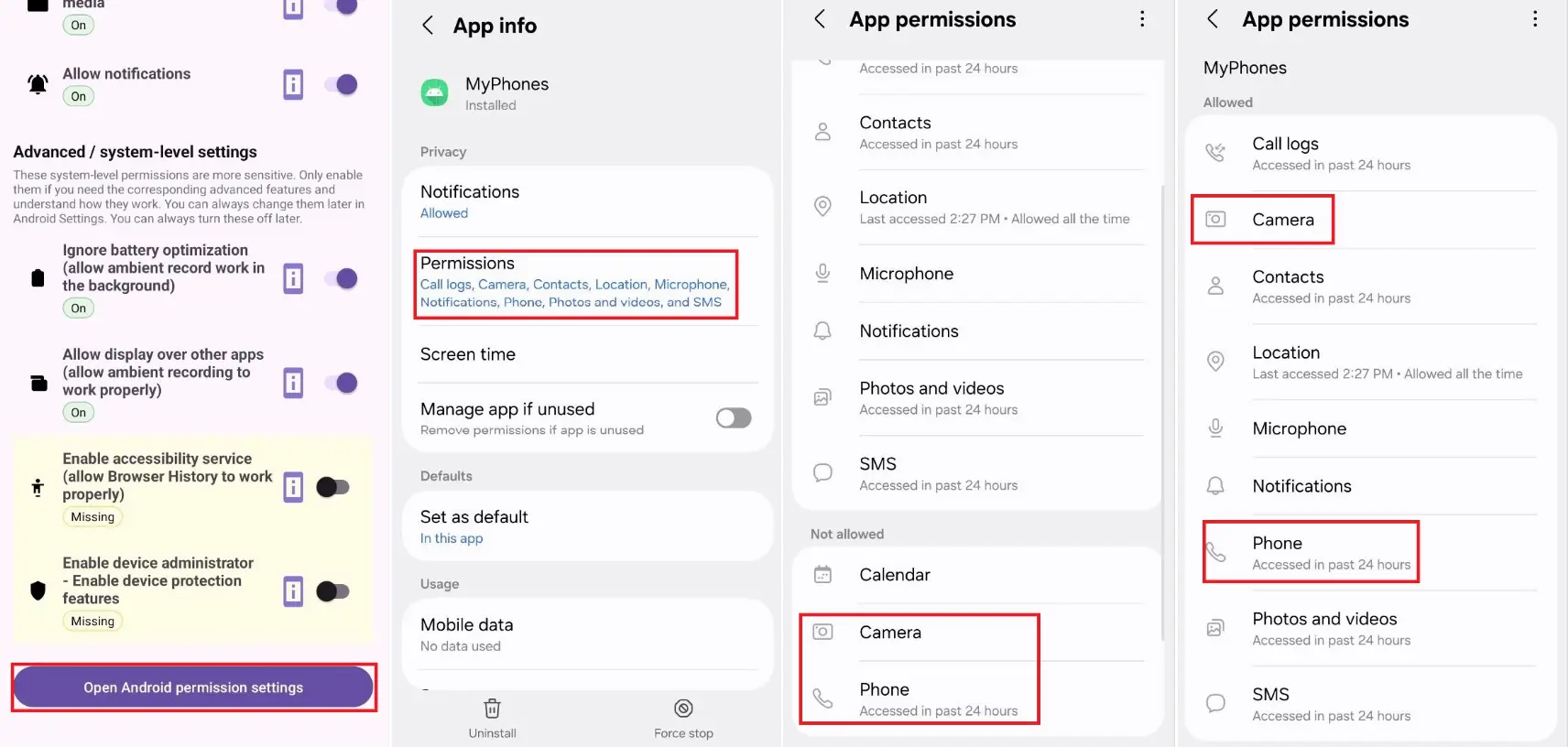
Step 4: Permissions Setup (1 min )
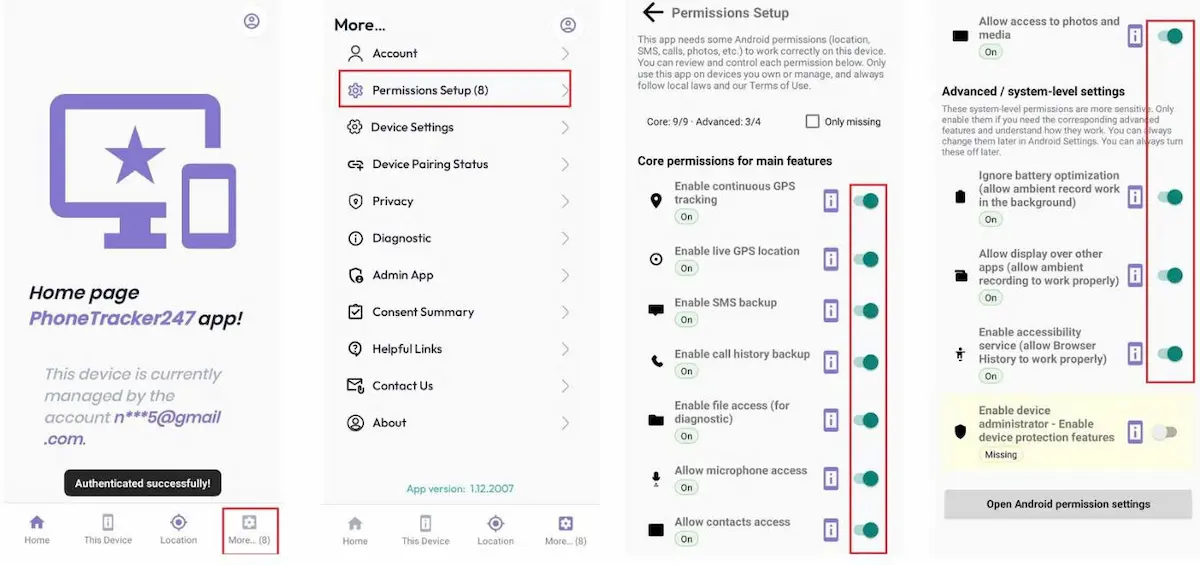
To use the Phone and Photo features, enable both required permissions in Android settings.
Tap:
Phone → Allow
Camera → Allow
Step 5: Start Monitoring with Confidence
Once the device is paired and permissions are set, you can monitor safely and consistently from the PhoneTracker247 Dashboard on mobile, tablet, or web.
Legal & Consent First
Before you follow the How to Install Phone Tracker App steps, make sure the setup is lawful, transparent, and easy to audit. That protects the people involved—and protects you.
1. Who is allowed to install
Device owner or manager only. Parents/guardians may manage a minor’s device.
Employers may install on corporate-managed phones when employees receive notice and sign an acknowledgement.
BYOD (personal phones used for work) requires explicit opt-in and a scoped policy via MDM or a clear agreement.
2. Informed consent: what it must include (plain language)
State who is monitoring, why (safety, device security, QA), what data is collected (e.g., location, app-usage metadata), who can access it, how long it’s kept, and how to revoke.
3. Documentation & audit trail (do this once)
Keep a timestamped consent record (scan or screenshot).
Note device ID/OS version, installer name, and policy link.
Set a retention window (default 30–90 days) and put it in writing.
Save a setup screenshot after you finish the How to Install Phone Tracker App flow.
4. Scope & transparency
Be explicit about boundaries. List what your tracker collects (e.g., location pings, time-in-app where lawful) and what it does not collect (messages/page content unless clearly allowed and opt-in). Use visible icons/notifications; don’t hide system prompts.
5. Prohibited uses (red lines)
No secret installs, no stalking/harassment, no bypassing OS protections, no rooting/jailbreaking to evade safeguards. If you’re unsure, pause and get legal advice.
6. Regional notes (high-level)
Privacy rules differ (e.g., GDPR in the EU, CCPA/CPRA in California, PDPA in several Asian jurisdictions). The principle is the same: lawful basis + informed consent + data minimization + user rights. Align your notice with the local law where the device is used.
Battery, Privacy & Retention
A compliant setup should be battery-light, privacy-first, and time-bounded. Use this section alongside your How to Install Phone Tracker App steps to keep updates reliable without over-collecting.
Battery (keep updates fresh without drain)
Android
Permissions: Location = Allow all the time + Use precise location.
Power: set the app to Unrestricted / Don’t optimize; enable Auto-start.
OEM managers (Samsung/Xiaomi/OPPO/Vivo): add the app to whitelists for background activity.
Work profile: confirm policies don’t throttle background location.
Tip: prefer event-based pings (movement/interval triggers) over constant tracking.
iOS
Location: Always + Precise, Background App Refresh: ON, Notifications: Allow.
Avoid prolonged Low Power Mode during critical hours; it may slow background updates.
Keep the app opened once after install to complete permission handshakes.
Both
Stable internet (Wi-Fi/cellular) improves “time-to-signal”.
After setup, run a test event and confirm a fresh timestamp in the dashboard.
Privacy (data minimization & transparency)
Collect only what your notice promises (e.g., location, device health, optional usage metadata); no content (messages/pages/calls) unless lawfully enabled and clearly opt-in.
Explain who can access data (guardians/admins), why it’s processed (safety/compliance/support), and how to revoke.
Enforce RBAC + SSO/MFA for admins; log who viewed/exported data and when.
Store consent artifacts (signed form/screenshot) with device ID and policy version for audit.
Retention (short by default, clear to users)
Default window: 30–90 days; extend only if a law, contract, or investigation requires it.
Automate deletion jobs when the window expires; document exceptions.
Offer simple user rights flows: access, export (CSV/JSON), correction, and erasure on request—and record closure.
For businesses: bind retention and rights handling in your DPA/Policy, and surface a contact.
Case Studies: What Works in the Real World
Real deployments beat theory. These snapshots show how families and businesses applied the How to Install Phone Tracker App steps, lawful consent, the right permissions, and light battery settings—to get fast, reliable location updates without drama. Use them as patterns you can copy, with measurable KPIs you can track.
1. Family Household (2 teens, mixed iOS/Android)
Context: Parents wanted predictable location pings after school with clear rules and opt-in.
Setup: Followed the How to Install Phone Tracker App flow on each phone; iOS with Location: Always + Precise and Background App Refresh ON; Android with Location: Allow all the time and Battery Unrestricted.
Results (week 1).
Time-to-signal: ≤2 minutes after install
Data freshness: 96% of pings within last 15 minutes during active hours
Battery impact: ≈2%/day additional drain on Android; ≈1–2%/day on iOS
Retention: 30 days, auto-purge
What worked. Event-based pings (movement-triggered) + visible app + written house rules.
Pitfalls avoided. No stealth modes; no content capture; consent screenshot stored with date/time.
2. SMB Logistics Fleet (12 Android work-profile devices via MDM)
Context: Dispatch needed near-real-time location to improve ETAs and reduce “dark” periods.
Setup: Android Enterprise + Managed Play; pushed agent via MDM, auto-granted Location All the time, Usage Access (metadata only), and enforced Battery Unrestricted + OEM whitelists.
Results (first month).
Permission compliance: 100%
Data freshness: >95% devices updated within 60 minutes
Missed ETA incidents: −28% after routing tweaks
Audit readiness: consent + policy version logged per device
What worked. Cohort rollout (pilot 5 → fleet 12), KPI dashboard, weekly policy checks.
Watchouts. Some OEMs re-enable optimization after OS updates—monitor and re-whitelist.
3. Retail Field Team (20 supervised iPhones, ABM + MDM)
Context: Regional managers move between stores; HQ wanted a light footprint with clear privacy lines.
Setup: Supervised iOS via Apple Business Manager; silent app push; config profile for Location Always + Precise, Background App Refresh ON, Notifications allowed.
Results (quarter).
Time-to-signal after enrollment: <5 minutes
Battery complaints: near zero after training on Low Power Mode timing
Data scope: location + device health only (no content)
Retention: 90 days with legal holds when required
What worked. Training micro-video (90s) embedded in MDM enrollment email; single-page privacy notice.
Watchouts. If Background App Refresh is toggled off by users, freshness drops—monitor with a policy alert.
4. BYOD Startup (30 employees, Android work profile + iOS opt-in)
Context: Security wanted asset protection without touching personal space.
Setup: BYOD policy with explicit opt-in; Android work profile only; iOS installed from the App Store with transparent scopes.
Results (8 weeks)
Opt-in rate: 83% after clear comms and a Q&A session
Incident response time: −22% (lost-device playbook)
Subject rights: <3 business days to export/delete on request
What worked. Narrow scope (location + device health), visible icon, and a clean revocation path.
Watchouts. Never extend scope (e.g., content capture) without new notice + renewed consent.
FAQs: Legal, Setup, Battery & Compliance
1. How do I install a phone tracker app on an Android phone?
Download the APK from the official source, install it on the device, then sign in and pair the device to your dashboard.
2. Do I need the target phone in hand to install the app?
Yes. Installation requires physical access to the phone (at least once) to download, install, and grant required permissions.
3. Is it legal to install a phone tracker app on someone else’s phone?
Only if you own the device or are authorized to manage it, with clear consent and compliance with applicable laws and policies.
4. What do I need before I start the installation?
A verified account, a stable internet connection on the phone, and access to the download link/dashboard for pairing.
5. Why do I need to verify my email before pairing a device?
Verification helps secure your account and prevents unauthorized access before any device is linked.
6. Where should I download the APK to avoid fake files?
Use the official download center provided in your guide. Avoid third-party APK sites.
7. My phone says “App not installed” — what should I do?
Re-download the APK, ensure enough storage, confirm your Android version is supported, and try installing again.
8. I can’t find “Install unknown apps” on Android — where is it?
Go to Settings → Security & privacy (or Apps) → Install unknown apps, then enable it for your browser/file manager.
9. What permissions are usually required for tracking features to work?
Typically location-related permissions (and sometimes background access) depending on the features you enable and your Android version.
10. How long does the installation and setup take?
Usually 5–10 minutes per device, depending on Android version and network speed.
11. How do I connect (pair) the device after installation?
Sign in to your dashboard, choose Pair New Device, follow the on-screen steps, enter the pairing code, then tap Pair Now.
12. Can I install and manage multiple devices under one account?
Yes. You can add and manage multiple devices from the same dashboard, then assign access based on your needs.
Conclusion: A safer way to set up parental control, fast, clear, and consent-first
In 2026, parental control isn’t just about “tracking”, it’s about creating a healthy, transparent safety routine for families. A good setup should be quick, respectful, and easy to explain to your child: “This is for safety, not spying.” That’s exactly how to use PhoneTracker247 the right way, on a child’s device with consent, strong account security, and practical settings that don’t drain the battery.
Quick summary table (install + pair in minutes)
| Step | What you do | Typical time | Output you should have |
|---|---|---|---|
| Step 0 | Confirm legal basis, define business purpose, capture consent/notice, and record policy owner | One-time setup | Written policy + consent/notice log (who/when/how) |
| Step 1 | Create admin account and verify email/phone to secure access | ~1 min | Verified admin login (account activated) |
| Step 2 | Download APK from Download Center and install on the managed device | ~2–3 mins | App installed (ready to pair) |
| Step 3 | Sign in → Pair New Device → enter pairing code to link the device | ~3–5 mins | Device linked (appears in dashboard) |
| Step 4 | Grant required Android permissions + set battery/background rules for stable reporting | ~1 min | Permissions complete (location + background allowed) |
| Step 5 | Verify first sync, review key views, and configure alerts/schedules for daily operations | ~1–2 mins | Monitoring live (fresh data + alerts configured) |
Parent pro tips that make this work long-term
Talk first, install second: Explain what you’ll monitor and what you won’t. Trust makes the tool effective.
Use safety settings, not surveillance habits: Focus on location sharing for pickups, school commutes, emergencies.
Keep the phone secure: Strong password + verified email for the parent account reduces unauthorized access risks.
Battery-friendly setup: Avoid overly frequent updates unless you truly need them.
Ready to set up parental control the right way? Create your PhoneTracker247 account, verify your email, install the app on your child’s Android phone, then pair it using the on-screen code. In about 5–10 minutes, you’ll have a safer, calmer way to stay connected, especially for school runs, after-class activities, and emergencies.