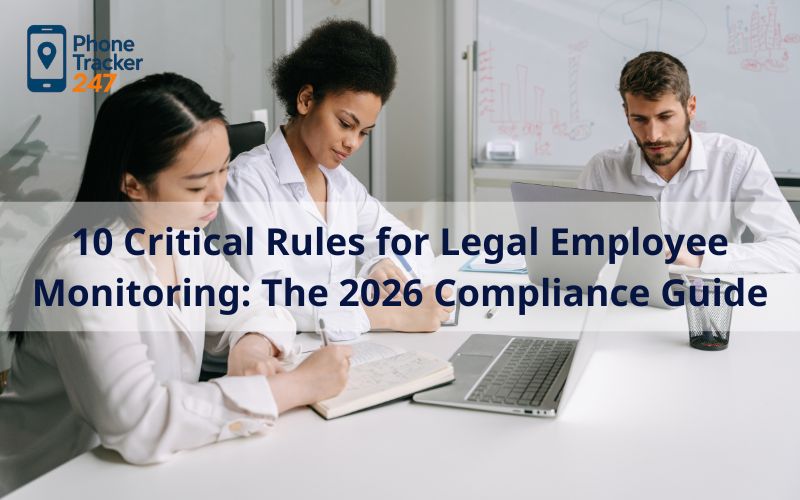
The modern workplace has undergone a radical transformation. With the rise of hybrid and remote work models, the global market for workforce oversight tools is projected to soar to nearly $24 billion by 2032. As of 2025, over 80% of businesses now utilize some form of activity tracking to ensure productivity, security, and data integrity. However, this surge in oversight has created a high-stakes “balancing act” between operational efficiency and the fundamental right to privacy.
Navigating the world of legal employee monitoring is no longer just an HR task; it is a critical compliance requirement. Failing to strike the right balance can lead to devastating lawsuits, massive regulatory fines, and a complete breakdown of organizational trust. This guide explores the essential legal frameworks, best practices, and ethical considerations for monitoring your workforce in 2025.
Contents
- 1 Understanding the Legal Landscape of Workplace Monitoring
- 2 What Can You Legally Track on Company Devices?
- 3 The 10 Golden Rules for Legal Employee Monitoring
- 4 Best Practices for Implementing a Compliant Monitoring Policy
- 5 Balancing Productivity with Employee Trust
- 6 Choosing a Legal-First Employee Monitoring Software
- 7 Top Legal Employee Monitoring Software in 2026
- 8 Future-Proofing Your Monitoring Strategy
- 9 FAQs
- 10 Conclusion: Staying Ahead of Future Privacy Legislation
Understanding the Legal Landscape of Workplace Monitoring
The legality of monitoring is not governed by a single, catch-all law. Instead, it is a patchwork of federal statutes, evolving state regulations, and international data protection mandates. To maintain a program of legal employee monitoring, businesses must understand where their jurisdiction begins and ends.
Federal vs. State Regulations (US)
In the United States, the primary federal framework is the Electronic Communications Privacy Act (ECPA) of 1986. The ECPA generally allows employers to monitor communications on company-provided systems if there is a legitimate business purpose. However, the “Business Extension Exception” and the “Consent Exception” are the two primary pillars that keep these activities within the realm of legal employee monitoring.
While federal law provides a baseline, states are increasingly passing stricter workplace privacy laws:
- California (CPRA/CCPA): Perhaps the most robust in the nation, California law requires employers to provide a comprehensive privacy notice to employees before collection begins. It also grants workers the right to access, correct, and even delete certain types of data.
- New York & Connecticut: These states mandate that employers provide prior written notice to all employees before any electronic monitoring of phone, email, or internet activity occurs.
- Illinois (BIPA): If your monitoring includes facial recognition or fingerprints, the Biometric Information Privacy Act requires written consent, with non-compliance resulting in fines as high as $5,000 per violation.
Global Compliance: GDPR, UK GDPR, and Beyond
For companies with a global footprint, legal employee monitoring must align with the General Data Protection Regulation (GDPR) or the UK GDPR. These frameworks are far more restrictive than US laws.
- Lawful Basis: You cannot simply track an employee because you “want to.” You must establish a lawful basis, such as “Legitimate Interest” or “Legal Obligation.”
- Data Minimization: Under GDPR for monitoring, you must only collect the minimum amount of data necessary to achieve your goal. If you can prove a worker is productive without taking screenshots every 60 seconds, then taking those screenshots may be deemed illegal.
- Transparency: Secret or covert monitoring is almost always prohibited under EU/UK law, except in rare cases of suspected criminal activity where a Data Protection Impact Assessment (DPIA) has been completed.
Table 1: Monitoring intensity tiers
| Monitoring tier | Typical signals collected | Best-fit business purpose | Privacy / legal risk level | What you must do to keep it compliant |
|---|---|---|---|---|
| Tier 1: Low-intensity (metadata + security logs) | Login events, device health, VPN connections, app names (not content), aggregate time-in-app | Security, access control, IT troubleshooting, license management | Low | Clear notice, data minimization, short retention window, role-based access, audit logs |
| Tier 2: Medium-intensity (workstream accountability) | Ticket timestamps, customer-call duration (not audio), business email headers, approved time tracking, location during shifts (field roles) | Accurate billing, operations planning, service quality, safety | Medium | Written policy + consent where required, strict work-hours boundaries, purpose limitation by role (field vs office), documented justification |
| Tier 3: High-intensity (content capture) | Screenshots, full URLs, message content, keystroke patterns, detailed productivity scoring | Insider threat investigations, regulated environments, incident response | High | Use only when necessary, reduce scope to specific roles or cases, privacy masking/redaction, DPIA-style review (where applicable), strict access approvals |
| Tier 4: Prohibited or near-prohibited in most workplaces | Covert monitoring, off-duty GPS, webcam/mic in private spaces, “stealth mode” surveillance | “Just in case” oversight or micromanagement | Very High | Do not deploy. Replace with outcomes-based KPIs, transparent analytics, and security-first logging |
What Can You Legally Track on Company Devices?
Transparency is the foundation of legal employee monitoring. However, even with consent, there are limits to what is considered “reasonable.”
Email and Instant Messaging
Employers generally have a high level of authority to monitor corporate email accounts and platforms like Slack or Microsoft Teams. Since these are company-owned assets, the “expectation of privacy” is significantly lower. However, legal employee monitoring becomes murky if an employee accesses a personal email account on a company laptop. Courts often rule that intercepting personal credentials or private messages on a personal account crosses the line into an invasion of privacy.
GPS and Location Tracking
With mobile workforces, GPS and location tracking have become essential. However, the law distinguishes between tracking a company vehicle and tracking an employee’s movement.
- Company Property: Tracking a company-issued phone or vehicle during work hours is generally legal.
- Off-Duty Tracking: Tracking an employee after they have “clocked out” is a significant legal liability. Many modern tracking apps now include “Scheduled Tracking” features to automatically disable location services outside of work hours to ensure legal employee monitoring compliance.
Screen Capture and Keylogging
Screen capture and keylogging or keystroke recorder are considered “high-intensity” monitoring. While technically legal in many US jurisdictions if disclosed, they are increasingly scrutinized by the National Labor Relations Act (NLRA). If monitoring is used to discourage “concerted activities”—such as employees discussing wages or working conditions—it could be ruled an unfair labor practice. To keep this legal employee monitoring tactic safe, use it sparingly and ensure it is never used to target union-organizing efforts.
The 10 Golden Rules for Legal Employee Monitoring
To ensure your strategy remains compliant and ethical, follow these ten industry-standard rules:
- Transparency is Key: Never hide the fact that monitoring is taking place.
- Obtain Written Consent: Update employment contracts to include explicit monitoring clauses.
- Define Business Justification: Ensure every data point collected serves a specific business need (e.g., security, billing, or safety).
- Avoid Personal Devices (BYOD): If possible, only monitor company-owned hardware.
- Respect “Off the Clock” Time: Tracking should cease the moment the workday ends.
- Secure the Data: Use AES-256 encryption for all stored monitoring logs.
- Limit Access: Only authorized HR or security personnel should view sensitive logs.
- Prohibit Private Space Monitoring: Never monitor webcams or microphones in private settings.
- Regular Policy Audits: Review your legal employee monitoring policy annually to match new court rulings.
- Focus on Outcomes, Not Minutes: Use data to measure productivity, not to micromanage behavior.

Best Practices for Implementing a Compliant Monitoring Policy
A tool is only as “legal” as the policy that governs it. To protect your organization, follow these best-practice steps.
The “Transparency First” Approach
The most effective way to ensure legal employee monitoring is to eliminate the element of surprise. Secret surveillance is the fastest way to destroy workplace satisfaction and invite legal challenges. Clearly communicate what is being tracked, why it is being tracked, and how the data will be used to improve the business.
Drafting a Written Disclosure Agreement
Every employee should sign a standalone monitoring policy template or an acknowledgment form during onboarding. This document should:
- List the specific tools used (e.g., “GPS tracking,” “Application usage logging”).
- Define the hours of monitoring.
- Explain the business justification (e.g., “To ensure accurate client billing”).
- State the data retention period (e.g., “Data is deleted after 90 days”).
Role-Based Access Control (RBAC)
Legal employee monitoring requires that data be handled securely. Only specific individuals—such as HR managers or direct supervisors—should have access to monitoring logs. Implementing Role-Based Access Control ensures that sensitive employee data isn’t being “vetted” by unauthorized staff.

Balancing Productivity with Employee Trust
Data shows that 56% of monitored employees feel higher levels of stress than their unmonitored counterparts. Therefore, the goal of legal employee monitoring should be empowerment, not “gotcha” management.
Shifting from “Surveillance” to “Analytics”
Instead of looking for reasons to discipline staff, use tracking data as a form of remote work surveillance ethics. Use analytics to identify which processes are taking too long or where employees might be experiencing burnout. If the data shows an employee is working 12-hour days, use that as a prompt for a wellness check-in rather than a productivity audit.
How to Respond to Employee Privacy Concerns
If an employee objects to monitoring, listen. They may have a valid concern regarding workplace privacy laws or the security of their personal data. Explain the safeguards you have in place, such as encryption and the fact that you do not track off-duty conduct. Open dialogue transforms “Big Brother” into a “Business Partner.”

Choosing a Legal-First Employee Monitoring Software
When selecting a vendor in the phone tracking app industry, look for features that prioritize employee tracking compliance.
| Feature | Importance for Legal Monitoring |
| Scheduled Tracking | Prevents illegal off-hours surveillance. |
| Visible Mode | Provides a tray icon so employees know when they are being tracked. |
| Data Deletion Tools | Helps comply with “Right to be Forgotten” (GDPR) requests. |
| Consent Pop-ups | Ensures explicit, recorded consent before the app activates. |
A compliant software solution should offer built-in privacy features that allow you to toggle off invasive settings like keylogging or webcam snapshots if they aren’t strictly necessary for your specific industry.
Top Legal Employee Monitoring Software in 2026
As we look toward 2026, the market for workforce oversight has shifted. Businesses no longer look for the most “invasive” tools; they seek “compliance-first” solutions that balance operational needs with strict privacy mandates. In an era of AI-driven legislation and heightened privacy awareness, choosing the right vendor is the first step toward legal employee monitoring.
Here are the top solutions leading the industry in 2026:
Phone Tracker 247: Best for Mobile Fleet and Field Compliance
For businesses managing a mobile workforce, Phone Tracker 247 has emerged as a premier choice for legal employee monitoring. Unlike many traditional tracking apps that operate in a “gray area,” this software is designed with built-in transparency features.
- Legal Advantage: It offers a robust “Scheduled Tracking” engine, ensuring that GPS and activity monitoring automatically disable outside of work hours. This prevents the illegal collection of off-duty data—a major liability under modern workplace privacy laws.
- Key Feature: Explicit Consent Interface. It provides a clear notification system, ensuring employees are aware when their device is being monitored for business purposes.
- Why it’s a 2026 Leader: It bridges the gap between powerful phone tracking and the strict “Necessity and Proportionality” tests required by international regulators.
Teramind: Best for Data Security and Forensic Auditing
Teramind remains a top contender for high-security industries (finance and healthcare). It excels in “Behavioral Analytics,” identifying insider threats before data breaches occur.
- Legal Advantage: It includes a sophisticated “Privacy Masking” feature that can redact sensitive personal information (like social security numbers or banking passwords) from screen recordings, ensuring GDPR for monitoring compliance.
ActivTrak: Best for Privacy-First Productivity Analytics
ActivTrak has successfully pivoted away from surveillance toward “workforce health.” In 2026, it is the go-to for companies that want to measure output without recording invasive details.
- Legal Advantage: By omitting features like keylogging and webcam access by default, ActivTrak significantly lowers the legal risk for employers in highly regulated states like California and New York.
Hubstaff: Best for Time Tracking and Automated Compliance
Ideal for remote teams and freelancers, Hubstaff links legal employee monitoring directly to payroll.
- Legal Advantage: Because tracking is tied to a “Start/Stop” timer controlled by the employee, the business has a strong legal defense based on “Contractual Necessity”—the employee is being tracked specifically to ensure they are paid accurately for their time.
Future-Proofing Your Monitoring Strategy
As technology evolves, the definition of legal employee monitoring continues to shift. Emerging AI tools can now analyze employee sentiment and tone, adding another layer to the privacy debate. Organizations must stay informed about upcoming legislation that specifically targets AI in the workplace.
To maintain legal employee monitoring, always perform a “Proportionality Test.” Ask yourself:
- Is there a less intrusive way to get this information?
- Does the business benefit outweigh the privacy intrusion?
- Have the employees been fully informed in writing?
FAQs
1. What is legal employee monitoring?
Monitoring is usually legal when it has a clear business purpose, is proportionate, and employees are informed.
2. Is employee consent required?
Sometimes. Many places allow policy notice, but higher-risk tracking or recordings may need explicit consent.
3. What’s the #1 compliance risk?
Collecting too much data “just in case” and using it beyond the stated purpose.
4. Can employers monitor BYOD phones?
Only in a limited work container in most cases. Full-device or personal-content monitoring is high risk.
5. Is GPS tracking allowed?
Often yes for field work during shifts. Off-hours location tracking is a major red flag.
6. Are screenshots or keylogging allowed?
They’re high risk. If used, keep it narrow, time-limited, and approval-based.
7. How long should data be kept?
As short as possible, based on the purpose. Then delete it.
8. How to monitor without losing trust?
Be transparent, limit scope, and enforce clear work-hours boundaries.
Conclusion: Staying Ahead of Future Privacy Legislation
Legal employee monitoring is not a “set it and forget it” initiative. As AI-driven surveillance grows, so will the legislation designed to curb its excesses. The “Necessity and Proportionality” test remains the gold standard: Is this monitoring necessary to achieve a specific goal, and is it proportional to the privacy being sacrificed?
By staying transparent, obtaining written consent, and choosing privacy-centric tools, you can protect your company’s bottom line while respecting the dignity of your workforce.
Quick Summary Table
| What you want to do | Safest legal approach | Red flags to avoid | Best practice checklist |
|---|---|---|---|
| Improve productivity visibility | Use Tier 1–2 signals (logins, app usage totals, work output metrics) | Secret tracking, “always-on” screenshots | Publish policy, limit scope to work apps, review quarterly |
| Protect company data | Focus on security logs, access controls, DLP alerts, incident-based reviews | Reading personal messages, collecting passwords | Least-privilege access, audit logs, short retention |
| Monitor remote teams | Track outcomes + time windows, not constant surveillance | Off-hours monitoring, webcam/mic | Work-hours boundaries, transparent notice, manager training |
| Use GPS tracking | Restrict to field roles and scheduled shifts | Off-duty location tracking | Clock-in/clock-out, role-based justification, opt-out where possible |
| Record calls for QA | Announce recording and limit to business calls | Recording private calls, no disclosure | Notice script, secure storage, QA rubric, limited playback access |
| Enforce compliance | Define what’s required by role and regulation | Monitoring “just in case” | Document purpose, DPIA-style review where relevant, legal review for high-intensity tools |
| Investigate misconduct | Use time-limited, case-based Tier 3 monitoring | Broad keylogging or blanket content capture | Approval workflow, narrow scope, preserve evidence, notify when required |
| Build employee trust | Be transparent, predictable, and consistent | “Gotcha” monitoring, vague policies | Plain-language policy, employee FAQ, escalation path, appeal process |
Legal Disclaimer: The information provided in this article is for informational purposes only and does not constitute legal advice. Workplace privacy laws vary significantly by jurisdiction and are subject to frequent changes. Before implementing any employee monitoring program, you should consult with qualified legal counsel or a specialized employment law attorney to ensure your policies comply with local, state, and international regulations.
For daily updates, subscribe to PhoneTracker’s blog!
We may also be found on Phone Tracker App on Facebook!